Monthly Archives: September 2023

Singling Out the Problem

Standard

Necessity is the mother of invention. She’s also the mother of “I guess now you’ll deal with that situation you’ve been avoiding.” For me, this week, it’s the one-car side garage that we use as a storage unit/extension of my laundry room. I’ve avoided cleaning this area for forever. But someone ran into the garage door with a car (not me), and it’s not the first time it’s been run into (again not me), so now it’s finished. We must replace it. When the garage door repairman came, we went inside the garage, and I was embarrassed. He said everyone is always worried about the state of their garage. He was nice and said that it wasn’t that bad compared to some he’d seen. But he said that some things would need to be moved so they could do the install. And so, necessity required that I move things. Unfortunately, the time frame did not allow me to truly organize everything. So, my dining room is now a disaster, but they can replace the garage door. 

During the semi-cleaning process, I had to tamp down the urge to criticize myself for my procrastination and tendency toward clutter. One of the reasons I haven’t previously managed to solve this situation is because it can feel overwhelming. I also connect memories to a lot of the clothes the kids have worn in the past, making it harder for me to toss or donate things. It takes a lot of emotional energy to go through this process, not just physical energy. 

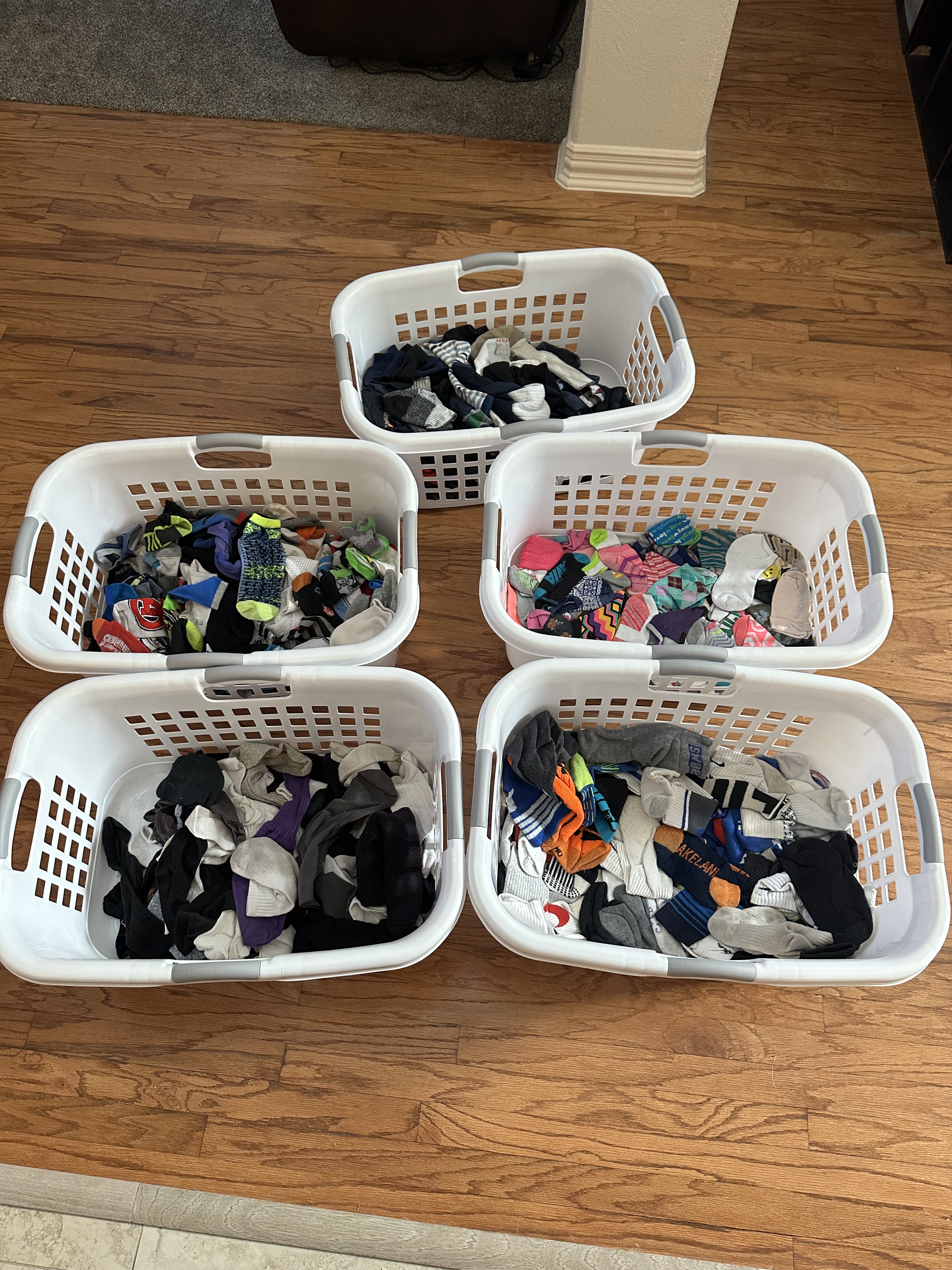
My commitment to this project started to wane, but then I found the laundry baskets that I hadn’t laid eyes on in a long time. There were FIVE of them, and they all contained socks. Individual socks. Single, “lost their partner” socks. I remember creating said baskets thinking I was being super organized and that I would return to the baskets repeatedly to find each person’s missing socks and magically unite all socks in our household together one day. Instead, the baskets were set aside, discarded, covered up, and I never once went back to them to search for errant socks. My good intentions never came to fruition.  

And so, this time, I threw all the socks away. I know I’m not the first to purge the sock basket(s), and more efficiently organized people would’ve thrown them away years ago instead of putting them in baskets. I’ve heard people talk about the freedom they feel when they get rid of the basket of single socks. And I felt some of that, but I ended up accepting the fact that it was just a first step, not a monumental triumph. Taking the first step is often the hardest part of any process. For me, beginning is often difficult because I want to know all the details of the process. I want to know how and when it will end. Unfortunately, that certainty I crave rarely occurs. Living with uncertainty is not easy for me, never has been, probably never will be. But avoiding the first steps because I’m afraid to tackle an unknown process is not a good way to live either. 

So, the next time I find myself stuck and unwilling to take the first steps necessary to start a project or process, I’ll try to remember the socks and the use the metaphor as an opportunity to kick off the next phase even though I don’t know the entire road I’ll walk, or maybe someday, even run. 

Support You Later

Standard

I’d just come home from a quick trip to Arkansas and immediately left for our church’s women’s retreat. This was our first one since before the Covid shutdowns, so I was excited for the retreat but also physically and emotionally exhausted from my trip. We were engaged in icebreakers, which I admit are not my favorite activities, when I made a mistake in front of the whole group. We were playing “Never Have I Ever” and instead of saying something I’d never done, I said something I had done. I was embarrassed because I hate doing anything wrong. So, I complained about my poor performance to my friend Karen. “I messed up,” I said. She gave me a side-eye and said, “I’ll support you later.” 

Immediately, I started laughing out loud. Karen had broken my train of thought that threatened to derail my good time. Karen short circuited my tendency toward self-loathing by pointing out that this mistake was not in any way important. A minor snafu in the grand scheme of things. Both Karen and I had been going through some heavy life events lately. She hilariously reminded me not to worry about something that wouldn’t matter later in the day. That is, unless I continued to dwell on it and launch myself into a shame spiral. Sometimes, we need someone to remind us of what really matters. To put things into perspective. 

We also need to remember that we may become upset about smaller things when there are larger, more serious issues looming. My children are good at calling me out on that. If I overreact to something they say or do, they will say, “you’re mad about something else, don’t get mad at me.” I hate it when they say it, but they’re usually correct in those circumstances. My therapist told me that when we are dealing with big emotional issues, but are also busy with the stress, logistics, and details of a situation, we may release our emotions in other ways, like when we cry at a sappy commercial or become sad over something minor and seemingly inconsequential. Or obsess over a stupid mistake to avoid dealing with the bigger, harder, more complicated issues. 

And there are other times when we stay in constant motion, so we don’t have to deal with the tough situations. Because if we slow down, we’re afraid we might collapse under the weight of the burden. But if we keep pushing ourselves and don’t allow ourselves to rest or decompress, we could end up ill or depressed. Our bodies may make us stop unless we give it the proper attention and take care of ourselves. 

When we find ourselves upset or stewing, let’s first ask if the issue is of paramount importance, and if not, look to gain a better perspective or find the real problem underneath the surface. We might discover that we need to focus on the larger picture instead of lesser matters or that we are fixating on something insignificant. And if it takes a friend like Karen to remind us to get our act together, let’s laugh and say thanks.    

Rest When We’re Done

Standard

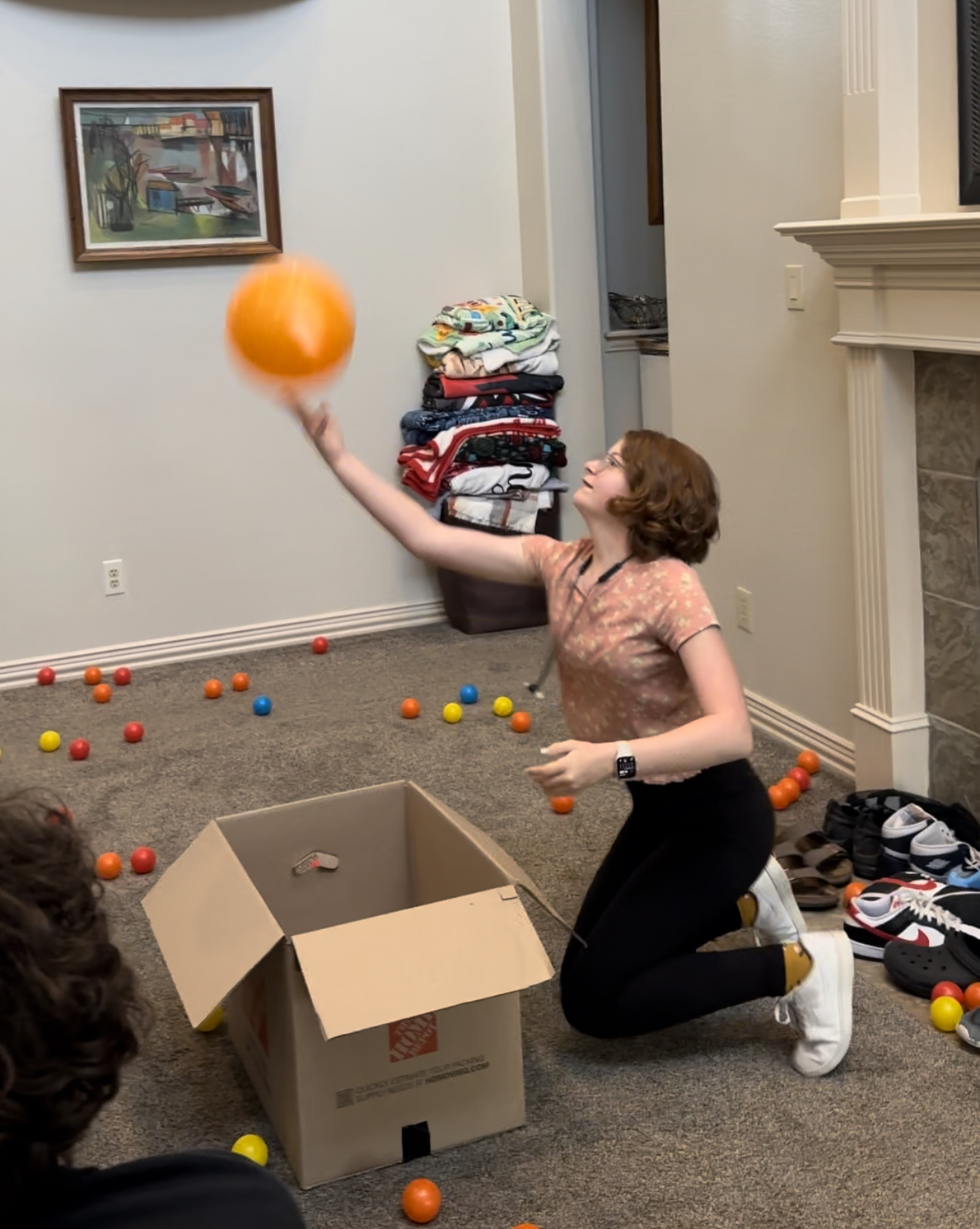
“Tina is done,” Claire said. She’s almost fifteen, and I’ve known her since the day she was born. As such, she knows me well too. We were at the end of a rather rowdy youth group meeting. The kids aren’t usually that chaotic. It was probably my fault because I’d introduced a game that involved a balloon and a ton of ball pit balls, so that even when I passed out some model magic to keep their hands busy during our discussion time, it didn’t calm them. So, Claire hit the nail on the head when she made her pronouncement.   

I’d had a lot on my plate emotionally because of my dad’s illness and some other outstanding issues. So, after youth group, I crawled in bed and watched a movie on my iPad, and all the guys in my house left me alone. My boys are used to me saying, “I’m done with this day,” as a warning that it’s time to settle down and go to bed when it’s getting late. But on this day, even though they hadn’t necessarily heard Claire and I hadn’t issued my day is done notice, they too knew that I’d had enough. I needed to rest.

Several of my friends and I have been talking/texting about how tired we are physically, mentally, emotionally. We are exhausted for a variety of reasons. And while finding time to rest is difficult, perhaps the greater obstacle is giving ourselves permission to retreat when we become overwhelmed. Instead, we soldier on, unwilling to stop because we think we will be considered lazy or unproductive. Stress is a marker of success in our culture, so we keep adding to our schedules. Succumbing to tiredness is seen as failure.

Unless we stop giving in to the false narrative that resting is a sign of weakness. What if we adopt the idea that rest is a key to being healthy and becoming strong? It makes sense intellectually. We know it is true. But what if we started living it? 

We are tired. I am tired. So, I’m going to cut this blog short and take my own advice. I’m going to rest, and I hope you do too.    

Notice the Connection

Standard

My son Alex and I were in Walgreens after school when the manager asked how we were doing. I responded with some sort of generic answer about getting back into the school routine while Alex perused the toys and games. Alex and I frequent the store a lot, so we are familiar with many of the people who work there. And they are familiar with us. So, I probably shouldn’t have been surprised when the manager looked me in the eyes and asked, “everything else is okay then?” In that moment, I knew she knew – I was not completely okay. I don’t have a good poker face, but I didn’t expect someone with whom I have a casual relationship to realize that I was off kilter. I decided not to burden her with all I had going on, so instead I told her I was tired. We discussed how she was tired as well in an unstated agreement that we would not dive deeper into the cause of my concerns but that we’d had a moment of connection, nonetheless. 

To be seen and understood. Isn’t that what we all want? Even when we choose not to respond with the details of our problems, we can feel comfort because we know someone else has noticed that we are not ourselves. Just the fact that someone else asks is enough in many circumstances. We still feel the warmth of another’s concern and care because they took a moment to ask or text or call. Of course, at other times, when someone shows us that they care and want to stand with us in our trouble, we can accept that opportunity and share our problems. It’s okay to confide or vent to someone whom we trust when they’ve shown they are willing to listen. Getting things off our chest and out of our minds can make us feel so much better. We can experience such relief when we unburden ourselves. 

At other times, we may be the observant one. When we sense that all is not well with someone, we should feel emboldened to ask how they are doing. Sometimes, we hesitate. We fear making the other person upset but acknowledging that they are unsettled may provide the love they need in that moment whether they provide a detailed answer or not. And when we listen to another share their story, we need to ask if they want us to just listen or offer suggestions. I often jump straight to giving advice, but recently, my daughter said she simply needed me to let her talk without telling her what to do. Easier said than done for this mom, but I’m learning. Giving someone the time and attention to express their feelings is often the best thing we can do. Sometimes, it’s the only thing we can do.

Presence is the gift we can give others. That presence can come in the form of paying attention to those in our lives. We can ask about their situation when we see they’re not themselves or we can follow up on an issue with which we knew they were previously struggling. Holding space if they want to talk or respecting their silence may provide the reassurance we all need. 

Happy Birthday, Mom!

Standard

Once when my brother Marty and I were young, we were arguing in the car as my mother drove us home from school. I have no idea what we were discussing with such vigor, but my mom had had it. I’m sure she’d told us to stop repeatedly. But we didn’t. Suddenly, she yelled, “I’m going to pinch your heads off and throw them at you!” At that, we burst into laughter and almost laughed our heads off. That memory is one of the funniest and one of my favorites. While that moment stands out, there are far too many to count in which my mom took care of us or spent time with us – reading, watching tv, attending sporting events. And in our adulthood, she has lovingly helped care for our children. But then again, my mom has always been a caregiver. 

When she was born, her mother, my grandmother, was nineteen years old and single. In those days, the stigma was great, and shame was inflicted. Eventually, my grandmother married a man with four children. They went on to have three children together. By that point, my mom became the one who cared for the younger children while her mother worked. I’m convinced my youngest aunt considered my mom to be her mother back when she was little. 

She also cared for them and kept them safe when her mom and stepdad were home but fighting. Back then, domestic violence was accepted and expected, and the authorities would not intervene in disputes inside the home. When my mom and dad met in high school and later married at the ages of 20 and 21, they decided that their home would be different than the ones that both of them had grown up in. To break a cycle that so easily repeats from one generation to the next took foresight and determination. Our home was peaceful and for that I am grateful. 

When they had kids, they decided that my mom would stay home. As a kid, I never thought twice about my mom being there all the time no matter what. As I grew up and became a mom myself, I realized that those days caring for children can be long and tiring. She would clean the house all day, and then I’d come home from school and destroy the scene by spreading my books and papers all over the living room floor so that I could do homework. I’m nowhere near the housekeeper she’s always been, but as I navigate athletic shoes and backpacks in the floor every night, I feel bad that I was so careless as a child. But then again, maybe that’s what happens when your home is a safe place where you can always be yourself. When your mother is a source of deep comfort. 

Later, I came to understand that my mom sacrificed a lot. She didn’t go out with friends, and my parents never went on date nights. I don’t recall ever having a babysitter. She didn’t get to pursue a career or have opportunities to express her creativity on a regular basis. Her sole focus was raising her children. All the while, she encouraged me to form female circles of friends and to study hard so I could obtain an excellent education. When circumstances required she go back to work when I was in high school, she shouldered all the home duties she always had along with navigating work life that was not always kind to her. 

When she and my dad stopped working, she didn’t get a retirement full of ease. My dad’s Parkinson’s disease has steadily caused his decline, and she has been his only caretaker. Once again, she carries the exhausting burdens of caring for another. These days, I see the costs of her sacrifice in real time and admire her selflessness and courage. Instead of resting and relaxing, she’s carrying the weight of heavy responsibilities more than ever before. 

I’m not sure I could do all she’s done. So many of her actions were meant to ensure that I never had to bear those same pressures at all, much less go it alone. My mom turned 75 this week. She has served others and loved them her whole life. I want her to know we see her and that we are grateful for her and all she’s done even though words can never fully express our appreciation. We love you, Mom! Happy Birthday!