Rest. Right. Now.

Standard

Rest is my “word” for 2022. In that vein, I try to give myself permission to rest when I’m tired emotionally, mentally, or physically. Because I often stay up late into the evening to make sure the kids, especially the high schoolers, finish what they need to do before the next day and get themselves to bed in a timely manner, I allow myself to take a nap some days to combat the tiredness that dogs me. I usually set the alarm on my phone for an hour, but in the silence, my head starts to spin about all the things I need to do. Then, I chide myself that I should stop thinking and start resting. I’ll look at the clock and realize that I only have 45 minutes left. I become worried about my inability to settle down and get the rest I need. I realized the other day that I had now risen to a new level of anxiety – putting pressure on myself to rest as quickly as possible! Pretty much the opposite of rest. 

On a girls’ trip last year, my friends and I were shopping at a boutique/gas station when I saw a dish towel that was meant for me. I had to buy it because it said, “Come on, Inner Peace. I don’t have all day.” I recognize my need for rest, calm, and peace, but I’m not always patient. I want it, and I want it now. But I’m finding that my attempts to hurry peace and rest don’t necessarily work. And I don’t like that. I figured that once I dedicated my year to rest, it would be easier to obtain, but I should’ve known better. I’ve always watched women in my family struggle to just sit down and be still. They’re usually in motion – cooking, ironing, doing laundry, washing dishes, or some sort of chore. (I’m looking at you Nina and Susie). 

In a familiar passage, Jesus told the crowds that if they were weary and burdened, they should come to him to find rest. In The Message translation of this story, Jesus says, “Get away with me and you’ll recover your life. I’ll show you how to take a real rest. Walk with me and work with me – watch how I do it. Learn the unforced rhythms of grace” (Matt. 11:28-30). True restoration may not come naturally or quickly. According to Jesus, finding rest and peace sounds like a process, not an instant fix. Jesus can teach this learned behavior with its rhythms to us when we spend time with him in prayer, study, and worship.

My friend M-J takes a deep, cleansing breath before she or another prays out loud. When I’m around her, I find myself becoming more grounded and focused as we enter prayer time because of her practice. Learning how to be more mindful and centering myself on God as I search for rest and inner peace is exactly the type of behavior Jesus wants to teach us through his words to us and through other people like M-J who’ve already learned a thing or two. 

We can’t rush into a state of rest when our minds are frantic, and our bodies are busy. But we can learn and practice Jesus’ “unforced rhythms of grace” so that we more naturally attain rest and peace and more easily connect with God and ourselves.  
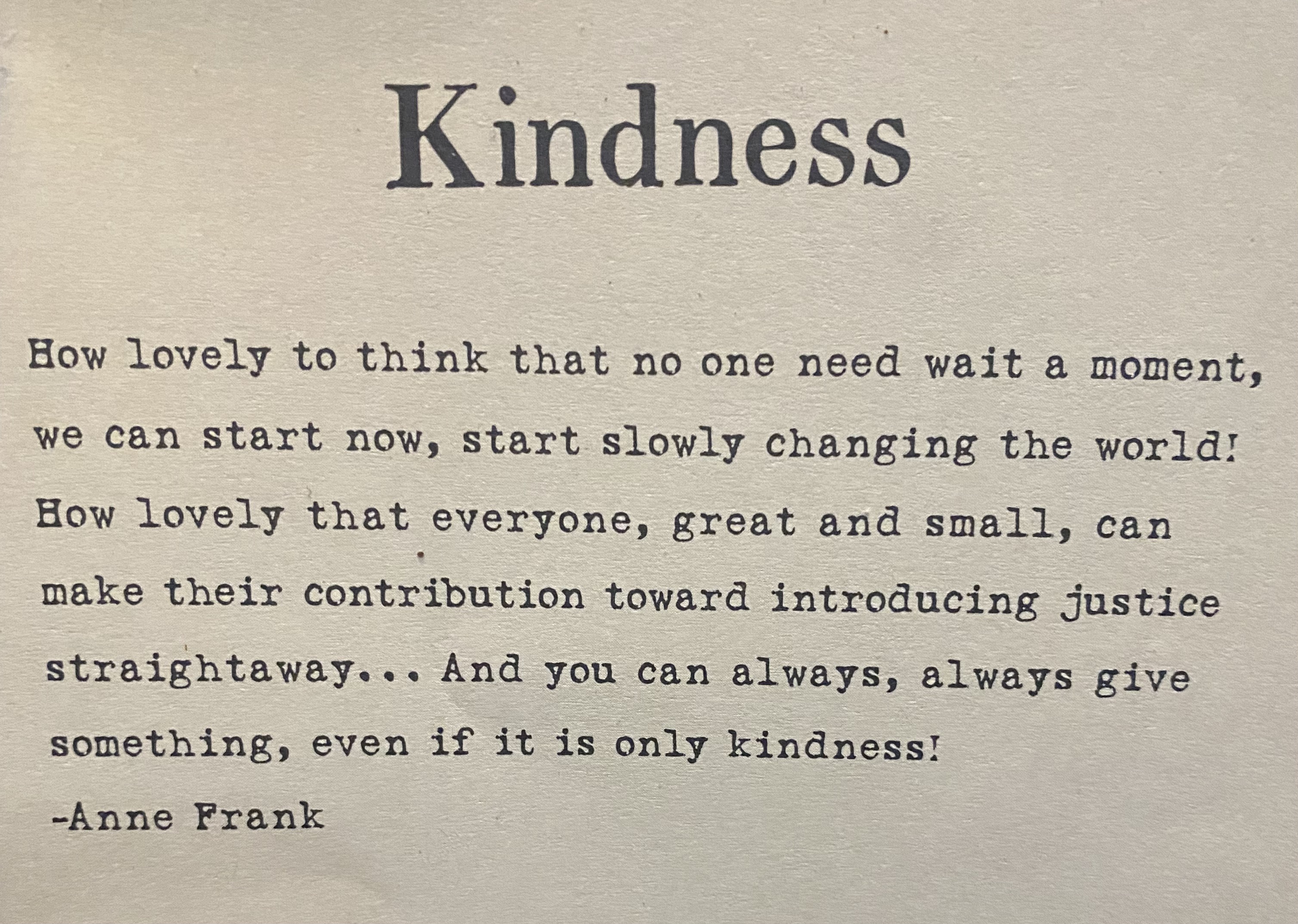
The Kindness Connection

Standard

I was not having a good week, and it was only Wednesday. I was exhausted after our spring break travel and the daylight savings time change. I felt like my to-do list was growing disproportionately. I’d barely avoided another car who didn’t yield to my green light that morning before my appointment for a repair estimate for the rear end collision I’d endured the month before. And events in the world felt heavy, so very heavy. I felt like a balloon about to pop. 

Before I proceeded to do my grocery shopping, which I’d been putting off, I looked around the clothing section to further delay the inevitable chore. I tried on a jacket and frowned at my image in the mirror when an older gentleman walked by and called out, “Looks good!” In that moment, I felt my spirits lift just a little. It was as if I’d been holding my breath like that tight balloon and instead of popping, I could exhale. I responded with thank you as he kept walking, not so much for what he’d said, but because he’d taken a moment to be kind. He didn’t know me at all, but he spoke kindness into my day, nonetheless. Nothing about the circumstances in the world or the hassles I’d encountered changed, but that man interrupted my thoughts and got me out of my own head where I’d been dwelling on the negative.

As a society, we talk about random acts of kindness and how we should teach our children to choose kindness, but doing those little things is not always so easy. I’ve chosen not to give someone a compliment because I worry it might feel awkward. Or worse, I feel a twinge of jealousy that another woman looks better, so I don’t tell her I like her outfit or her hair. Comparison can quickly be the killer of kindness. Insecurity may win the day instead of generosity of spirit.         

Quoting the Old Testament, Jesus said the greatest commandment was “‘Love the Lord your God with all your heart and with all your soul and with all your mind and with all your strength.’ The second is this: ‘Love your neighbor as yourself.’ There is no commandment greater than these” (Mark 12:30-31). But when I’m stingy with kindness, I fail to follow these commandments. When I find myself hesitating to share the kind word or do the kind thing for whatever reason, I should ask myself how I would feel if someone did or said the kind thing to me? Would I appreciate the text from a friend checking in? Would it make me feel good if someone told me they thought I looked nice? Would I get a break from my anxieties if someone made a genuine connection with me even if just for a second?

As obvious as it sounds, when we love others, we demonstrate God’s love. We also remind ourselves how it feels to be considered and noticed, to know that God loves us even when we feel unlovable. Jesus could’ve stopped his answer with the first commandment to love God, but he continued with his directive for us to love each other. Let us be kind and show love to one another in the moment and resist the temptation to keep those words of grace to ourselves.  

Don’t Block the Blessing

Standard

The college application process has changed greatly in the last thirty years. No need to use a typewriter to fill out individual applications to each school or for each scholarship like I did. Obviously, the whole process is now completed via computers and a common application that allows the student to fill out one application for most universities. Once they’re accepted, students use portals to link to the universities to manage housing, financial aid, etc. It’s all very fancy when it works, but, of course, technology has its glitches. When my daughter Riley tried to access a college portal the other night, the site wouldn’t let her in. She sighed loudly and said, “it’s temporarily going through something.” I laughed because she’d acted like the portal was a person who was having a rough go of it.   

But her comment made me think about when I have tough times. I often forget that on most occasions, the circumstances are temporary and will pass quickly. While I realize that some situations present complicated problems that last for a long time, many are short lived. But I tend to catastrophize and think the temporary emotions will remain. Instead of allowing myself to feel the emotions so that I can get through them, my instinct is to fight the feelings off. Instead of having a good cry or just giving myself an hour to wallow, I start overanalyzing, trying to figure out why I’m upset with the goal of fixing the problem. In the movie Frozen, Elsa sings, “conceal, don’t feel.” My initial reaction to hard emotions is “don’t feel, fix it,” usually prolonging the situation. 

On top of my efforts to fix the circumstances and deflect the uncomfortable feelings, I often act like the computer portal when it’s not working in that I won’t necessarily let anyone in. Sometimes, I’ve told my close friends after I’ve recovered from a difficult season. In response, they’ve asked “why didn’t you tell us?” I don’t always know the answer, maybe it’s embarrassment or my belief that no one else can help. But when I’m more rational, I know that my friends offer a source of support when I tell them I’m having a hard time. That they would come to my aid if I even hinted at a problem. 

Recently, one of my close friends said to another close friend that we needed to mark our calendars for a summer outing because they know I get down for a few days when my kids go to sleepaway camp. Their proposal comes from our shared history and a girls’ trip that helped me through the sadness after a previous camp send off. Because they know me and want to encourage me, they are already planning to help me at a time when they know I’ll need them. But if I hadn’t told them that their presence had helped me, they wouldn’t know and wouldn’t be able to support me in the future. 

God does not want us to isolate when we feel down. We must remember that God provides many resources, including people to help us when we are in need. If we do not let people in, if we block them so they cannot reach us, we also prevent God from providing comfort and help. In Jesus’ day, a group cut a hole in a roof so they could lower their disabled friend down to where Jesus was teaching. If the man had told his friends not to bother, that he was fine, that he didn’t want to trouble them, he would’ve missed out on Jesus’ help and grace (Luke 17-26). We should feel emboldened to ask for help from our friends. 

We all have times when we’re temporarily going through something, but we don’t have to go through it alone. When we open up and ask the people around us for help, we allow them to rise to the occasion and in turn, share God’s love and comfort with us on God’s behalf.    

Like Father, Like Daughter

Standard

When I graduated from law school, my friend and fellow graduate Shannon threw a big party at a country club type of place. Before we went, my dad told me he wasn’t that comfortable going to events like that where he might be required to mingle with people he didn’t know. But he went anyway. After the photos were developed (yes, it was that long ago), I noticed that my dad was in the background talking to a different individual in almost every picture. So much for dad’s aversion to socializing.

This wasn’t the first time I’d seen dad visiting with numerous people. When I was a kid and we arrived at church early, I watched my dad walk around the sanctuary, shaking hands, saying hello to the members of our small congregation. I didn’t think much of it at the time because it was just what dad did at church along with leading our hymns or singing a special song on occasion. Small churches require folks to take on many roles. My mom tells the story about dad leading the Sunday School program in engaging the community surrounding the church. Some neighbors started attending after that effort, so I grew up in an integrated church, not knowing that was a rarity in America.   

As I’ve grown older and become heavily involved in my own small churches, in St. Louis, Missouri, and Frisco, Texas, I’ve realized that observing my dad all those years influenced how I relate to my faith communities. For the last twenty plus years, I’ve served in a lot of positions at church but my most consistent role is that of greeter. I love to welcome people to church, to shake hands, to give hugs, to check in to see how they’re doing. I enjoy meeting visitors and learning their names. If I don’t talk to you at the front door, I’ll probably catch up with you during the passing of the peace or after the service. The ability to know almost everyone in attendance is one of the upsides of belonging to a smaller congregation. 

I’ve learned that not everyone enjoys greeting. Standing at the front door and chatting is uncomfortable for some. I didn’t understand that at first. I guess I assumed that because I liked greeting, everyone else would too. But I’ve heard from several people that this was not their calling. The Apostle Paul wrote that the body of the church, in which many members have various gifts, is like a physical body with differentiated parts (1 Cor. 12:13-31). For example, I don’t like to make meals for others. Some people show the love of Christ by lovingly making delicious food for which I’m grateful. If I sign up to bring a meal to someone in need, it will be take-out.

We can all focus on sharing the gifts, strengths, and talents we have with the broader faith community. In so doing, we can build up Christ’s kingdom and enjoy the work at the same time because we are fulfilling God’s call to help with the gifts God has given us. When we serve with passion and love, we inspire others to do the same, including the children who are watching. 

My dad turns 75 years old today. He doesn’t get out much anymore because of Parkinson’s Disease. But every time I use our shared gift to meet people in the name of Christ, his legacy continues to grow as a testament to God’s work that continues. Let us find ways to use our gifts so that we can joyfully demonstrate God’s love to everyone. Happy Birthday, Dad.    

God is Awake

Standard
Photo credit: Jed Carter


At 3:30 in the morning on 2/22/22, I woke up to hail beating on my windows. I didn’t get out of bed immediately though. My husband Ben was out of town, so my youngest son Alex was already sound asleep and secure in my bed. I hoped that my other kids would sleep through it. I was wrong. Within a few seconds, Clay, my twelve-year-old, came in, followed immediately by sixteen-year-old Jed holding his phone up with the flashlight shining in my face. Riley, my eighteen-year-old daughter, was right on their heels. They were startled and couldn’t sleep from all the noise.  

So, I got out of bed and went to the front to better assess the situation. Hail inundated the windows and house; the sound was almost deafening. We looked out the front door to see the ground and sidewalks covered in marble sized ice. The hailstorm stopped just a few minutes after it started. Alex was still asleep in my bed. One kid settled on the couch and the other two ambled back upstairs to their rooms. The storm was over, and we resumed our rest. 

I admit I kind of loved the way the kids came running to me when the storm started, when the noise became unbearable, when the stress rattled them. Especially now that my children are older, it’s nice to feel needed, to know I still provide a source of comfort and security for them. I wonder if we do the same when we struggle with stress and anxiety. Do we immediately run to God for comfort and security? Or do we hesitate? I think we often try to solve our problems on our own before we turn to God. We may decide we don’t want to bother God with our troubles when there are so many terrible problems in the world. 

But God is constantly available at all times of the day and night to help us in our times of need. The Psalmist said, “I lift up my eyes to the mountains – where does my help come from? My help comes from the Lord, the Maker of heaven and earth. He will not let your foot slip – he who watches over you will not slumber; indeed, he who watches over Israel will neither slumber nor sleep” (Psalm 121:1-4). 

Being the word nerd that I am, I looked up the definition of slumber as compared to sleep. Slumber is to sleep lightly or to be in a state of inactivity (dictionary.com). In college, I sometimes sat on my bed with my back propped up against the wall, eyes closed, in the middle of the afternoon. When my friends would ask if I was going to sleep, I would say, “I’m just resting my eyes” because I was sort of awake and sort of not. If my friends piqued my interest with their conversation, I would rouse myself and join in. But I might get too comfortable in my state of inactivity and fall deeper into sleep.   

God is not like me – God doesn’t doze in and out of consciousness. God doesn’t try to remain asleep in bed when the storm rages, hoping no one wakes up. God is already awake and aware. God is at the ready in every season, in every circumstance, at every turn. We can approach God at any moment with our hardships and our angst. We need not hesitate. Instead, let us run into God’s presence when the storms unsettle us knowing God watches and waits to be our refuge. 

Twisted

Standard

Time-honored household debates include how to load the dishwasher, how the toilet paper roll should spin, and how to squeeze the toothpaste tube. While my husband Ben and I don’t have these specific debates, I’m about to take up the toothpaste tube squeezing issue with my sons. Some people methodically squeeze from the bottom. Others squeeze from the top or the middle. My boys have come up with a new technique that involves twisting the tube as if they’re wringing water out of a sopping wet towel. I applaud their efforts to get the last drops of toothpaste out of the tubes, but all that remained were mangled shells. 

Sometimes, our lives may feel twisted. Circumstances that may be out of our control leave us feeling depleted. Our expectations may be dashed. The world may not look like anything we planned or hoped for. Even if everything looks neat and tidy on the outside, our insides may, in fact, feel twisted. We may be confused or tapped out emotionally and mentally. We may feel as though our internal and/or our external situations are so misshapen that there’s no way to be whole again.

I’m taking an online Theology course through Austin Presbyterian Theological Seminary this semester. Last week, our reading and discussion were about Jesus’ humanity and divinity. I was flummoxed because I’d never heard some of the theories, and I didn’t know what to think anymore. My brain was twisted into knots, and my frustration poured out of me on paper and via Zoom. Thankfully, Professor Cynthia L. Rigby was gracious and supportive in the face of my confusion. I still don’t know if I understand the scope of Jesus’ humanity and divinity, but Professor Rigby is always asking “so what”? What does our rumination on theological topics mean for our everyday lives? I was thinking about the issue days after our discussion when it occurred to me, the “so what” is that Jesus knows how hard life is. He knows how we as human beings feel when we are wound so tight, we physically ache, cry buckets of tears, and can’t think straight. When we are twisted and have nothing left to offer.

Jesus experienced a twisted situation in his hometown when he was teaching in the synagogue. The people who’d always known Jesus’ family were offended that Jesus talked with such authority. “Isn’t this the carpenter? Isn’t this Mary’s son?” (Mark 6:3-6). They noted that they knew all his brothers and sisters. To paraphrase, they asked, “who does Jesus think he is now?” Jesus said to them, “A prophet is not without honor except in his own town, among his relatives and in his own home.” Jesus “could not do any miracles there, except lay his hands on a few sick people and heal them. He was amazed at their lack of faith.” Jesus experienced the rejection and ridicule of people he’d known his whole life, so Jesus understands how it feels to be hurt when things don’t go as planned. 

The “so what” is Jesus knows what it means to be human and experience pain. We can take refuge in Jesus’ love for us and believe that he will always be with us even when life feels twisted. 

God’s Relentless Pursuit

Standard

Our family adopted a new kitten a little over a week ago. We got her for our son Jed for his birthday and because we thought our older cat might need a friend to avoid depression once our daughter Riley goes to college later this year. Jed named her Daenerys after a Games of Thrones character. Dany is a sweet girl but has been a bit skittish during this adjustment. She hides under his bed, on his windowsill, and on shelves behind his massive sized shoes. Honestly, I didn’t think she’d venture out of Jed’s room for a long time, which is why I didn’t shut the door completely the other night when Jed went to bed. 

I was almost asleep when I heard a loud commotion from upstairs. Jed burst into our bedroom and exclaimed, “she’s not in my room anymore.” He explained that Dany had seemed a little too quiet, so he’d started looking for her, which is when he found her on the stairs outside of his room. When she saw Jed, she spooked, jumped off the landing onto our downstairs recliner, and then ran to the front of the house. We looked and looked for her but couldn’t locate her. I suggested that maybe we suspend the search because cats hide, that she would eventually find her way back to his room. “We have to find her,” Jed insisted. “She might be hurt or scared. She may not know how to get back to my room.” And so, we kept searching, finally removing the breakables from the shelves of three bookcases and pulling their heavy frames far enough from the wall to find her hiding underneath. Around midnight, Jed carried her back to his room, safe and sound.

Sometimes, the people we love run away from us physically, mentally, or emotionally. Sometimes, we may want to pursue them, but we can’t continue. We must pull back in order to establish healthy boundaries. Sometimes, they don’t want us to find or rescue them from their difficult circumstances. And sometimes, we may be the ones who run and hide from those who love us. The resulting pain can overwhelm us. But we can take comfort in the fact that God won’t give up on any of us no matter how lost we are.       

Jesus told the parable of the lost sheep to his followers.

 “Suppose one of you has a hundred sheep and loses one of them. Doesn’t he leave the ninety-nine in the open country and go after the lost sheep until he finds it? And when he finds it, he joyfully puts it on his shoulders and goes home. Then he calls his friends and neighbors together and says, ‘Rejoice with me; I have found my lost sheep.’” (Luke 15:4-7).  

Jesus said that in the same way, heaven rejoices over one sinner who repents. 

Jesus won’t stop searching for any of us ever. God relentlessly pursues relationships with us. No matter how far we run or how long we hide, we can rest assured that God is always right behind us, waiting to share our burdens, comfort us when we hurt, and ease our aches with his love. 

Please don’t tell Jed because he will never let me forget it, but his persistent search for the kitten reminded me of Jesus and the lost sheep. Jesus won’t leave us when we are hurt, scared, act out, run, or hide. We cannot escape God’s presence or his quest for us. God loves us too much to let us go. Thanks be to God.     

The Struggle is Real

Standard

When I heard the weather report last week, I physically felt the anxiety rise in my body. The forecast called for a high of 70 degrees on Sunday but predicted that the temperature would fall to 28 degrees with a possibility of wintry precipitation by Thursday. The weather people claimed the artic blast would not match the drama of the previous February when ice blanketed Texas for a week. But the memories of the past winter event panicked me. “I just hope it’s not like last year,” I said. My twelve-year-old son Clay responded, “Why? That was fun.” The look on my face conveyed my shock. “Not the rolling black outs, but the rest of it was fun,” he said. 

My recollection of events differs quite a bit from Clay’s. I remember the negatives – the cold house, hurriedly plugging in our devices when the electricity came on for short spurts, the inability to leave because of the frozen roads, the fear that our pipes might burst like those of numerous neighbors. But Clay remembered the good things like playing in the snow, days off from school, and the way we worked together to make meals in the dark.      

Clay and I have different personalities though. He is more laid back than me and more go with the flow. And while I realize he doesn’t worry about things like I do as a parent, I also understand that he has the innate ability to see things in a more positive light. He’s a glass-half-full guy, while I’m a glass-half-empty gal, or at least I worry about what we’re going to do when we drink the rest of the glass.  

I’ve noticed I tend to focus on the negatives in the past. When I recall seasons in my life, the bad parts often come to my mind first and crowd out the good memories. And that penchant carries over to worry about the future, like overwhelming anxiety about another ice storm. Even when I’ve prepared as much as I can for an upcoming event, like said ice storm, I struggle to let the worry go. 

While getting worked up by a couple of days of icy weather may sound funny, the anxiety that I live with is not. In fact, my anxiety and depression can become overwhelming at times. And I know I’m not alone. Many of us have a tough time dealing with worry that consumes us and sadness that can overwhelm us. 

In “The Message” translation of the Bible, Jesus’ famous words about not worrying read like this: “Give your entire attention to what God is doing right now, and don’t get worked up about what may or may not happen tomorrow. God will help you deal with whatever hard things come up when the time comes.” (Matt. 6:34 MSG). Jesus said God would help us handle hard things, which sounds good in theory. But Jesus didn’t specify exactly how God would help us. On the surface that may seem frustrating because of the lack of details. I think we can look at Jesus’ promise as freeing though when we realize that God’s help is open-ended and unlimited. 

God can help us in many ways: a deep conversation with a friend, a long nap, a walk in nature, a tough workout, journaling, meditation, or a good meal. But God’s help also comes in the form of professional mental health care. Medication and therapy, especially talk therapy, can be invaluable, perhaps even crucial to our well-being. God has provided these medical professionals with intelligence, education, training, advances in science, insights, and caring hearts. They can work as God’s servants to guide and support us as we travel the sometimes-rocky road of mental health.       

Personally, I’ve benefited from both medication and therapy, and I am grateful to God for these sources of help. As Christians, we can work to destigmatize the need for mental health care. We should not feel ashamed when we seek mental health care but can claim this as God’s provision and help. We can discuss mental health in our church communities so that others know they are not alone and need not hide their struggles or isolate with their pain. 

A Place to Breathe

Standard

When my daughter Riley was a baby, she had a respiratory infection and required a nebulizer to provide the breathing treatments she needed. The nurse at our pediatrician’s office informed me that the company who provided the machine would ask for it back but that we’d already paid for it and therefore should keep it. That tip has proved invaluable for our family because we’ve used it repeatedly over the years, especially me with my asthma. 

Recently, my nine-year-old son Alex needed a breathing treatment, so I put the mask on his face with the strap around the back of his head and turned on the nebulizer so the steam and medicine could soothe him. I assumed everything would be fine, but I didn’t realize that Alex had never used the nebulizer until he called out, “Am I supposed to breathe?” Apparently, he’d spent the first few seconds holding his breath instead of breathing in as intended. “Yes, breathe,” I said. “It’s supposed to make breathing easier.”

Sometimes, I think we forget that God wants us to breathe easier in life and that he provides tools to help us, including church. The idea of church feels constricting to many. We may have had bad experiences in the past in which people in the church treated us poorly to put it mildly. When my mom was a little girl, she tried to go to a church with her cousin, but being uninformed and poor, they wore pants to the worship service. That was back in the day when one wore a pretty Sunday dress to church, and so they were turned away. 

Many have encountered this type of experience, but it’s compounded exponentially because they’ve been rejected not because of their clothes but because of who they are. The hurt and shame imposed by church can leave deep scars. No wonder some people think all churches are places with restrictive rules that only condemn – that make them feel like they have masks strapped to their faces that require them to hold their breath, not be themselves.   

Of course, not all churches are the same. Churches exist that are accepting, affirming, and open to all. And while those churches may take effort to find, they are worth the search. The church is supposed to be a place in which we can find support and care and most importantly, God’s love. The community of people that we find in church can surround us when we hurt, sit with us when we doubt, and uphold us when we falter. God intended for churches to help us breathe easier, not make life harder. 

When I first joined the Presbyterian Church (USA) twenty years ago, I asked my pastor Rev. Kelly Allen about a controversial issue in the world of religion and why my new denomination held such different views on this topic than the churches I’d attended previously. Kelly was a brilliant pastor, and I’m sure she explained how we needed to view this subject in terms of the context and history of scripture. In fact, I know we did a series of lessons on this topic at a later point in time. But on that day, she responded to my query with a simple statement about her approach to God and people that will always stay with me.  She said, “I choose to err on the side of grace.” If only we all viewed others through the lens of grace and welcome. To love people so that they feel God’s love.  

Let us not give up on church if we’ve become disillusioned. Instead, let us seek God and in so doing, pray to find a community that embodies God’s authentic love for all people. 

The Way We Were (and Probably Will Be Again)

Standard

As I put away the Christmas decorations this month, I picked up a box full of ornaments and shrieked because it looked like someone had drawn on my brand-new dining room floor in green marker. A second later I realized it was not marker but green string from some sort of tassel off a gift tag. But in that moment of panic, I was a young mother again, ready to go on the hunt for which little person had ruined my floor. While my four kids may aggravate me at times, at ages nine to eighteen now, they don’t write on the floors, walls, or themselves (all over her toddler body with sharpie) anymore. And although my alarm ended in a flash, I reverted to a previous version of myself while it lasted. 

But sometimes, I go back to a version of myself that I don’t wish to revisit. When one of my children faces potential pain or rejection, I feel not only the fear of a mother wanting to protect her child, but also the hurt of my younger self who struggled with those difficult emotions. Back in those days, I tried to push past the bad stuff as quickly as possible. Unfortunately, though, I can feel the heartache of that girl still. 

At times, I regress to my former ways when it comes to spiritual matters as well. If I encounter a situation that tests me, I don’t always turn to God in trust but in doubt. I question God’s purpose out of a place of heightened emotion and wonder if God is really for me, not against me. Later, when I realize that I’ve allowed my fear to get the better of me, I approach God again with regret for my lack of gratitude and faith. 

I take comfort that the disciples who knew Jesus personally seemed to fall back into their old ways regularly too. On one occasion, the disciples, many of whom were fishermen, were in a boat with Jesus when they were encountered a scary situation.  

A furious squall came up, and the waves broke over the boat, so that it was nearly swamped.Jesus was in the stern, sleeping on a cushion. The disciples woke him and said to him, “Teacher, don’t you care if we drown?”He got up, rebuked the wind and said to the waves, “Quiet! Be still!” Then the wind died down and it was completely calm. He said to his disciples, “Why are you so afraid? Do you still have no faith?” Mark 4:37-40.

The disciples’ fear and uncertainty emerged when they asked Jesus face-to-face, “Don’t you care if we drown?” They’d reverted to their doubtful selves in the midst of trouble. And while Jesus reminded them that they should have greater faith, he still acted to help the disciples. Jesus didn’t refuse to support and comfort them just because they challenged him. On the contrary, he calmed his people even when they fell into their old patterns.  

God won’t abandon us when we falter in our faith and slip into patterns of doubt and worry. In times of fear, we can rest assured that God loves us and will comfort and calm us until we become ourselves again. And then, God will help us grow even stronger and deeper in our relationship with him so that our belief is greater the next time.