The Names We’re Called

Standard

Turks and Caicos is our family’s favorite vacation destination.  The island is the epitome of paradise with gorgeous beaches, crystal clear water, and swaying palm trees.  We can relax, slow down, and just enjoy life while we are there.  The beauty of the place is enhanced by the beauty of the people.  The people we meet are usually from Turks or Jamaica.  They are friendly and gracious and make us feel at home.  And many also have fantastic names.  We’ve met people named Princess, Esmerelda, Geiko, and Cadet.  

On our recent trip, I was ordering a meal at a food truck when the woman supervisor said to another young lady, “Lovely, will you man the drink station?”  I thought she was using the term “lovely” in the way certain folks in the southern United States use phrases like “honey,” “sweetheart,” and “darlin’.”  But then I saw the woman’s name tag, which said “Lovely.”  I couldn’t believe it.  This young lady’s actual name was Lovely.  All day, every day, every person she meets calls her Lovely.  I thought about how lovely it is to be reminded constantly that one is lovely.  And then I thought about the words that run through my head on a regular basis.  I think “stupid” if I make a mistake; “ugly” when the mirror seems unkind; “failure” when I don’t live up to my expectations as a wife, mother, human being.  I cannot recall an instance in which I’ve looked at myself with abundant compassion and called myself lovely.  

On another day, I accompanied my daughter Riley to obtain a kayak for she and my son Jed.  The man in charge was flirting and asked Riley if I was her sister, which is obviously not true.  I smiled and said, “you’re funny” as we bumped our forearms.  I looked at his name tag and was once again surprised.  His name was Prophet.  I wondered if he took his name as indicative of his calling.  Did he feel he was anointed to point others to God, to show them how they could live and love better?   I often question my calling.  Or my perception of my calling.  I wonder if I’ve understood God correctly.  Do I really know what God wants me to do or to be?  I feel lost sometimes with respect to whether I’m following the correct path.  I found myself wishing that my name was the equivalent of my calling.                     

We often assume God shares the negative opinions we have about ourselves.  We think that God must constantly degrade us and label us bad and sinful.  We believe that God’s judgment aligns with our own worst fears.  Surely, God is just as disappointed with us as we are with ourselves.  And if God only knows us by names of disdain, then surely he doesn’t have a calling for us.  How could God use us when he knows how incompetent and worthless we really are?  We think we can never be good enough for God.      

But I wonder what names God actually uses for us.  I think God showers us with names that reflect his love, not our shortcomings.  I imagine God calls us lovely, beautiful, and kind. That God believes we are good, smart, and worthy.  That throughout our lives, God calls us to different roles in different seasons.  For a while God may need us to be prophets and inspire those around us to live into God’s hopes for us and humanity.  At other times, God may ask us to serve as teachers, workers, givers of hospitality, or learners.  The list of God’s potential callings is infinite. 

God wants us to embrace the positive and endearing names that he gives us.  God hopes we believe that he calls us to help build his kingdom on earth.  When I think something negative about myself, I want to substitute my vacation friends’ names, Lovely or Prophet, or some other encouraging term.  God says, “I have called you by name, you are mine” (Isaiah 43:1).  Let’s decide that the names God uses for us are wonderful affirmations that reflect how much he loves us and all the good he knows we can bring to the world.  

I Got You

Standard

My son Clay enjoyed wake boarding at camp this year, so upon his return, we purchased a morning of wake boarding at a water park as a birthday gift.  Instead of a boat, though, a cable pulled him through the water.  Because he needed to adjust to wake boarding with a cable, he went with another kid to practice at a different portion of the facility.  The other mother and I stood there unsure of whether to go or stay when one of the teenagers who worked there looked at the boys and said, “we got you.”  In that moment, I realized I’d heard that statement a lot this summer from other young people.  This variation of “I’ve got your back” often comes out of their mouths as “igotchu.”  For example, at restaurants I’ve had more than one waiter say, “I got you” when I asked for a menu item or a refill.  

I like the recent uptick in the use of this phrase.  When someone says, “I got you,” they convey an air of confidence.  They know how to do the task at hand or can access what another needs or wants.  The speaker tells the other person that they will take care of them and that they will act as a backstop of sorts. They will provide comfort and help when needed.     

We all want someone to stand in the gap for us when we feel lost or untethered.  But sometimes we face dilemmas that we think no other person will understand.  We may not want to admit our true feelings or concerns to another. Honesty with someone else may seem impossible when we can’t first be honest with ourselves.  The possibility of rejection may make us afraid to confess our failings or anxieties.  We may become defensive and build up our walls so that no one will find out the pain we hide.  When we think that no one has got us, the isolation is real and hurtful.  

And sometimes, we feel that God hasn’t got us either.  The peace and comfort we want doesn’t arrive in a timely fashion, and we may doubt that we will ever be better again. When we worry that God has abandoned us, the grief is deep and the silence deafening.  We may find ourselves shutting down emotionally with God as well because we question whether God is in the struggle with us.  We can build walls with God just like we do with other people.   

Even though we may not feel God’s presence at times, God is still with us.  A familiar but favorite passage of mine captures God’s promise to never leave us: 

“Do not fear, for I have redeemed you; I have summoned you by name; you are mine.  When you pass through the waters, I will be with you; and when you pass through the rivers, they will not sweep over you.  When you walk through the fire, you will not be burned; the flames will not set you ablaze….  Do not be afraid, for I am with you; …   Forget the former things; do not dwell on the past.  See, I am doing a new thing!  Now it springs up; do you not perceive it? I am making a way in the wilderness and streams in the wasteland.”   Isaiah 43:1-2, 5, 18-19.  

God will bring us out of the spiritually depleted season eventually.  We must hang on to our faith when we are in the dry, arid desert emotionally and mentally. One way God provides a path forward is through other people.  We may be consumed by isolation, but rest assured almost everyone has been there.  We have all felt lost and disconnected from other people and from God.  We can reach out to others for their support and encouragement, confident that they’ve most likely traveled this same road.  Then, those people can repeat the words that God wants us to believe every single day, even in the hard times – “I got you.”     

Ease the Pressure

Standard

The familiar bumper sticker says, “Please be Patient.  Student Driver.”  I see them all over town even though my daughter adamantly opposed putting one on our car.  Every time I view some version of the student driver warning, I ease off of the gas a little bit so that I don’t put unnecessary pressure on the teenager.  But I’ve found that I put unnecessary pressure on myself when it comes to driving.  When I’m at a red light turning right, I feel the need to closely monitor the oncoming traffic in case an opportunity arises to enter the road before the light becomes green.  In the past, I’ve had people behind me honk because they think I should turn, even when they don’t have a clear view of the cars coming.  Usually when I look in the rearview mirror there are no other cars behind me.  No one else is actually pressuring me.  I’ve internalized the pressure and have made it all my own.   

Honestly, though, driving is the least of my worries when it comes to self-imposed, internal pressure.  I walk around carrying a lot of burdens, my own and those of other people I love and care about.  I feel the constant pressure to do something, analyze the problem, figure it all out.  And I struggle with my inability to control things and make them “right” in my eyes.  When Ben and I first married, we talked about the need to relax more, and I said, “But what if I lose my edge?”  Without missing a beat, Ben replied, “I think it’s okay if you lose a little bit of your edge.”  Over the past twenty years, the pressure I experience has changed as my life has evolved but the drain on my mind, heart, and body still exists.  I hope I’m less anxious now, but I still feel the constant weight of self-imposed pressure.  

I don’t think God wants us to put so much pressure on ourselves.  God wants us to live in peace with others but also with ourselves.  When we place too much pressure on ourselves, we feel heavy and unsettled.  We are not at peace.  Apostle Paul said, “Be completely humble and gentle; be patient, bearing with one another in love.  Make every effort to keep the unity of the Spirit through the bond of peace.”  Ephesians 4:2-3.  This verse applies, not only to our relationships with others, but to ourselves.  God wants us to be completely humble and gentle with ourselves; be patient with ourselves, bear ourselves in love.  God asks us to make every effort to keep ourselves in unity with the Spirit through the bond of peace.  

God wants us to release some of the pressure that we impose on ourselves.  We can give ourselves a break.  We don’t have to be so hard on ourselves all of the time.  God desires that we accept the grace and mercy that God freely provides.  God is here to support and guide us.  Imagine God posting reminder stickers all around us that say, “Be Patient with Yourself.  Let Me Drive.”    

Encourage, Accept, Embrace

Standard

When the Milwaukee Bucks won the NBA championship last week, ESPN reporter Malika Andrews interviewed the team during the trophy presentation.  She noted that the Bucks had been knocking on the championship door for several seasons but that when player Jrue Holiday joined the team this year, they finally broke down the door.  She asked Jrue, “What made you such an immediate fit with this team?”  Jrue said, “They embraced me.”  He added, “They believed in me.”  While Jrue may have been the missing link that helped the Bucks win the finals upon his arrival, he credited his teammates for welcoming him and making him comfortable as the secret to their success.  

Joining a new team, starting a school year, or entering into any new situation can be stressful.  Setting foot into a church for the first time can be one of the most angst inducing choices anyone can make.  Some may carry a lot of emotional baggage associated with religion and churches.  They may have heard that they were unloved and unwanted from the pulpit.  They may have felt excluded, either explicitly or subtly, by other members of the faith community.  For others who were not introduced to church by family or friends, the decision to approach a church may fill them with uncertainty, which can produce a great amount of fear.  

Even for those raised in a healthy church setting, finding a new church environment can be daunting.  Churches are like any other social communities – people naturally form friendships and smaller groups within the larger group of members.  And while one of the greatest benefits of church can be the close relationships that develop, churches can also have cliques, which make it hard for new people to feel comfortable.  

Sometimes, those of us who are members of churches fall into the trap of thinking it’s the job of the new people to fit in, that if they want to belong, they will make an effort.  But we “on the inside” need to welcome those who bravely stand on the threshold.  We need to make an effort to get to know them and introduce them to others.  While some of us who belong to churches may not feel completely comfortable talking to new people because of our own insecurities or the inherent fear of rejection, we must remember that the newcomers probably feel much more intimidated and wary.  

In Galatians, the Apostle Paul said, “So then, as we have opportunity, let us do good to everyone, and especially to those who are of the household of faith.”  Galatians 6:10 (ESV).  We have the opportunity to do good when we welcome people into the household of faith.  At best, our faith communities can become families who support one another in good times and bad.  Even though not every person who enters the church will stay for a long time or be as invested as others, we can show them grace when we encounter them, no matter how briefly.   

In his letter to the church in Rome, Paul stated, “May the God who gives endurance and encouragement give you the same attitude of mind toward each other that Christ Jesus had,  so that with one mind and one voice you may glorify the God and Father of our Lord Jesus Christ.  Accept one another, then, just as Christ accepted you, in order to bring praise to God.”  Romans 15:5-7 (NIV).  We glorify God when we accept God’s people.  We have the honor and privilege to demonstrate God’s love to people as they seek to become closer to God.  Let us embrace them as they pursue a relationship with God knowing that we will strengthen our own relationships with God in the process.       

Keep Showing Up

Standard
Keep Showing Up

On Saturday night, my family participated in a trivia night at the pool where we spend a lot of our time in the summer.  A total of ten teams with six to ten players each accepted the trivia challenge.  Most of the teams consisted of younger and older adults so they could access a wide range of knowledge.  The members of our team named “The Carter Kids” were the following ages: 9, almost 12, 15, 17, and two 40-something adults (my husband and I).  The odds were not in our favor.  During the first round, we hung in there, though we didn’t do that well.  By the end of the second half, the spread between the team in last place and the one in first was only about 20 points, and we were ranked sixth – 13 points off the lead.  

The last question was multi-part, and each team decided their wager between 0-20 points.  But this time, if the team missed the question, the points were deducted from their final score.  Sticking with our most common strategy up to that point, we guessed.  We decided to go big or go home and bet 20 points.  We were shocked when the announcer said, “coming from sixth place to win, The Carter Kids!”  We whooped and cheered.  Our friends who work at the pool rushed in to give us fist bumps and high fives.  I think the other teams were surprised and perhaps a bit miffed that our little group had pulled off a victory.  

The experience made me think of Jesus’ disciples.  From their outward appearance, they were not going to win any awards or be that effective.  For the most part, their group consisted of inexperienced, uneducated laborers pulled off of fishing boats and those guys’ brothers or buddies.  Jesus could’ve convinced more elite people in the community who had standing and education to join his band. Instead, he selected imperfect guys who would mess up on a regular basis.  Peter is one of my favorite Biblical characters for his bluster and blunders.  Thomas will always be special to me because he expressed the doubts most of us would’ve had (or maybe that we have today). They were a ragtag bunch by anyone’s standards, but Jesus, God incarnate, chose to be friends with them, traveling, eating, teaching, laughing, and eventually launching them out to continue his work when he was gone.  

Even though they were not the team most would’ve picked, they kept showing up even when they were wrong or didn’t understand what Jesus was really doing.  They added value because they were present and open to learning.  They hung in there even when all seemed lost.  They loved Jesus and invested in their relationships with him by spending time with him.  While they wandered, denied, or questioned at times, they always came back around to join Jesus in his efforts.   

When faced with challenges, we often tell ourselves that we are not capable or competent.  We derail our own hopes and dreams because we retreat or run.  If we are asked to do something in our faith communities, we may think we are unworthy – that there’s no way God could use us for God’s purposes.  But sometimes, just showing up will turn the tide in a situation: being available to help, open to the idea that someone else sees something in us that we cannot see, and willing to try even though success by human standards is not guaranteed.  We can find solace in the disciples’ characteristics and actions.  They weren’t perfect, but they consistently and continually asked Jesus what he wanted them to do (even when their tone verged on impertinent).  

We can be like the disciples and ask God what we can do, with all of our foibles and failures.  Ultimately, God wants and needs us in order to reach others.  We may never feel that our efforts result in a big win, but God sees all that we are doing for the kingdom on earth.  I believe wholeheartedly that God appreciates our willingness to keep showing up over and over again.            

Cultivating Connection in Community

Standard

“Help, help,” the little girl called out.  From my vantage point by the pool and her sing-song tone, I could tell that she wasn’t in distress but was playing in the water with friends instead.  I taught my children from an early age that they shouldn’t yell “help” at the pool unless they genuinely needed the lifeguards’ assistance.  I didn’t want them to cause unnecessary alarm and hoped people would take them seriously when they actually called for help.    

Asking for help only at dire times makes sense when we’re talking about water safety.  Unfortunately, in our culture, we’re conditioned to believe that asking for help in most circumstances demonstrates weakness.  We’re taught to be rugged individuals and pull ourselves up by our bootstraps.  We think we shouldn’t ask for help unless we are desperate, and even then, we should hesitate before reaching out to others.  We’re told to take care of ourselves and depend on no one if we can avoid it. 

Instead of making us stronger, however, our collective focus on individualism can create seclusion and loneliness.  Our go it alone attitude has the potential to do us in.  I’ve come to believe that community is more important than ever, especially after last year’s pandemic cut us off from each other.  Honestly, I never realized how much I need to connect with people until we started emerging from the shutdown.  I missed hearing people’s stories, giving hugs, asking about their families, learning about their circumstances, and spending time with them.  Whether it is one on one or in a group setting, the sense of belonging and the deeper bonds that I feel after being with others is essential to my wellbeing.  I wasn’t fully aware of the heaviness I carried until it started to lift in the presence of others.   

As we went back to church in person, I began to understand just how vital the community of faith is to me.  I was relieved to again be with these people that I loved and found joy in welcoming new people into our faith family.  The writer of the book of Hebrews said it well, “Let us hold unswervingly to the hope we profess, for he who promised is faithful.  And let us consider how we may spur one another on toward love and good deeds, not giving up meeting together, as some are in the habit of doing, but encouraging one another . . .”  Hebrews 10:23-25.  God intends for the people of God to hold one another up and to be together when we are able.

While not everyone is ready to venture back into their communities of choice, I urge all of us to reach out and connect to others in some way.  We are not meant to do life alone.  Don’t get me wrong, I enjoy some alone time, but long-term isolation is not the same as taking a little time to relax, rest, and recharge.  We grow in empathy and understanding when we are with others.  We expand our vision and deepen our faith when we come alongside others and walk with them through the minutiae of the everyday routines and stay with them during the harder times when they need help.  

We give and receive God’s love when we are together.  If we invest in one another, we will feel more comfortable asking for help before desperation sets in, and we can rest assured that our people will rally around us in difficult times.  Let us make the time to find and develop relationships with people for the good times and the bad knowing God is with us through it all.     

Dreams Might Come True

Standard

I love the first day of a new month.  To me, it feels like a fresh start with new possibilities, like a mini-New Year’s Day or the start of a school year.  I particularly enjoy changing the calendars around the house.  I can’t wait to see what image or phrase accompanies the turn of the calendar.  This July, I flipped the page to find the words “Let your dreams come true” in red, white, and blue script.  At first, I didn’t think much of it, but then I realized that this was not normally the way I’m used to hearing this encouragement about dreams.  Usually, the saying is “make your dreams come true.”  The difference in the wording struck a chord with me.

The emphasis on “making” one’s dreams come true focuses on the person’s actions.  “Letting” one’s dreams come true changes the focus to allowing dreams to materialize.  Don’t get me wrong, I believe in working hard to achieve goals.  Discipline, practice, and consistent effort are essential to accomplishing anything.  But sometimes, even when we want to make things happen in our lives, we end up sabotaging ourselves.  The relentless pursuit of our objectives may produce anxiety that can grow out of control.  We may allow fear of failure to consciously or unconsciously undermine our efforts.  We may be haunted by the feeling that we are not good enough or suffer from imposter syndrome.  If our work doesn’t produce the exact results we want, we may feel so disappointed that we can’t see another way forward.  We close ourselves off to expanding our vision of the future.  And the self-doubts are amplified if we think that our dream is a calling from God.    

In Moses’ story in the Old Testament, God beckoned Moses into conversation initially through the sight of the burning bush.  God told Moses, “I am sending you to Pharaoh to bring my people the Israelites out of Egypt.”  Moses had plenty of doubts about his abilities.  Moses said to God, “Who am I that I should go to Pharaoh and bring the Israelites out of Egypt?”  God replied, “I will be with you” in order to reassure Moses.  But Moses had more questions and said to God, “Suppose I go to the Israelites and say to them, ‘The God of your fathers has sent me to you,’ and they ask me, ‘What is his name?’ Then what shall I tell them?”  God gave Moses a lengthy answer about what Moses should say to the elders of Israel to convince them that Moses was called to lead.  And in response, Moses said, “What if they do not believe me or listen to me and say, ‘The Lord did not appear to you’?”  Once again God gave Moses a long answer and showed him physical signs that he could perform to convince people.  

Moses himself wasn’t convinced, however, and protested further.  “Pardon your servant, Lord.  I have never been eloquent . . . I am slow of speech and tongue.”  God said, “I will help you speak and will teach you what to say.”  “But Moses said, ‘Pardon your servant, Lord.  Please send someone else.’”  The extent to which Moses tried to block God’s instructions because of his own insecurities is almost comical.  He might as well have taken the stance of a toddler who crossed his arms, stomped his foot, and said, “I don’t want to!”  Exodus 3-4.        

I relate to Moses’ reactions and find them quite comforting.  He was unsure and full of doubt.  He questioned his competence and qualifications.  If left to his own devices, Moses would have refused to act at all.  Even when God encouraged and supported him, Moses didn’t think he could do it.  Like Moses, our doubts may play on a constant loop in our heads.  Our negative thoughts can close us off to our dreams and God’s dreams for us.   

Moses had to get out of his own way in order to let God’s dreams for Moses and the people of Israel come to fruition.  If we believe in the possibilities instead of our doubts, we can make space to let our dreams come true, especially those dreams that come from God.  God believed in Moses, and God believes in us too.    

The Good, the Bad, and Everything in Between

Standard

All four of my kids are at camp for three weeks this year.  Unlike prior years, my seventeen-year-old daughter Riley serves on the staff this year and therefore has access to her cell phone.  She doesn’t text or call often because she is working hard, but one night, she called me in tears.  Someone said something extremely unkind to her; she wasn’t sure how to handle it; and she was exhausted – physically and emotionally.  We discussed what to do in the immediate situation.  She called me back later that same night with an update, and then we hung up so she could get some much-needed rest.  I stayed up for a long time afterward though, worried about her, hoping she would bounce back the next day.  When she called a couple of days later, she said, “sorry about only calling when something bad happens.”  I told her that I wanted to be there for her when she was upset, but that it would be nice to hear about the good things too.  She took that message to heart and called to recount another day’s events in a cheerful conversation that lasted an hour.         

This experience gave us a good trial run for the future when Riley goes to college in the fall of 2022.  I want to act as a sounding board and safe haven for her during tough times.  I also want to know when she’s happy and content.  I can’t recall whether I struck a good balance with my parents during my early adult years.  I called my parents when I was sad or down (on more occasions than I’d like to admit), but I’m not sure I shared as much about the good stuff with them.  

I know that I struggle with this same dilemma in my relationship with God.  I tell God all about my pain, my suffering, my worries, and my anxieties.  I cry and journal and ask, beg, and plead for God’s help.  But I don’t always talk to God about the wonderful aspects of my life.  I don’t thank or praise God enough.  Instead, I rely on the theory that God already knows everything or the concept that “no news is good news.”  But that’s not the best way to deepen and grow a relationship, any relationship, even with God.

King David’s relationship with God spanned the triumphant highs and tragic lows of David’s life.  David was brutally honest with God in anger, sadness, or peril.  He told God when he felt abandoned or scared.  But David also shared his joy and gratitude with God.  In Psalm 13, David covered the gambit of emotions in only six verses.  He began with lament: “How long, Lord?  Will you forget me forever?  How long will you hide your face from me?  How long must I wrestle with my thoughts and day after day have sorrow in my heart?”  (Psalm 13:1-2).  David expressed his fear that his enemy would overcome him.  Then he said, “But I trust in your unfailing love; my heart rejoices in your salvation.  I will sing the Lord’s praise, for he has been good to me.”  (Psalm 13:5-6).  David communicated with God openly and continually, which resulted in a close and intimate connection.

God wants to hear about our hard times and act as our refuge in times of trouble.  But I’m convinced that God wants to hear about the positive events in our lives as well.  When we take time to focus on good things, in addition to the bad, in our prayers, our hearts will open to God in gratitude and praise.  We can be like King David, and in the same conversation express a range of emotions to God.  Riley and I will work on this balance to establish a more full and abundant relationship.  I’ve decided to try and strengthen my relationship with God by expressing more of the good along with bad.  God wants us to share the good, the bad, and everything in between.  

Been There, Done That

Standard

Several years ago, water was dripping on the outside of our house from the eaves onto the driveway.  I wasn’t sure if the situation was, in fact, problematic, and so, being a responsible homeowner, I ignored it.  But one day, a woman driving down the alley stopped and rolled down her window.  She said she’d had a similar situation at her house and that I needed to call a plumber soon to fix it before it became much worse.  I thanked her and then contacted the plumber.  I appreciated her willingness to help me out and the way in which she approached me.  When she told me that she’d been in the same boat at one time, she gained my attention and I listened.  She wasn’t merely doling out unsolicited advice about what I should do.  She was speaking from a shared experience. 

At church last Sunday, a friend and I had a long conversation about children.  She is ahead of me on the motherhood journey, which is good, because as it turned out, I needed to discuss the teenage years with someone who’d already been through this stage.  We talked about navigating the ups and downs of parenting independent minded children and how hard it is to strike the balance between guiding them and allowing them to chart their own course.  She agreed that parenting high school and college aged children could be difficult and conveyed some of her experiences.  I felt seen and heard when she assured me it was hard but survivable.  And because I know that her children are awesome adults, I felt a greater sense of confidence and hope.  I appreciated her willingness to be open and share her knowledge with me.  

Often, we pretend that life is perfect and portray an image that doesn’t reflect reality.  In so doing, we may become more isolated and feel that we are the only ones who’ve ever gone through the specific difficulties.  When we find others whom we trust that faced similar experiences, we help ourselves if we are vulnerable and ask them for advice.  Perhaps some of our reluctance to ask how another person made it through stems from our fear that they will scold us or tell us we are doing things wrong or that we are somehow less than because we need guidance.  But most of the time, we will find a common bond of understanding that only deepens when we ask for support from someone who has been through similar circumstances.  

The Apostle Paul wrote that we, as members of the body of Christ, should “encourage one another and build each other up.” 1 Thessalonians 5:11.  When we let our guards down, either in asking for help or sharing our history with others going through a tough time, we cultivate relationships that not only build one another up but build the kingdom of God on earth.  God wants us to live in community and in relationship with one another.  The time and effort we invest in each other is valuable and in keeping with God’s hopes for us.  

Sometimes we throw out the phrase “been there, done that” as almost a joke.  But maybe that’s exactly what someone else needs to hear so they don’t feel alone.  Let us encourage each other by sharing our stories because when we do, we help ourselves and others and serve God at the same time.     

Little Love Notes

Standard

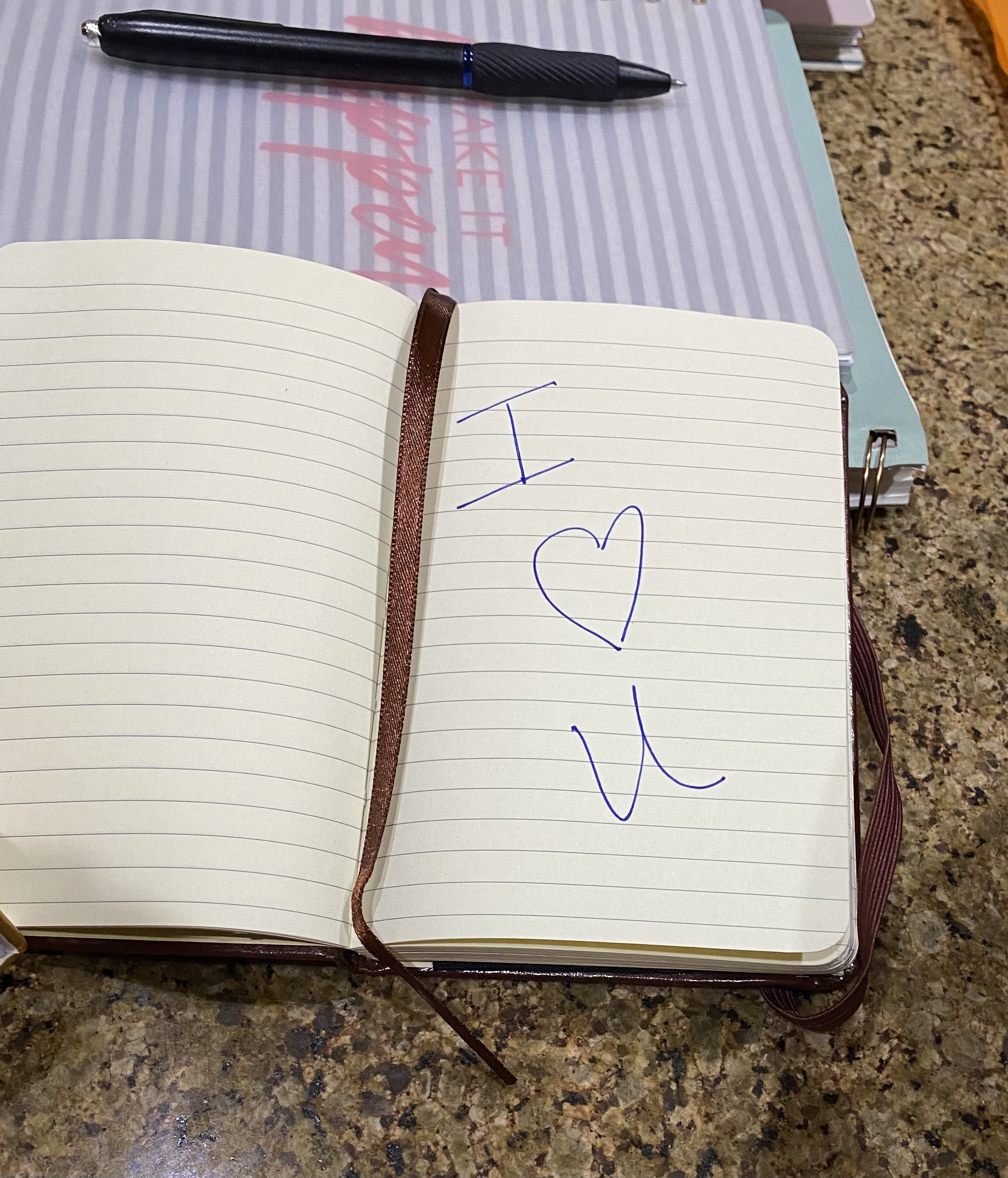
Every year before my kids go to camp, I buy a small journal for each child and write a note for each day of camp.  In that way, they will have a message from me every day even if they don’t receive an email or card from me on that particular day.  I started this tradition when my oldest child went to camp for the first time, not contemplating the time when four of them would go together for three weeks.  The notes are short, but sweet.  I tell them I’m proud of their kind natures and their ability to make friends; I remind them of activities I enjoy doing with them; I tout their accomplishments from the prior year; I encourage them to have confidence and believe in themselves.  I knew my daughter Riley loved the notes and referred back to the journals on occasion.  I wasn’t sure my boys cared at all until eight-year-old Alex told me he liked reading his book and looking at the stickers I’d included for decoration.  Alex’s comment made me feel like my efforts to celebrate them were worth all the work to write the multitude of notes.  

Growing up in church, I heard a lot about God’s judgment.  I even recall imagery about God writing all of our transgressions in a book, waiting until we confessed our sins in order to wipe the slate clean (as if God would actually employ the human concept of record keeping in a book).  Despite our collective belief in Jesus, the focus pointed to retribution, not grace.  The concept that God only kept count of the bad things caused shame and anxiety for me considering my tendency to focus on the negative.  I learned to fear God’s wrath and punishment.  As a result, I struggled to view God as a loving parent when God was portrayed as a far-away entity who eagerly hoped to catch me doing or thinking something wrong. 

As I’ve grown older and my faith has matured, I’ve come to understand that God is love and grace and mercy.  And that while God wants us to do good and make moral choices, God is not gleefully lying in wait for us to screw up.  Instead, God hopes we show others love in response to the love God has for us.  If God had a book, I believe God’s notes to us would be uplifting and supportive, not a list of all the times we’ve messed up.  What would God’s love notes to us be?  Perhaps something like – “I was proud when you helped that stranger today” or “I enjoyed spending time with you when you prayed last night” or “Believe in yourself because I believe in you” or simply “Remember, I love you.”

God wants to have a relationship with us that is deep and strong and ever growing.  God’s love is the foundation of that relationship.  God will guide us back to Him when we do something wrong because God loves us, not because He wants to trap us.  Let us believe that God is constantly sending love notes to us so that we better believe in our own goodness and then, with confidence, share God’s love with others.