Piling On

Standard

The basketball game that night was tough. We’d lost, and we were all frustrated. We’d talked about it but that hadn’t cured our heavy moods. I went to the laundry room off the kitchen to check on the latest load as I do numerous times a day and saw the fitted bedsheet still in the basket. I asked Jed, “are you going to change your sheet?” He responded, “can you not pile on right now?” I stopped short, knowing he was correct, and said, “sorry I wasn’t trying to pile on.” I knew the sheet could wait. It wasn’t important at that moment. I think my need to regain control, when everything about the basketball situation was out of my control, led to my effort to get something, anything, done. But it wasn’t the right time to ask. I didn’t need to bother Jed with this when we were both in such a bad mood.    

Jed’s question reminded me of something I’d seen in a movie, but I couldn’t figure out what movie. I racked my brain. Then it came to me. In the 2021 version of Cinderella, Camilla Cabello plays Ella who, in a modern twist, is trying to sell her dress designs in the marketplace when she is accused of stealing the dress, told she can’t engage in business because she’s a woman, and is mocked unmercifully. The prince who is in disguise so that she doesn’t recognize him, approaches her and suggests she lower her prices. She shoots him a look and says, “Sir, please don’t pile on, okay?” She was already handling a bad situation and didn’t need his advice. A very real moment in the midst of a fairy tale. 

This is a valuable way of telling someone to back off. Yes, it is a little snarky, but it’s better than exploding in another person’s face. It indicates that the person asked to do something is already struggling with the weight of their situation. They have enough to deal with. They can’t handle another request. It also reminds the person asking that their demands do not rise to the level of importance at this time. Sometimes, like in Cinderella, we don’t need someone else’s suggestions to “fix” the issues. We need to be supported but not told what to do. Sometimes, like in my situation with Jed, the person asking is the one with the issues and is trying to off load them onto another. By asking that person to not pile on, they’re demonstrating their unwillingness or inability to take on that issue as their own. I respect that.

During the holiday season especially, all of us have a lot going on. Several times over the last few weeks, I’ve thought if one more person adds one more thing to my to-do list, I might lose it. But I wonder what would happen if we respected others and ourselves enough to think through our requests or suggestions before we offer them. Will we be adding something that is not the other person’s burden to carry? Should we investigate our own motives? Must we ask right now? Maybe it’s not the time and the request is not urgent. What are they facing? How can we help alleviate their load in a way that actually helps them? Then maybe we will conclude that now is not the moment. Can we avoid piling on? I think we can. 

To Feel Our Worth

Standard

Almost every year while listening to holiday music, a lyric of a familiar song will strike me in a different way. This year, it was “O Holy Night.” This song has been one of my favorites for a long time. When I was in elementary school, one of my classes sang holiday songs both at school and in a few other locations, like the bank. I wanted to sing “O Holy Night” but instead the teacher saved that one for her solo. She had a lovely voice and that is a hard song to sing, but that didn’t change my mind that I wanted to sing that song. So, I mouthed the words behind her whenever she sang. If we’d had cell phones or the internet back in those days, I’m sure someone would have recorded me and showed the teacher, and I would have been in trouble. Or I would have become a meme. Or both. 

Anyway, my love for this song goes way back. Imagine my surprise then when I heard it the other day on the radio and this line jumped out at me anew: “Long lay the world in sin and error pining till He appeared, and the soul felt its worth.” The soul felt its worth? Jesus was born and then the soul felt its worth? Really?

I know a lot of people, especially women, who struggle with feeling worthy deep in their souls. The idea that Jesus came so that we might feel worthy makes sense intellectually, but it’s so hard to accept. And not only accept, but truly believe it in our hearts. Because I know that confident little elementary aged girl singing to herself behind the teacher simply because she loved the song is hard for me to find most of the time as an adult.

I thought about Jesus’ words: “The thief comes only to steal and kill and destroy. I came that they may have life and have it abundantly” (John 10:10). Jesus came so we can live an abundant life. For the soul to feel its worth. When I read through John 10, however, I noticed that Jesus first tells those listening to him that the sheep will only respond to the voice of their shepherd, not to that of a stranger or thief to explain his relationship to his people. Then the author notes, “Jesus used this figure of speech with them, but they did not understand what he was saying to them” (John 10:6). So, he tries again.

He goes on to say he came to give them life abundantly followed by his story about being the good shepherd who lays down his life for his sheep. I realized that Jesus had to tell the folks who were there and could listen to him in person about his love for them in several different ways because they didn’t get it. But he didn’t stop telling them in multiple ways. He didn’t throw up his hands and dismiss them because they didn’t understand.

And I think Jesus is still in the business of telling us repeatedly that he loves us. That he came for us, so that we would feel our worth. Let us try and settle into the belief that Jesus loves us and will continue to remind us of that love over and over as long it takes.   

Bad Day or Bad Tomorrow?

Standard

My eleven-year-old son Alex had a bad day at school. He missed one of four questions on a math test at the start of the day and according to him, it went downhill from there because he was in such a foul mood after that first class. He cried, he was angry, and he didn’t truly recover all evening. I told him it was okay to chalk a day up as a bad one and be mad sometimes. The next morning, I reminded him that it was a new day, but he wasn’t having it. He said it was going to be awful just like the day before. I said that if he decided it was going to be bad before it even started, then it was pretty much guaranteed to be bad. I told him he’d been doing so great in middle school, and he said, “until now.” I encouraged him to put it behind him and approach the new day with a better perspective. He said that was not easy, but I was acting like it was simple. I agreed that it wasn’t easy and that I have a hard time with this same problem.  

In fact, I’d encountered the same issue earlier in the week. On Monday night, I’d suddenly realized that the boys’ basketball teams’ parents were responsible for operating the concession stand on Tuesday night. I’d been confused thinking the girls were also playing that night and were handling the concessions, but I was wrong. So, as the team mom tasked with arranging for that coverage, I texted the parents in a panic asking for their help. I felt unprepared, unorganized, and quite frankly, stupid. Thankfully, some parents stepped up, but their willingness to help didn’t cure my dismay. I woke up on Tuesday morning, and my first thought was how much I dreaded the day ahead. Not a great attitude and it dogged me all day, which turned out to be tough. Not because of the concessions stand, which turned out fine, but because I couldn’t shake the anxiety from the day before. I was guilty of the same thing as Alex – deciding the day would be bad from the jump.

I don’t know how to solve this problem. Perhaps acknowledging that I have this tendency is the first step in fixing it? Or I should take a moment each morning to notice if I’m fully present for the day ahead or dragging my worries into the new one. Jesus even got in on this one when he said, “So do not worry about tomorrow, for tomorrow will bring worries of its own. Today’s trouble is enough for today” (Matt. 6:34). And yet, I still struggle. But maybe, just maybe, I need to give myself some grace when it happens because it’s normal and not easily avoided.

Alex came home and reported that his day had been much better than the previous day. His whole demeanor was different, and he was much more at peace. He reminded me that even though it’s difficult at times, we don’t always need to carry our burdens from one day to the next. May it be so.  

You Are My Sunshine

Standard

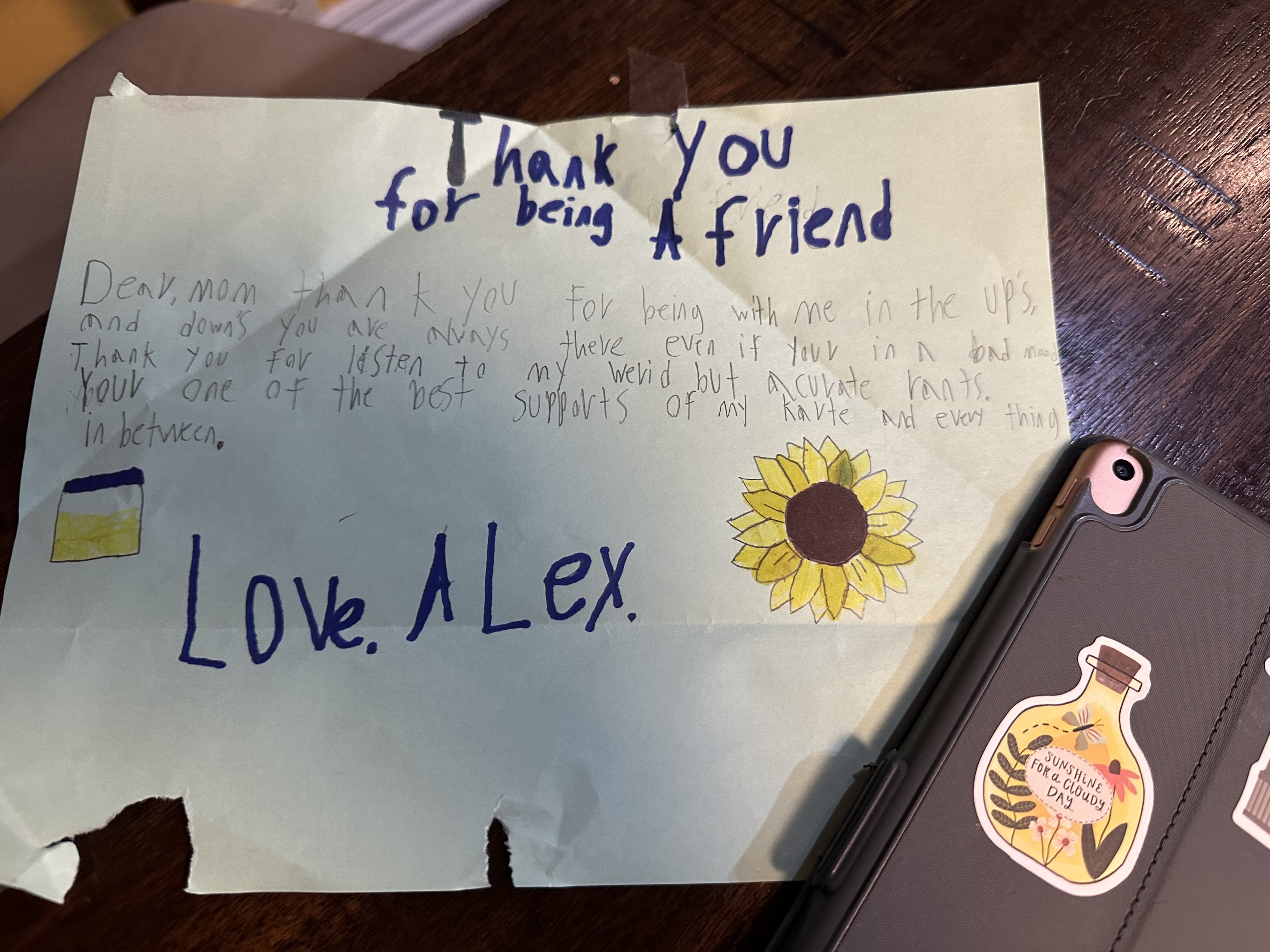
For Thanksgiving, my eleven-year-old son Alex wrote me a thank you note. His note was entitled, “Thank you for being a friend.” Then he wrote, “Dear mom, thank you for being with me in the ups and downs. You are always there even if you’re in a bad mood. Thank you for listening to my weird but accurate rants. You’re one of the best supports of my karate and everything in between. Love, Alex.”  

Obviously, I was moved by his sweet words, but I was also impressed with how fitting his note was. He said, “thank you for being a friend” because he knows how much I love “The Golden Girls” and their iconic theme song. We watch the show together most nights before he goes to sleep. I’ve indoctrinated him into the world of Dorothy, Blanche, Rose, and Sophia. On the bottom of his letter, he drew a small plastic bag that represents one of my favorite episodes when Blanche is delirious from writing her “novel” and mistakes the egg yolks in a plastic bag for “little balls of sunshine.” Alex knows this makes me laugh every time, so he highlighted the connection we’ve made over this funny scene.  

I also adored how real his note was. He didn’t sugarcoat things, especially with the line, “you are always there even if you’re in a bad mood.” Because I’m not always in a good mood, no one is, but my kid realizes that presence is important no matter what. Showing up, day after day, in the routine of life is not always easy, but it makes a huge difference to those we love and those who depend on us. Even when we don’t feel like enthusiastic participants, even when we feel like we’re going through the motions, being there says something to our families, friends, and communities.  

And Alex realizes the beauty in showing up as himself as well when he says thanks “for listening to my weird but accurate rants.” Alex talks nonstop. Non. Stop. And he loves to talk about video games. Sometimes, I have a hard time following along (actually that’s most of the time), and he knows that video games are not my thing. But he appreciates that I listen, and I appreciate that he continues to tell me about them even though I’m not the connoisseur that he is.    

To top it all off, he drew and colored a sunflower, which he knows is one of my favorite flowers. And he gave me two stickers, one that was a stack of books with a Gilmore Girls theme because he knows I love books and that Gilmore Girls is another of my favorite shows. The second one is a bottle with a cork filled with flowers, colored yellow, and says “sunshine for a cloudy day.” I don’t think he realized just how well he tied all his threads together with the little balls of sunshine, a sunflower, and sunshine in a bottle. He is my little sunshine when I need someone to cheer my days. 

Maybe we can follow Alex’s lead and not only be present for others when they need us, but also express those sentiments so they know we care. We can shine the light for others and bask in the light they bring us. 

Be Patient With Me

Standard

I stood at the Starbucks counter inside Target before I commenced my shopping. I’d noticed an employee exit the area, leaving only one woman behind the counter. She looked straight at me and said, “Be patient with me.” It wasn’t so much a request as a demand. I think I may have held up my hands like I was under arrest. “Of course,” I said as pleasantly as I could. She was obviously new and in training. I could see a list of notes beside the register to help her remember things. She was about my age, and I could see the fear in her eyes. I felt for her. I know I would be anxiety ridden too if I had to learn the myriad number of drink combinations for which Starbucks’ customers are famous. But I admired the way she’d expressed her need for patience. She didn’t equivocate. She essentially claimed patience for herself. 

And couldn’t we all use more patience at this time of year as we head into the holidays? More patience from others and with others. Instead of relishing time and relaxing during Thanksgiving and Christmas, we tend to ramp up the stress and busyness. We have events that crowd our schedules: our children have holiday programs and concerts; we may be invited to holiday parties or events; we may host an event of our own; we may travel or need to prepare for family to visit. 

In our house, we have two high school basketball players, Jed and Clay, who have tournaments over both holiday breaks. And because one is a senior and one is a freshman, they are going to be at separate tournaments in different places. For someone like me who wants to know the schedule and anticipate all the logistics, tournament brackets present issues in the first place because winning or losing determines the next game time. The last Friday of school before Thanksgiving break, Jed has a game at 7:45 in one location, Clay has a game at 8:00 in another, and we also must retrieve Riley from the airport at midnight. Divide and conquer will be the name of the game on Friday, Monday, and Tuesday leading up to Thanksgiving. The upside is we don’t have to decide where to spend the holidays because basketball means we must stay at home.   

I haven’t shopped for the Thanksgiving meal. Not one child has given me a Christmas list. We haven’t decorated for Christmas yet, and while I love the finished product, the process of getting everything out and putting the empty boxes back up can be exhausting. I need to make a couple of doctor appointments to get the most out of insurance benefits but who knows if that will happen. All while trying to make sure nothing falls through the cracks, like ensuring Alex has nice clothes for his first orchestra performance.   

If we let it, the to do list becomes so long during the holiday season, it can strangle us. So, this is my reminder to all of us. Be Patient! Be patient with the people we only encounter briefly who are trying to do their jobs like the lady at Starbucks. Be patient with other drivers because I’m convinced the holiday stress pours over onto the roads (I need this reminder a lot). Be patient with our family members even when they are getting on our last nerves. Be patient with ourselves because none of it will be perfect compared to unreasonable expectations that we may put on ourselves and others. Let’s attempt to enjoy this time of year, which can be beautiful if we can be patient and simply be.  

Say Something That Connects Us

Standard

Alex and I were at Walgreens to get his covid and flu shots. Because Alex is 11, he had to get the pediatric covid shot but the Walgreens we usually use didn’t offer the shots for children. So, we ended up at the pharmacy across town where we aren’t acquainted with the staff. The woman helping us seemed frustrated. She had to get the pharmacist’s help to find the pediatric doses. She was stone faced and seemed unhappy. I tried to be pleasant and patient. I looked at her while she worked and realized that I had a similar, if not the exact same, type of sweater. I decided to take a chance to talk to her even though I wasn’t sure it would help. I said, “I think I have the same sweater. It’s very cozy.” Her face changed instantly. She smiled and her eyes lit up. I was so surprised at the level of her reaction and change in her demeanor. I couldn’t help but smile back at her. I was glad I’d told her. We both benefitted. 

Finding a small moment of connection can make quite a difference. I wear press-on nails, which range from conservative French manicures to wild designs including jewels and holiday designs. So, I notice other people’s nails as well. When I think their nails look cool, I tell them, “I like your nails,” and they will always smile and say thank you. They usually respond with “I like your nails too.” And I can tell you that when someone notices my nails first, it makes me happy. At our Halloween trunk-or-treat at church, I told a little girl that I liked her nails knowing that her mother is a nail aficionado. She held her hand out so I could see them better, and said, “my mom did them.” She was proud I’d noticed something she obviously loved and an experience she’d shared with her mom. 

I’ve watched my sons connect with strangers over their brand and style of basketball shoes. There is instant admiration that blooms between them. I can’t tell you how many times I’ve heard someone ask the boys, “Are those Luka’s?” That’s the brand of shoe named after our hometown Dallas Maverick.  I think each of us has something that’s a representation of our personality. Be it our hair or clothes or shoes or jewelry or makeup. Maybe it’s a sports team we wear on our sleeves or a love for coffee or we carry a certain type of water bottle. We can use those little things to connect to others even if for a brief time.  

Maybe it’s not always possible to find something that connects us with another person in a quick interaction, but it’s worth the effort. And if we can’t find a personal tie to the other person, it’s fine to revert to the weather or some other generic topic as long as we try to connect in a way that goes deeper than a strictly transactional interaction. We can create moments of connection and strengthen our humanity when we look for the little things we may have in common.    

Giving and Gaining

Standard

In September, two of our dear friends from church, Chuck and Jeanie, made a road trip to Montana with a stop in Boulder, Colorado. Our daughter Riley goes to college in Boulder, and they visited her and generously took her out to dinner. To have friends lay eyes on her and hug her neck made my mama heart happy. They’ve known Riley since she was almost 3 years old, and she will be 20 in January. During all that time, they’ve poured love and attention and concern into her. They didn’t have to spend the last seventeen years caring for her and our boys, but they chose to take the time and invest in these children. And our family is the richer for their involvement in our lives. 

I witnessed a similar scene on Halloween night. Our friends invited us to their block party a couple of streets over. I noticed a young man skateboard up to the festivities, and immediately, the men of the group started talking to him about his high school football team and how they’d watched him play recently. They asked about the upcoming game and the playoff situation. Almost two hours later, I looked over and the guys were still talking to the young man who was still engaged and appeared to be having fun. The men were his father’s and grandfather’s ages and even though none of them were related to him, there they were pouring time into him. And I expect the men benefited from talking with him as well. 

I love watching intergenerational friendships grow and flourish. Especially when the people are not members of the same family, there is freedom for the adult to advise without the pressure and responsibility of raising the child. And the young person can listen without feeling they’re being told what to do by their guardians. The adults bring wisdom from their years of living. The young people bring an energy and excitement to these interactions that serve to uplift and enliven the adults. The relationships may never officially be labeled as mentor and mentee, but they provide the same type of teaching and learning in a less formal setting. They’re mutually beneficial and worthy of our time and attention. 

Sometimes, in middle age, we’re so busy taking care of our own children or aging parents that we don’t think we have time for these types of friendships. But I’ve gained so much from these types of relationships over the years. During the summer of 2020, I became the “pool mom” to the high school and college aged servers and lifeguards because it was the only place we could go for outdoor entertainment that season. Everyone was starved for human connection after we’d been cooped up in our homes for months with the Covid shutdown. So, I decided, unconsciously at first and then intentionally, that I would be another adult in their lives that cared since they’d been deprived of teachers during the shutdown. I hope that I made a positive impact on them, but I know those young people brought a lightheartedness to me and my family throughout that summer.       

Perhaps we can all look for intergenerational relationships and be open to the ways we can both contribute to and benefit from them. We can learn from those ahead of us on this life journey and offer bits of advice for those coming behind us. And most importantly, find friendships that fill everyone with love.     

What’s Right For You

Standard

Right before I boarded my return flight home from visiting my daughter Riley in Boulder, Colorado, I realized that I was going to be in the middle seat on the plane. My husband Ben knows I prefer an aisle seat, and he almost always books the aisle for me. Considering we booked this trip only a few weeks before, I figured the middle seat was the only one available and accepted the fact that I would probably feel uncomfortable during the flight. But when I sat down the woman in the window seat smiled and said hello. She wore an airline uniform and said she’d worked the flight that had just arrived and was heading home as well for several days off. I asked her what job she worked on the plane because I didn’t want to make any assumptions – for all I knew she could’ve been a pilot. She told me she was a flight attendant and then asked me about my job. I gave a self-effacing chuckle and said, “I’m a stay-at-home mom.” Then she said, “I love that for you.” She followed up saying she was working toward that goal someday. I could tell she wasn’t being sarcastic or demeaning. She was completely sincere when she said, “I love that for you.” 

So often we criticize others when they tell us about their decisions that differ from ours. Not to their faces of course, but in our heads. We don’t merely think “that’s not what I would do.” Instead, we belittle them or think poorly of them for their actions. But the reasons for our negativity are not necessarily rooted in the other person truly making bad choices that could cause poor consequences. I contend that often we tear others down because we want to feel better about our own lives. We want to feel like we’re right, that our path is correct. We may default to defensiveness to justify what we do. We may react out of fear worried we aren’t doing what’s “best” compared to others. To rationalize and support our own actions, we deride others.    

I wonder what would happen if we all took the stance taken by that airline attendant when someone tells us about their choices: “I love that for you.” Assuming that the choices are not dangerous (obviously), I don’t have to agree with you. I don’t need to compare myself to you. I don’t need to overanalyze and rethink my life just because we have taken different journeys. I can choose to celebrate you and what you’re doing with your life. I can praise you for making choices that are right for you. I can encourage you to follow your bliss even if I would never do the same thing. I can support you without judgment. This is not a southern “bless your heart” moment when someone is being facetious and clearly couching their criticism in niceties. “I love that for you” is a genuine way to cheer others on toward their best selves. 

As I tell my kids, we might not be able to control our first thought, but we can control our reactions. So, instead of ripping another to shreds in our heads because they made different choices, let us authentically and with joy tell them, “I love that for you!”

The Need for Hope and Love

Standard

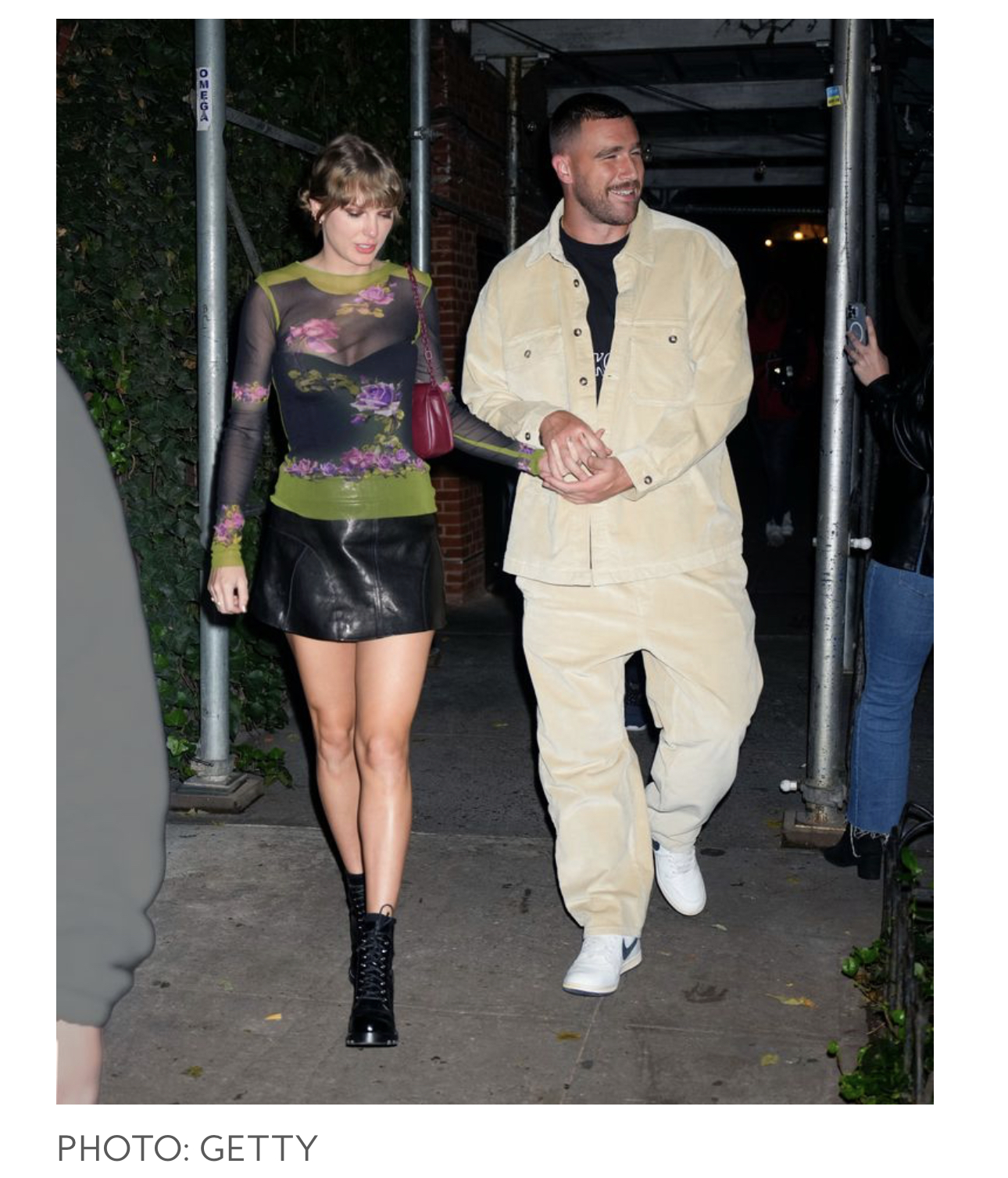
I’ve always been a pop culture junkie. I like to follow along with celebrity culture. So, of course, I’m a little obsessed with the budding romance between Taylor Swift and Travis Kelce. I’m a Taylor Swift fan, but I don’t know every song by heart like the most ardent Swifties. And while I know football, I admit I didn’t know about Travis Kelce and his brother Jason until this past season’s Super Bowl in which their respective teams, the Kansas City Chiefs and the Philadelphia Eagles, faced off. I became enamored with their mother Donna as did most NFL fans during the lead up to the big game. Truthfully, the spotlight on Taylor and Travis has increased my level of attention in the last few weeks. I’ve now listened to Travis’ and Jason’s “New Heights” podcast, and we watched the Amazon documentary about Jason and his family. I’ve read articles trying to pinpoint exactly why we are so locked in on their burgeoning relationship. My husband Ben and I have talked about it too. I’ve gone down the rabbit hole, and I couldn’t be more pleased. But why do we care so much? 

For me, as a mom of three boys and a daughter, my appreciation is partly rooted in the brothers’ relationship. I love the way Travis and Jason interact on their podcast. They have a tight relationship, which also includes Jason’s wife and daughters. The boys continually make fun of one another and laugh uproariously at their childhood stories and current events as well. They’re irreverent and potty mouthed at times. In short, they’re hilarious. They give me hope that the endless, and at times, merciless teasing that goes on at my house may translate into adult friendships that are not merely obligatory but healthy, fun, and close knit. 

As for the Taylor and Travis romance, those of us who admire Taylor want her to find a man who appreciates and respects her. And from what we’ve seen so far, Travis is protective and, being highly successful in his own right, not threatened by her stardom. We want them to work together as a couple. I think this demonstrates that despite all that’s wrong with our society, we love the idea of people falling in love. We want to bear witness to the first blush of romance. Love still matters, and we all crave it for ourselves and our beloved celebrities. 

I return once more to the concept of hope. While we watch much of the world burn and the threats of mayhem increase, we need something, anything, that gives us hope. Perhaps our focus on Taylor and Travis serves as a distraction, but I’m actually fine with that. I’m not suggesting we turn a blind eye to the horrors of the world right now, not by any means. But I think we also need glimmers of hope and love so that we don’t drown in the despair that could so easily overwhelm us. Maybe after we have our celebrity-based diversion, we can reconnect with the reality of the world with a better perspective based on love and hope. Are you ready for it? I am.    

No Mind Reading Necessary

Standard

Our Goldendoodle Cypress is six years old and displays a lot of human-like traits. Cy has a spot-on internal clock. He might as well be wearing a watch. At 11:00, he lets you know it’s time for his lunch bone, at 5:00 it’s dinner, and 9:00 it’s his bedtime snack. When he informs you of food/treat time, he will hit you with his paw – firmly and without equivocation. He will not relent until you get up to feed him. This is about as aggressive as he ever gets, but you know without a doubt when you’re approaching feeding time. 

Most of time, though, Cy comes to you and gently lays a paw on your arm or leg and looks up at you with his puppy dog eyes. That’s when you know that he needs you to simply spend time petting him. I think he could be content for hours if someone will just pet him. Cy spent the first few months of his life at our kids’ favorite place, Camp Olympia, as part of the Puppies in Training program, which teaches young campers how to take care of dogs. As such, Cy was constantly petted and pampered as a puppy before we adopted him. We joke that Cy’s love language is most definitely physical touch. When he demands attention in these circumstances, he is simply ensuring his love tank is refilled. 

Cy might be on to something. He is attuned to his body and his needs. When Cy needs help or attention, he asks for it. Obviously, he’s a dog so he doesn’t overthink whether he should find his humans and make his needs known, he just does it. What if we acted similarly? When we need something, what if we simply asked for it? Over the years, I’ve heard a lot of women talk about how their partners, husbands, friends, don’t get them or help them. It can be as minor as the other person walking by unfolded laundry for days on end without bothering to take a turn folding. Or it can be more serious when they don’t notice that we’re not ourselves and are struggling.

But oftentimes, we don’t express what we need in our relationships. We expect others to read our minds. If they can’t or don’t, we might feel resentment and discontent. I’ve spent many hours in group settings reminding women that we cannot get our needs met unless we tell people what we need. I’ve explained this to my young adult daughter as she navigates new types of relationships. And I’ve had friends remind me of the same thing when I fall into the same trap of believing someone should intuitively know what I need even though I’ve gone quiet. When we build a wall by refusing to ask for help, we guarantee our desires will not be met. Open communication is the key to ensuring we all come closer to getting what we want or need. 

We can learn lessons in many ways. My dog reminded me that it’s okay to ask for the love and attention we need, when we need it. The people in our lives will feel grateful that we’ve lessened the guess work and given them the framework to help us. In that way, everyone wins.