Back to Life

Standard

My son Alex was telling me about his day in sixth grade after I picked him up from school when he explained he’d become tired during the afternoon. He said he hit a low point but then realized he hadn’t been drinking enough water. He said he drank some water and it “brought him back to life.” That reminded me of one day when we were at Disney World this summer and it was extremely hot. We were in a long line outside when Alex said he was thirsty. I didn’t have any water to give him at that time, so I offered him a piece of gum thinking that might help. “That won’t give me salvation,” he huffed. I think he meant saliva, but I appreciated the way he mistakenly phrased his frustration. He needed replenishment in both circumstances. Thankfully, he recognized his need and sought it out.  

On the other hand, my daughter Riley doesn’t always see what’s coming until it’s almost too late. She is very susceptible to becoming “hangry.” This phenomenon happens when a person needs food desperately but has waited too long to eat and is now angry with everyone and about everything. It’s almost become a joke in our family. I say almost because the results of her hanger can still be unsettling. She’s called from college upset or mad about something, and later texted that it turned out she hadn’t eaten in a while so that could’ve been partly responsible for her mood. I told my husband Ben that maybe I should first ask if she’s had anything to eat when she calls in a tiff. We’ve told her not to make big decisions or tell anyone off until she determines whether she’s hungry. The girl needs to carry a granola bar with her constantly just in case. 

We don’t always realize when we need restoration. Even though there are times when we probably should recognize we are nearing empty physically, mentally, or emotionally because we are going through a stressful or hectic season. Instead, we usually barrel ahead ignoring the signs or the nagging sense that we are not, in fact, okay. And while water, food, and a good nap can solve many problems, we need to determine what else we need when we are struggling.

When I find myself depleted, I examine what I could do help myself, and I usually find that I’ve failed to do the very things that could provide nourishment for my soul. I need make sure I’ve taken my medication. I need to write to process my feelings and ground myself in my truth. I need to visit with my friends and talk to my therapist. I also need some alone time to reset but not so much that I isolate completely. I need to go to church. I need to look at my schedule so that I am neither overwhelmed nor underwhelmed with activities. I need to watch a good rom-com to lift my spirits because I know it will have a happy ending. I need to read a good book. 

I’m not saying that these actions work all the time. Sometimes, life can’t be put back together with a simple list like mine, but I know to try them first. To fall back on what’s worked in the past to try and heal the present. If we could all spend some time thinking about the strategies that work best for us, we can better default to them instead of feeling completely lost when we seem to be losing our way. Maybe then we can bounce back to life just a little easier.    
Singling Out the Problem

Standard

Necessity is the mother of invention. She’s also the mother of “I guess now you’ll deal with that situation you’ve been avoiding.” For me, this week, it’s the one-car side garage that we use as a storage unit/extension of my laundry room. I’ve avoided cleaning this area for forever. But someone ran into the garage door with a car (not me), and it’s not the first time it’s been run into (again not me), so now it’s finished. We must replace it. When the garage door repairman came, we went inside the garage, and I was embarrassed. He said everyone is always worried about the state of their garage. He was nice and said that it wasn’t that bad compared to some he’d seen. But he said that some things would need to be moved so they could do the install. And so, necessity required that I move things. Unfortunately, the time frame did not allow me to truly organize everything. So, my dining room is now a disaster, but they can replace the garage door. 

During the semi-cleaning process, I had to tamp down the urge to criticize myself for my procrastination and tendency toward clutter. One of the reasons I haven’t previously managed to solve this situation is because it can feel overwhelming. I also connect memories to a lot of the clothes the kids have worn in the past, making it harder for me to toss or donate things. It takes a lot of emotional energy to go through this process, not just physical energy. 

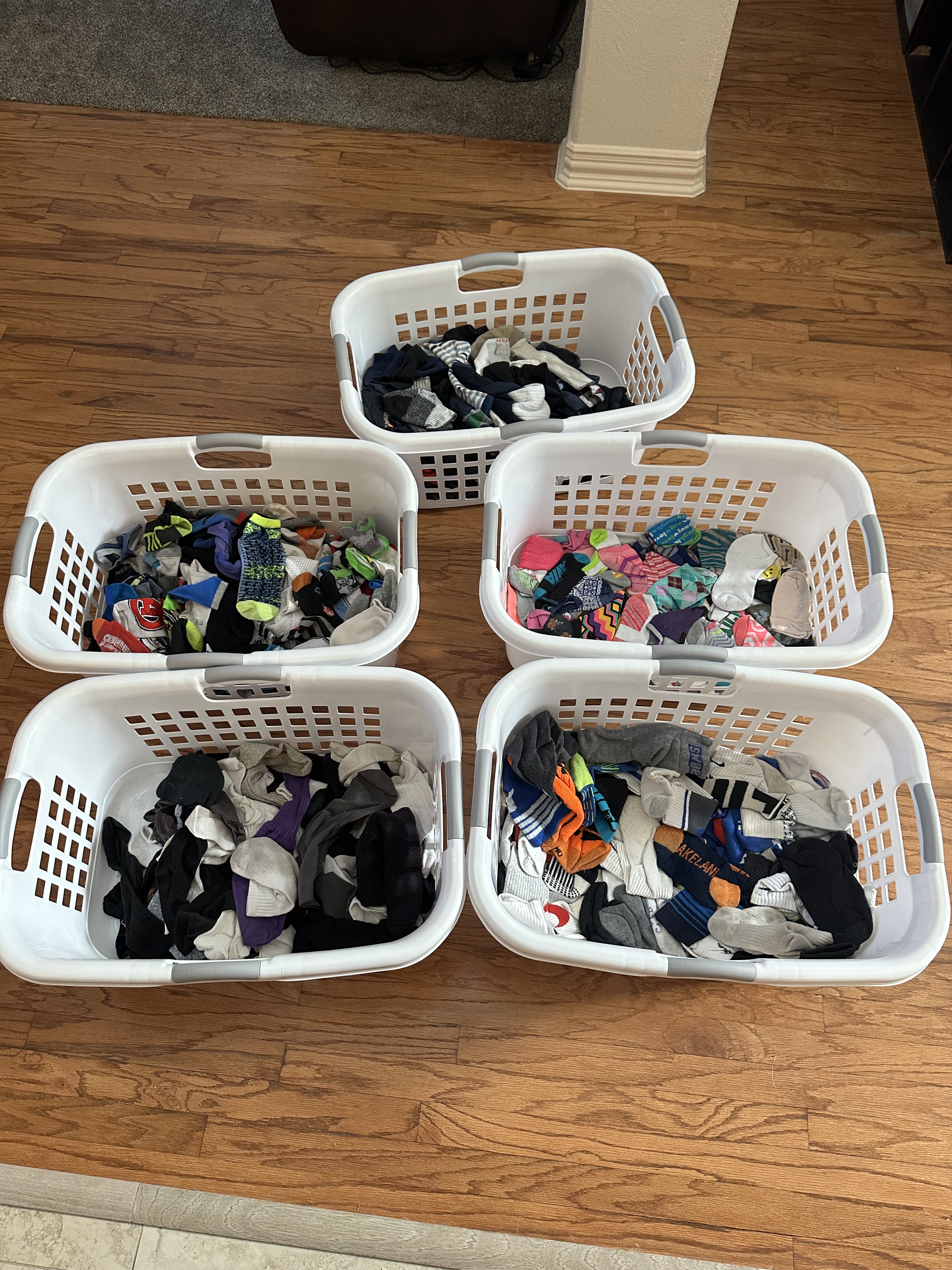
My commitment to this project started to wane, but then I found the laundry baskets that I hadn’t laid eyes on in a long time. There were FIVE of them, and they all contained socks. Individual socks. Single, “lost their partner” socks. I remember creating said baskets thinking I was being super organized and that I would return to the baskets repeatedly to find each person’s missing socks and magically unite all socks in our household together one day. Instead, the baskets were set aside, discarded, covered up, and I never once went back to them to search for errant socks. My good intentions never came to fruition.  

And so, this time, I threw all the socks away. I know I’m not the first to purge the sock basket(s), and more efficiently organized people would’ve thrown them away years ago instead of putting them in baskets. I’ve heard people talk about the freedom they feel when they get rid of the basket of single socks. And I felt some of that, but I ended up accepting the fact that it was just a first step, not a monumental triumph. Taking the first step is often the hardest part of any process. For me, beginning is often difficult because I want to know all the details of the process. I want to know how and when it will end. Unfortunately, that certainty I crave rarely occurs. Living with uncertainty is not easy for me, never has been, probably never will be. But avoiding the first steps because I’m afraid to tackle an unknown process is not a good way to live either. 

So, the next time I find myself stuck and unwilling to take the first steps necessary to start a project or process, I’ll try to remember the socks and the use the metaphor as an opportunity to kick off the next phase even though I don’t know the entire road I’ll walk, or maybe someday, even run. 

Support You Later

Standard

I’d just come home from a quick trip to Arkansas and immediately left for our church’s women’s retreat. This was our first one since before the Covid shutdowns, so I was excited for the retreat but also physically and emotionally exhausted from my trip. We were engaged in icebreakers, which I admit are not my favorite activities, when I made a mistake in front of the whole group. We were playing “Never Have I Ever” and instead of saying something I’d never done, I said something I had done. I was embarrassed because I hate doing anything wrong. So, I complained about my poor performance to my friend Karen. “I messed up,” I said. She gave me a side-eye and said, “I’ll support you later.” 

Immediately, I started laughing out loud. Karen had broken my train of thought that threatened to derail my good time. Karen short circuited my tendency toward self-loathing by pointing out that this mistake was not in any way important. A minor snafu in the grand scheme of things. Both Karen and I had been going through some heavy life events lately. She hilariously reminded me not to worry about something that wouldn’t matter later in the day. That is, unless I continued to dwell on it and launch myself into a shame spiral. Sometimes, we need someone to remind us of what really matters. To put things into perspective. 

We also need to remember that we may become upset about smaller things when there are larger, more serious issues looming. My children are good at calling me out on that. If I overreact to something they say or do, they will say, “you’re mad about something else, don’t get mad at me.” I hate it when they say it, but they’re usually correct in those circumstances. My therapist told me that when we are dealing with big emotional issues, but are also busy with the stress, logistics, and details of a situation, we may release our emotions in other ways, like when we cry at a sappy commercial or become sad over something minor and seemingly inconsequential. Or obsess over a stupid mistake to avoid dealing with the bigger, harder, more complicated issues. 

And there are other times when we stay in constant motion, so we don’t have to deal with the tough situations. Because if we slow down, we’re afraid we might collapse under the weight of the burden. But if we keep pushing ourselves and don’t allow ourselves to rest or decompress, we could end up ill or depressed. Our bodies may make us stop unless we give it the proper attention and take care of ourselves. 

When we find ourselves upset or stewing, let’s first ask if the issue is of paramount importance, and if not, look to gain a better perspective or find the real problem underneath the surface. We might discover that we need to focus on the larger picture instead of lesser matters or that we are fixating on something insignificant. And if it takes a friend like Karen to remind us to get our act together, let’s laugh and say thanks.    

Rest When We’re Done

Standard

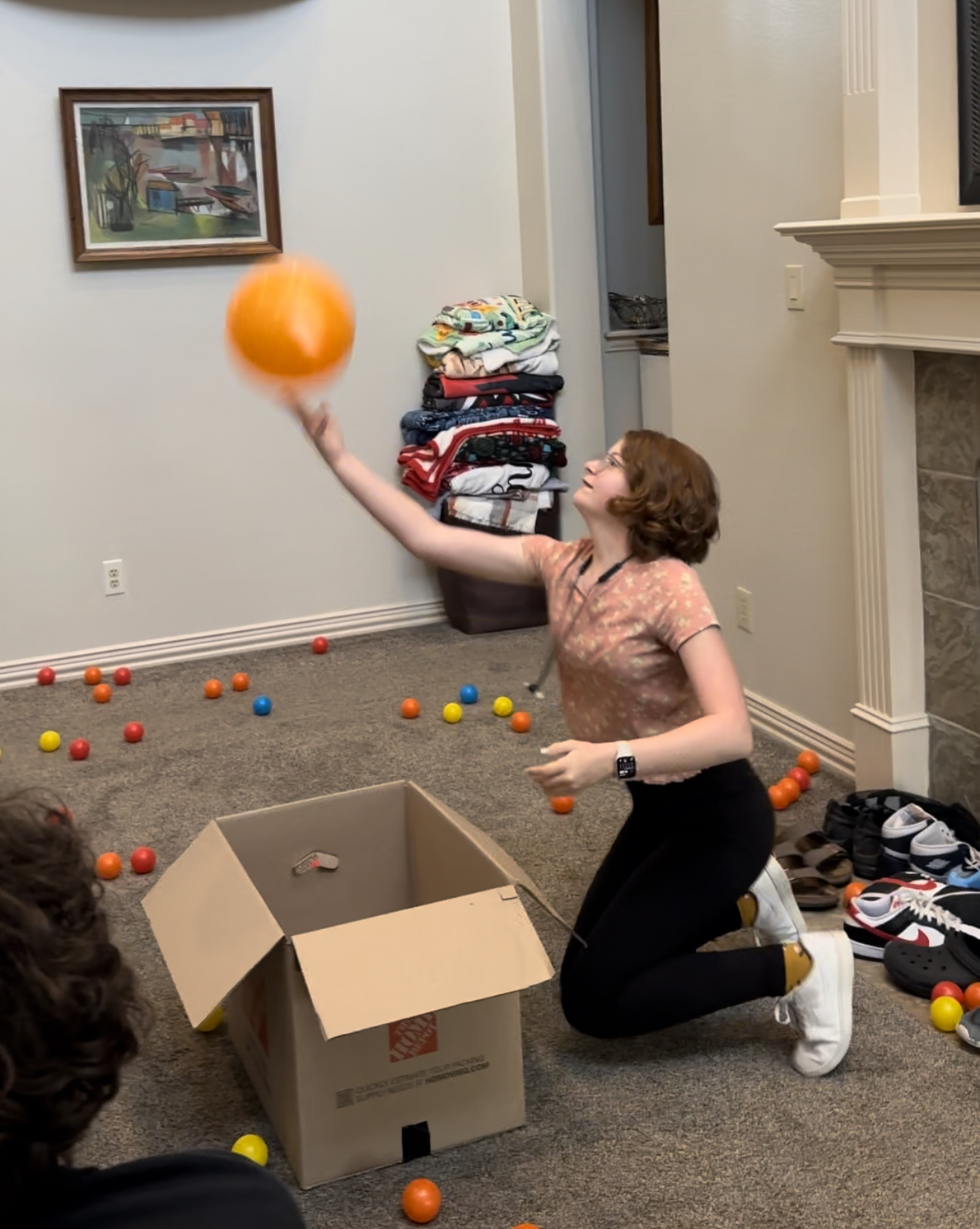
“Tina is done,” Claire said. She’s almost fifteen, and I’ve known her since the day she was born. As such, she knows me well too. We were at the end of a rather rowdy youth group meeting. The kids aren’t usually that chaotic. It was probably my fault because I’d introduced a game that involved a balloon and a ton of ball pit balls, so that even when I passed out some model magic to keep their hands busy during our discussion time, it didn’t calm them. So, Claire hit the nail on the head when she made her pronouncement.   

I’d had a lot on my plate emotionally because of my dad’s illness and some other outstanding issues. So, after youth group, I crawled in bed and watched a movie on my iPad, and all the guys in my house left me alone. My boys are used to me saying, “I’m done with this day,” as a warning that it’s time to settle down and go to bed when it’s getting late. But on this day, even though they hadn’t necessarily heard Claire and I hadn’t issued my day is done notice, they too knew that I’d had enough. I needed to rest.

Several of my friends and I have been talking/texting about how tired we are physically, mentally, emotionally. We are exhausted for a variety of reasons. And while finding time to rest is difficult, perhaps the greater obstacle is giving ourselves permission to retreat when we become overwhelmed. Instead, we soldier on, unwilling to stop because we think we will be considered lazy or unproductive. Stress is a marker of success in our culture, so we keep adding to our schedules. Succumbing to tiredness is seen as failure.

Unless we stop giving in to the false narrative that resting is a sign of weakness. What if we adopt the idea that rest is a key to being healthy and becoming strong? It makes sense intellectually. We know it is true. But what if we started living it? 

We are tired. I am tired. So, I’m going to cut this blog short and take my own advice. I’m going to rest, and I hope you do too.    

Notice the Connection

Standard

My son Alex and I were in Walgreens after school when the manager asked how we were doing. I responded with some sort of generic answer about getting back into the school routine while Alex perused the toys and games. Alex and I frequent the store a lot, so we are familiar with many of the people who work there. And they are familiar with us. So, I probably shouldn’t have been surprised when the manager looked me in the eyes and asked, “everything else is okay then?” In that moment, I knew she knew – I was not completely okay. I don’t have a good poker face, but I didn’t expect someone with whom I have a casual relationship to realize that I was off kilter. I decided not to burden her with all I had going on, so instead I told her I was tired. We discussed how she was tired as well in an unstated agreement that we would not dive deeper into the cause of my concerns but that we’d had a moment of connection, nonetheless. 

To be seen and understood. Isn’t that what we all want? Even when we choose not to respond with the details of our problems, we can feel comfort because we know someone else has noticed that we are not ourselves. Just the fact that someone else asks is enough in many circumstances. We still feel the warmth of another’s concern and care because they took a moment to ask or text or call. Of course, at other times, when someone shows us that they care and want to stand with us in our trouble, we can accept that opportunity and share our problems. It’s okay to confide or vent to someone whom we trust when they’ve shown they are willing to listen. Getting things off our chest and out of our minds can make us feel so much better. We can experience such relief when we unburden ourselves. 

At other times, we may be the observant one. When we sense that all is not well with someone, we should feel emboldened to ask how they are doing. Sometimes, we hesitate. We fear making the other person upset but acknowledging that they are unsettled may provide the love they need in that moment whether they provide a detailed answer or not. And when we listen to another share their story, we need to ask if they want us to just listen or offer suggestions. I often jump straight to giving advice, but recently, my daughter said she simply needed me to let her talk without telling her what to do. Easier said than done for this mom, but I’m learning. Giving someone the time and attention to express their feelings is often the best thing we can do. Sometimes, it’s the only thing we can do.

Presence is the gift we can give others. That presence can come in the form of paying attention to those in our lives. We can ask about their situation when we see they’re not themselves or we can follow up on an issue with which we knew they were previously struggling. Holding space if they want to talk or respecting their silence may provide the reassurance we all need. 

Happy Birthday, Mom!

Standard

Once when my brother Marty and I were young, we were arguing in the car as my mother drove us home from school. I have no idea what we were discussing with such vigor, but my mom had had it. I’m sure she’d told us to stop repeatedly. But we didn’t. Suddenly, she yelled, “I’m going to pinch your heads off and throw them at you!” At that, we burst into laughter and almost laughed our heads off. That memory is one of the funniest and one of my favorites. While that moment stands out, there are far too many to count in which my mom took care of us or spent time with us – reading, watching tv, attending sporting events. And in our adulthood, she has lovingly helped care for our children. But then again, my mom has always been a caregiver. 

When she was born, her mother, my grandmother, was nineteen years old and single. In those days, the stigma was great, and shame was inflicted. Eventually, my grandmother married a man with four children. They went on to have three children together. By that point, my mom became the one who cared for the younger children while her mother worked. I’m convinced my youngest aunt considered my mom to be her mother back when she was little. 

She also cared for them and kept them safe when her mom and stepdad were home but fighting. Back then, domestic violence was accepted and expected, and the authorities would not intervene in disputes inside the home. When my mom and dad met in high school and later married at the ages of 20 and 21, they decided that their home would be different than the ones that both of them had grown up in. To break a cycle that so easily repeats from one generation to the next took foresight and determination. Our home was peaceful and for that I am grateful. 

When they had kids, they decided that my mom would stay home. As a kid, I never thought twice about my mom being there all the time no matter what. As I grew up and became a mom myself, I realized that those days caring for children can be long and tiring. She would clean the house all day, and then I’d come home from school and destroy the scene by spreading my books and papers all over the living room floor so that I could do homework. I’m nowhere near the housekeeper she’s always been, but as I navigate athletic shoes and backpacks in the floor every night, I feel bad that I was so careless as a child. But then again, maybe that’s what happens when your home is a safe place where you can always be yourself. When your mother is a source of deep comfort. 

Later, I came to understand that my mom sacrificed a lot. She didn’t go out with friends, and my parents never went on date nights. I don’t recall ever having a babysitter. She didn’t get to pursue a career or have opportunities to express her creativity on a regular basis. Her sole focus was raising her children. All the while, she encouraged me to form female circles of friends and to study hard so I could obtain an excellent education. When circumstances required she go back to work when I was in high school, she shouldered all the home duties she always had along with navigating work life that was not always kind to her. 

When she and my dad stopped working, she didn’t get a retirement full of ease. My dad’s Parkinson’s disease has steadily caused his decline, and she has been his only caretaker. Once again, she carries the exhausting burdens of caring for another. These days, I see the costs of her sacrifice in real time and admire her selflessness and courage. Instead of resting and relaxing, she’s carrying the weight of heavy responsibilities more than ever before. 

I’m not sure I could do all she’s done. So many of her actions were meant to ensure that I never had to bear those same pressures at all, much less go it alone. My mom turned 75 this week. She has served others and loved them her whole life. I want her to know we see her and that we are grateful for her and all she’s done even though words can never fully express our appreciation. We love you, Mom! Happy Birthday!

Verve and Vivacity

Standard

Over the last few years, my seventeen-year-old son Jed has become invested in international football, aka soccer. When I say invested, I mean Jed learns all the things about the players and teams. He’s known everything about the NBA since he was about five years old, so this is not a new process for him. His favorite team is the Tottenham Spurs from England. He’s drawn our family into the team’s activity too. The other day, we were watching a match downstairs while Jed was watching upstairs. There was a slight delay so when the team scored a goal, we would hear Jed’s excited reaction a couple of seconds later. I enjoyed those few seconds of anticipation waiting to hear him yell, “GOAL.” At the end of the game, the announcer said that the Spurs had played with “verve and vivacity.” I thought that description was magnificent and asked Jed about it. He told me the announcer was Peter Drury, and with reverence said, “he’s a poet.” 

Verve is defined as great energy and enthusiasm, and vivacity is defined as the quality of being vivacious, which means attractively energetic and enthusiastic. (dictionary.cambridge.org). I knew that soccer fans around the world were rabid for their teams and that they cheered and chanted for the course of entire games. But I’d recently witnessed a bit of the verve and vivacity of the international football community up close. We were at Disney World where people from all over the world come for entertainment. Jed wore soccer jerseys on several days. I witnessed Jed and fellow fans nod in acknowledgement as they passed by one another. They would say, “I like your jersey” on other occasions. While we waited for the Tower of Terror ride, Jed had an in-depth conversation with a Londoner about the teams in the league. I hadn’t expected to see the camaraderie between fans when they were not at games but based merely on the jerseys they wore. They were connected even though they didn’t know each another. I especially hadn’t anticipated the sheer number of soccer fans that Jed would encounter.

Energy and enthusiasm. What if we tried to create communities based on those tenants? Or inject those qualities into organizations to which we already belong? Sometimes members of our groups become overburdened or overwhelmed. The issues seem too large or complicated and frustration sets in. Some may feel burned out and ready to give up. That’s when others must step up and bring energy and enthusiasm to support those who are struggling. To give the encouraging nod. To say, “I see you and believe in you.” To remind them we are connected and when one of us is down, the other will step up to fill in the gaps. To cheer up the team when they feel like there is no chance of winning. 

When one of those in our community is having a hard time, we can step into help them. Embracing energy and enthusiasm can strengthen our connections, so that we can build up the members of our communities when they are in need. And know that they will do the same for us when we need a boost of verve and vivacity.

To Pick Up the Pace or Not?

Standard

My son Alex and I entered Walgreens just as a mom and her daughter exited. The girl was about four or five years old, with long brown hair, and she trailed behind her mom several steps. “Pick up the pace,” her mom called. At that moment, I passed by the girl and smiled down at her. She looked up at me, and grinned, twinkle in her eyes. The mischievous look on her face told me that she had no plans to speed up at all. 

I sympathized with the mom because I have a child who moves slowly as well. We must harass him to get in the car to go places. We have to persuade him to get out of the car in a timely manner when we arrive back home, even when it’s hot outside. I’m not sure my son drags his feet on purpose most of the time. He is naturally more laid back than the rest of us. That’s just how he is. But that girl – she gave off the vibe that she knew exactly what she was doing. It was her choice. I’m sure that can be aggravating for her parents at times, but I admired her boldness. In that split second, I thought, “You be you, little sister.” 

The world will try to change her. To make her pick up the pace in every single way. Participate in more activities, then specialize in one so that you can be the best. Make straight A’s, so you can get into a great college and find a fantastic job. Work harder. Be better. Faster and faster so you can do it all. And when you’re an adult, you’ll feel overwhelmed, stressed and like you’re spinning out of control a lot of the time. 

I worry I haven’t done enough to protect my own children from the rat race because I also want them to do well. Trying to strike a balance between achievement and having a life that feels authentic and true is not always easy. I worry especially about the mixed messages my daughter may have received just by soaking in the culture. In the Barbie movie, America Ferrara gives an impassioned speech about the nearly impossible difficulties of being a modern woman, and both times I saw the movie, women cheered out loud in response. They felt heard and seen maybe for the first time. 

I’m not sure what we can do to make life easier for the younger generations. Except to tell them they are worthy and important no matter what they do. That performance is not the source of our pride. To encourage them to embrace effort and be responsible, so that they can build confidence and be proud of themselves. Urging them to love themselves as much as we love them. And maybe to help them understand that picking up the pace is not always the answer. Sometimes rest and self-care are what they need. To balance work and play better than we’ve done as a society until now. 

And when someone tells them to pick up the pace when they get older, they get to decide whether that is the correct choice for them in that moment just like that spirited little girl.  

New Views of Old Things

Standard

Due to unforeseen circumstances, we had to switch the location of our church youth group’s Back to School Bash from the church property to our house. Because we intended to include games of water balloons and shaving cream, which of course ultimately turned into a free for all, we had to clean up the backyard before the chaos began. I swept the back patio and picked up the errant odds and ends scattered around the area. I thought that perhaps the students might end up in our playset’s fort as part of the games, so I climbed the ladder with my broom and swept out the leaves and debris from the fort. 

None of us had been up in the fort in a long time. We’ve had the playset with slide and swings for at least fifteen years, but now that the kids are older, the playset doesn’t get much use. When I got up on the ladder, I realized the playset is not in the best shape anymore. The wood is extremely dry. I’m not sure any amount of stain could revive the poor wood. The wooden beams that hold the monkey bars are warped. The bolts in several places looked like they were on their way to rusting. I couldn’t see all the wear and tear from the ground level. The view from the top was not good.

Even though my kids haven’t used it as much as they did when they were little, the playset has been sacred to me. We’ve never discussed taking it down because in my mind, it is a tribute to the kids’ childhoods. And somewhere in the back of my head, I thought maybe their children would use the playset in the future. But I don’t know that the playset will make it until we have grandbabies big enough to use it since we are still years away from that reality. For the first time, I reconsidered my stance on the playset. Should we take it down?

I admit that my heart ached a little at the prospect. I worried that the actual removal would make me sad, so I haven’t discussed it with Ben or the kids yet. But seeing the playset from a different perspective made me rethink my strong conviction that the playset should never be removed. 

Sometimes we face a new way of viewing things or find new information that makes us question things we thought were not up for debate. When we encounter a different perspective, we have a choice: reconsider our stance or dig in our heels. If we take time to analyze the new data, we may end up right where we started, upheld in our beliefs. If we aren’t open to reevaluating our opinions, however, we may miss an opportunity to grow and change. Our beliefs may be shallow if they remain unexamined. Especially if we refuse to hear others’ stories and experiences, we will not mature in our understanding of our communities or the world.      

I’m not sure if the playset will stay or go because to me, it is still symbolic of my kids’ childhoods. Now, it also serves as a reminder to me that we need to reevaluate our convictions when presented with new information. We may be surprised at how much we still need to learn. 

Put It Behind You

Standard

We were late. Late for a very important date. We had reservations at Disney’s Magic Kingdom for breakfast at the Crystal Palace where we would meet Winnie the Pooh and friends, Eeyore, Piglet, and Tigger. It’s one of my favorite family traditions. Perhaps it’s more important to me at this point than for my kids.  My nursery as a baby was Winnie the Pooh themed. The cartoons about the Pooh eating so much he got stuck in his doorway, the blustery day, and Pooh pretending to be a rain cloud with a blue balloon in order to get honey from a beehive played on the Wonderful World of Disney on Sunday nights, so I’ve always loved Pooh Bear. I read the original A.A. Milne version of the stories to my daughter Riley when she was a baby, and we would rock at naptime reading those stories.  

On this morning, the bus literally pulled away while we were headed to the bus stop, so we had to wait quite a while to catch another one. By the time we got to the Magic Kingdom, through the admission lines, and walked to the restaurant, we were at least twenty minutes late. Miraculously, I hadn’t yelled at anyone in our family up to that point because we were all at fault, but I felt anxious. Mostly I worried that we might not be seated and end up being charged the high cost anyway. 

Yet when we arrived at the restaurant, we met the sweetest woman named Sammy at the check-in desk. She could’ve come right out of central casting for a fairy godmother for a Disney movie. She had white hair and glasses and wore the yellow apron and white hat as her uniform. We apologized for our tardiness and explained that we’d had a hard time catching a bus. She checked us in and told us not to worry. Then she said, “Put it behind you now. You’re going to have a fantastic day.” She could see the panic in my eyes and chose to ease my concerns. As we walked away to wait for our table to be ready, she called out in a sing-song voice, “Remember, it’s all behind you now.”  

She could’ve given us a hard time for being late. I would’ve accepted it as what we deserved for our mistake. Instead, she offered an abundance of grace. She could feel my stress but decided to ease my worry. Her advice changed my outlook and my day. I also used the same tip later when one of my kids was upset about something that had occurred. I said, “Remember what the lady told me? We’re going to put this behind us now.” 

Simple advice in some ways but Sammy gave it at the right time about a minor problem – one that could’ve hampered my entire day. So, I’m going to try and remember the mantra that Sammy, the pseudo fairy godmother, said when I feel myself pulled into worrying about a small issue that’s in the past and remember to put it behind me.