Enjoying the Ride

Standard

Last summer, I felt nervous about my daughter Riley leaving for college after her high school graduation. The anticipatory anxiety was overwhelming at times. A year later, she’s completed her first year with flying colors, and the guys and I had a great year at home. Even though I was consumed with worry before she left, everything worked out just fine. I am proud of how all of us adjusted and thrived. Then, the other day at church, while I was holding my son Jed’s hand in a prayer circle for the 2023 seniors, tears started to prick my eyes. Jed is going to be a senior in the coming year. Because we’d made it through Riley’s senior year and freshman year of college, I lulled myself into thinking it would be a breeze next time. And while it may be easier because I have survived one child leaving the nest, I now realize that I will still ride an emotional roller coaster with Jed as a senior. 

Life is like that sometimes. We think we’ve got it all figured out because we’ve been through something similar previously. But then what worked with one child completely backfires with a different child. We think we’ve anticipated all the things that can go wrong and have prepared for all contingencies but are thrown for a loop of epic proportions. We believe we’ve worked through an emotional situation, only to have a song or memory fell us with a flood of tears. 

When I was helping Riley move out of her dorm recently, her best college friend Julia and I were talking when she said her high school volleyball coach used to tell them that progress was not linear. Athletes may enjoy a good streak and then have a terrible game. That didn’t mean all their training and advancement were lost. It simply meant they had a bad game. 

In our lives, we may be on an uphill trajectory but then take a dip before we again proceed upward. Of course, trusting that a step backward is merely part of the process and not a devastating failure is easier said than done. I find that I both overanalyze my negative emotions and try to avoid them at all costs. I also tend to blow them out of proportion as opposed to giving them their proper place. Making a mountain out of an emotional mole hill is my expertise. But it doesn’t have to be that way. I need to practice allowing and accepting my emotions as they occur. Then, after I’ve permitted myself to experience those emotions, I can decide if I need to give them more time and attention or chalk them up to a temporary downturn.    

So, as I face the start of Jed’s senior year, I’m going to try and hang on as we ride the nonlinear roller coaster with its scary parts and exhilarating portions knowing we will make it through it all. I can’t avoid the tears, but I will attempt to enjoy the ride.

P.S. Right before I posted this, Jed came in from his last day of school and said, “Well Mom, I’m a senior in high school. Only one year left.” And I burst into tears.  
Dear Corbell Elementary,

Standard

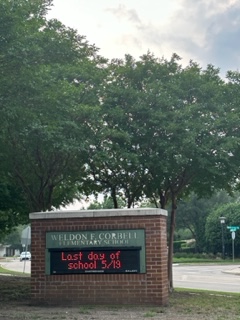
In August of 2009, my oldest child started kindergarten at Corbell Elementary, and since then, a Carter kid has been at Corbell every single year. Riley just finished her first year in college, Jed is completing his junior year of high school, Clay eighth grade, and Alex fifth grade. Alex will move to middle school next year, which means that our time at Corbell is coming to a close. I hadn’t thought much about it until I went to parent open house this spring and it came up over and over. I found myself getting teary. Fourteen years at one school is a long time. I’m pretty sure that next week at fifth grade “graduation” those tears will fall, so during this teacher appreciation week, I’ll say thank you to the people that have made this place so special for our family. 

My children learned so much in elementary school. That seems obvious, but the day-to-day work teachers put into helping my kids and all the other kids learn is monumental. When one of mine couldn’t quite grasp reading, we were worried. His teacher whom we’d had for another of his siblings identified this issue as well and got him the help he needed. Two years of daily dyslexia lessons later, he can read and read well.  I thank God that we attend a school with the personnel and the resources who saved him from years of tortured learning and the low self-esteem that would’ve resulted. This is just one example of the immeasurable support and encouragement this community has given my family. 

One of the greatest features of Corbell is staff consistency. We’ve known some of the teachers and staff for years.  A couple of the Specials teachers have probably seen a Carter kid once a week, every week for the entire time we’ve been there. When I see teachers that the kids have had in the past, they always ask how the kids are doing. They are always amazed at how tall the kids have gotten and are proud of all they’ve accomplished. The love the teachers pour into their students does not end when those kids leave their classrooms but follows them throughout their lives. 

During the last fourteen years, teachers have had to take on burdens we couldn’t have anticipated. The sheer number of school shootings has made active shooter drills a part of their daily existence. I’m glad my children know what to do and where to hide at their schools but am deeply grieved that this knowledge is necessary. We journeyed through Covid together when we left school for spring break and didn’t return that school year. The teachers had to pivot to teach via Zoom and create online assignments. My appreciation for them deepened as this experiment in homeschooling went on for months. I don’t know how or why only three years later, teachers have become political targets for doing their jobs and trying to do them well. I trust the teachers who are educated on how to educate children. I stand with them. But I hate that the pressures on teachers and school staff have increased dramatically in our years in elementary school. I want them to know we see them and that we know they should be paid more and given more praise at the very least. 

I could go on and on about the wonderful attributes of the people who make up the heart and soul of Corbell. They have blessed us more than they’ll ever know. Over the years, I hope we’ve shown them a small modicum of how much we love them. Because we do – we love you, Corbell. And we always will. 

Seeking Reassurance

Standard

My thirteen-year-old son Clay is the most laid-back member of our immediate family – by a mile. But the one thing that really bothers him is the thought of eating expired food. I don’t think he’s ever had food poisoning or even eaten anything that tasted bad because it was past its prime. Maybe the root of his concern comes from watching me check the dates on items at the store before I buy them. For whatever reason though, Clay consistently checks expiration dates on food before he eats them. In his quest to make sure he only eats unexpired food, he pulls a snack out of the pantry and then asks one of us if the date listed on the package has passed. On most occasions, Ben or I usually respond sarcastically saying something like, “Of course not, it’s May, and the expiration date is not until June. Don’t you know the months of the year?” This went on for a while until one day Clay said, “Can’t you just tell me yes or no without riding me about it?” 

At first, I thought, no, I’m your mother and need to make sure you know the days and months of the year! Then I realized, he’s thirteen and a straight A student, he knows how to use a calendar. He doesn’t need a time calculation tutorial. Instead, he wants reassurance. He wants to know that we prioritize his safety and protection. That we won’t let him eat something hazardous or do anything harmful. And that in seeking that reassurance, he won’t be shamed or harassed. I felt bad for having made a big deal out of a simple question.

After that realization, I endeavored to listen to those around me with a different perspective. When my ten-year-old Alex told me that a boy purposely hit him in the head with a ball at school, I asked if he told a teacher. He said no, and then asked, “are you mad at me?” No, I replied, but my face must have looked otherwise because he asked, “Are you sure you’re not mad at me?” Part of me wanted to say, why would I be mad at you when someone else hit you? But I reframed my exasperation with his question because he needed reassurance. I replied, “No, I’m not mad at you. He shouldn’t do that to you.” He needed to know that he was not in the wrong. That it was not okay for someone to mistreat him.

We all need a little reassurance from time to time. We need to know someone cares about our well-being. We deserve to feel worthy. We need to trust that if we reach out for help, we will be met with love and protection. And since we all need that type of reassurance, we need to keep that in mind when another asks us for that same care and love. We may have to answer questions that seem obvious to us: of course, I love you; of course, I’ll help you; of course, I’ll come when you need me. A small answer can be big to those seeking reassurance.  

Now when Clay asks if the food is expired based on the date on the package, I don’t harangue him anymore. I simply answer yes or no. It’s an easy way to give him the reassurance that we all need.  

A Simple Prayer

Standard

My ten-year-old son Alex and I waited for the show to start. The whole family had traveled to see my daughter Riley dance in her end-of-the-year college recital. She was cast in three pieces, including a solo, which was a huge honor for a freshman. I confessed to Alex that I was nervous for her because it was such a big deal. He told me he was nervous too and that he’d said a prayer. Loving that he’d said a prayer for his sister, I told him that I too had said a prayer. Then Alex said, “I prayed that Riley kicks ass.” I nodded and tried not to laugh. “Good prayer,” I said. After Riley completed her solo, dancing beautifully, Alex held up his hands in the dark for a double high five. Now we could breathe easier and enjoy the last fun and upbeat number of Riley’s dances.

I realize some people might be taken aback by Alex’s prayer – keep in mind he is the youngest of four siblings – but I thought his prayer was awesome. He felt comfortable enough in his relationship to God to just say what he was thinking and feeling. He wanted his sister to do well and be strong and confident. He didn’t edit himself or try to make his prayer sound pretty or ostentatious. Simple and direct, that’s what he expressed. He invited God into the situation and asked for help for another. In doing so, he also calmed himself because he was sharing his anxiety with God. 

As adults, sometimes we get tripped up making prayer complicated because we believe it should be time-consuming and high-minded. We fail to pray because we think we don’t know how to pray. We choose not to pray because we are mad at God about our circumstances and think we shouldn’t express those feelings. We don’t think God is willing or able to be involved in our lives in the present, so we don’t bother. 

I have a friend who is going through some tough stuff right now. She said she thinks her mother is upset with God. I totally got that because as a mama bear myself, I’d rather go through the fire than watch one of my children suffer. And I know that will continue far into their adulthood, just like her mom. My response to her: God can handle it – all of it. The seeking, the pleading, the rage, the desperation. God is present even when we choose to ignore him. Even when we are so tied in knots, and we cannot express ourselves at all. It’s okay to pray in short bursts, through tears, or in screams. We don’t need to censor our emotions. Honesty is important in relationships and that’s no less true in our relationship with God. The old adage “give it all to God” is true in my opinion – give it ALL to God, every single thought, word, emotion. Period.

My friend has a long road ahead of her. We’ve already started praying, and we will continue to do so. But I think I might just adopt Alex’s prayer for her too. Irreverent – perhaps – but she and I have that kind of relationship. And I know God understands what I mean when I pray, “God please help her kick ass.”    

Turn the Lights On

Standard

We have a complicated relationship with the lighting in our home. There always seems to be a light fixture that doesn’t work somewhere. I think if we called the electrician out to fix a light every time one broke, they would constantly be at our house. So, our strategy is to wait until we cannot stand it anymore and then call someone to come help. My husband Ben reached that breaking point recently after our garage light and the lights in both of our closets had been out for months. The electrician came, changed out the old fixtures, and voila, we had light. But I found myself going into the garage and still walking in the dark to the refrigerator where we keep our sodas. Instead of turning on the light, I automatically fell into the habit of fumbling my way to the fridge. The new light made the old patterns obsolete. But I was so accustomed to being in darkness, I didn’t take advantage of the new opportunity to light the path in front of me. 

Sometimes, I do this to myself in life as well. I’ll make progress on a problem or situation that’s been bothering me, but instead of embracing the relief from anxiety, I continue to worry and obsess. I wander around in the darkness because it’s comfortable and familiar. It’s easy to fall back into the way things have been instead of fully plunging into the way things could be. Or my brain starts looking for another source of concern to replace the old darkness.

Recently, I read a book titled, “Relationship OCD” by Sheva Rajaee, MFT. She noted that anxiety does not just go away after we begin implementing recommended strategies that help us deal with anxiety. When we’ve become better at handling our regular sources of anxiety, “anxiety is left to search and scan, looking for something, anything at all, to rile them up, no matter how redundant or ridiculous it may be.” She named this the “lighthouse effect” for the “searching and endless seeking beneath the stories our anxiety tells us.” 

When “lighthousing,” the brain spins and when it does not locate a familiar source of anxiety, we might have the “urge to attach a story, any story to the feeling of anxiety and the threat it produces.” It sounds backwards, and maybe it is, but the author stated as we become more conscious of this phenomenon, “you’ll begin to notice that not all anxiety has a reason to be there; not every feeling means there is an actual threat.” She also explained that as you learn to cope with anxiety, “you don’t need to demolish your lighthouse; you only need to recognize when its frantic searching captures your attention or tries on some new, shiny piece of content, and then gently disengage.” 

When I feel my chest tighten – my body’s signal that anxiety is on the rise – I revert to old stories or find new sources to explain the anxiety I’m feeling. Instead of a lighthouse, for me, it’s like I’m out in the dark garage with a flashlight looking for the next subject to analyze and fixate on in order to explain my anxiety. Through therapy and medication and this latest book, I continue to make efforts to detach from my anxiety. Instead of staying in the dark garage where anxiety can grow and thrive, I can try my hardest to turn on the lights and live a little easier. 

“You Go, Girl!”

Standard

I was watching my favorite morning show when a woman came on to discuss useful products that the viewer could get for discounted prices. The skinny, well dressed, tan woman then said, “I’m a mother of four, and every Sunday, I cook all day for the week ahead.” And I said, “oh, shut up.” Out loud and to myself because I was the only one home. I thought something like, well, I’m a mom of four and go to church every Sunday, lead youth group every other week, and also take a nap when I can. The disdain I felt for this woman I didn’t know was rapid and intense. The level of dislike I felt kind of startled me. 

But then I realized I’d encountered a similar issue recently. My husband Ben was an early follower of Iowa point guard Caitlin Clark. He’s watched her for three years now, not like the new fans she found in the recent NCAA Women’s March Madness. I, on the other hand, have not really been a fan of Clark’s. Intellectually, I know Ben loves great basketball, and he admires her skills.  It’s not like she’s a supermodel posting bikini pics on TikTok. She’s just really talented and brings intensity and passion to the game.

 During the NCAA tournament, though, I realized I was jealous. Jealous of a 21-year-old young woman in another state who can play basketball. Jealous of the tv lady because she seemed so organized with her family and career. And then I felt guilty. I pride myself on being a supporter of women. I’m supposed to champion women’s successes, especially when they break into male dominated fields. My 17-year-old son Jed even suggested that women’s sports are not as popular because women don’t want to watch women play. He might be right. Because it’s hard to watch and cheer when you feel that spark of jealousy flare. 

I can support all women in theory, but in reality, I struggle with it. I have all sorts of signs and quotes that I’ve collected extolling the virtues of women’s empowerment. “Her success doesn’t lessen yours.” “Women support women.” I talk a good game but my follow through is less than perfect. 

I’ve tried to teach my children that we can’t necessarily control our initial thoughts about a situation, but we can manage and improve our reactions after the first one passes. So, I need to work on what I do after my jealousy shows up. Instead of feeding the jealous thoughts, I can step back and remember that my goal is to encourage women, not tear them down. And thankfully, I have a husband and sons who will call me out when I’m not being kind to other women. Feminism is alive and well at my home. I just need a reminder sometimes. 

The Unworthy

Standard

Easter kind of snuck up on me this year. I didn’t have Easter baskets ready or a plan for our Easter meal. I had a dress but realized I needed a pedicure. All first world problems I know and trivial in the grand scheme of things. Not really in keeping with the true spirit of Easter – cue the same lament that Christmas usually brings. But the pedicure got me thinking about Jesus choosing to wash the disciples’ feet at the Last Supper. 

As a reminder, Jesus gathered with his twelve disciples for the Passover meal. By this point in the narrative, Jesus knew that the authorities were seeking to silence him and that his death was the most likely result. Later that night, he would be arrested, tried, and sentenced to death. Before the meal though, he filled a basin with water and got on his knees to wash and dry his friends’ feet, a task usually reserved for the slaves of the household because people’s feet were filthy from the dust and lack of foot coverings. In so doing, he demonstrated once and for all servant leadership. When Jesus attempted to wash Peter’s feet, Peter refused saying the Lord would never wash his feet. Jesus replied, “If I don’t wash you, you can’t be part of what I’m doing.”  

Peter, never one for nuance, responded, “Not only my feet, then. Wash my hands! Wash my head!”

Jesus said, “If you’ve had a bath in the morning, you only need your feet washed now and you’re clean from head to toe. My concern, you understand, is holiness, not hygiene…” Jesus continued, “So if I, the Master and Teacher, washed your feet, you must now wash each other’s feet. I’ve laid down a pattern for you. What I’ve done, you do.” (John 13:1- 17 (MSG)).

Peter argued with Jesus about washing his feet because Jesus was his Lord, and he didn’t want Jesus stooping to such a low position. Peter didn’t feel worthy. And he wasn’t. Peter didn’t deserve to have Jesus wash his feet, none of the disciples did. But I wonder if part of Peter’s protest was rooted in his experience with Jesus. If Jesus performed an act, he was probably going to turn around and tell his followers to do the same. He’d previously commissioned the twelve to preach and heal people. Maybe Peter was thinking “not again.”

Because if Jesus took the position of a servant that meant Peter would have to act as a servant to others who didn’t deserve it. Jesus commanded servant leadership for Peter and for us too. And that is not what we usually want to do. We can be judgmental in determining who we believe does or does not deserve our help or mercy. We pick and choose. But I’m confident Jesus was telling us that the choice is not ours to make. 

It’s easy to skip straight from Palm Sunday’s celebration when Jesus entered Jerusalem to Easter morning when Jesus was resurrected. We don’t like to linger in the tragedy of Holy Week or Jesus’ gruesome execution by the authorities. But when we spend time with Jesus and his followers in the days leading up to the crucifixion, we see that one of Jesus’ last acts was serving those who were unworthy. We are unworthy as well, just like Peter. We don’t deserve the grace Jesus freely gives to us. But Jesus showed us how to love by serving others, deserving or not. Jesus wants us to extend grace to others because he extended his grace to us first. When we find ourselves sitting in judgment of others, may we remember Jesus on his knees with our dirty feet in his hands. 

The Age of the Children

Standard

We traveled to Washington DC for spring break a few weeks ago so that my oldest son Jed, who is 17 and a junior in high school, could visit a couple of colleges. We toured American University and George Washington University. Jed loves politics and history, so these schools are right up his alley and thankfully lived up to his expectations. They’re both still on the list of universities to which he’ll apply in the fall. We are entering this exciting time in which he has so many options ahead of him, but it’s also stressful and pressure filled. Helping him find a balance so that he can enjoy this season of life and find a path that fits with what he wants for his future will be our task in the next eighteen months. And our joy as his parents.

There are some other children and parents who should be navigating this time of life but are not. That’s because those children died in the gun massacre at Sandy Hook Elementary in Newtown, Connecticut ten years ago. I’ll always know how old those children should be because Jed was in first grade at the same time those children were murdered. Those twenty little gap-toothed babies will never grow past that stage. Six adults from the school were killed that day too. We donate to Sandy Hook Promise, the charity that advocates for sensible gun control and school safety, that was formed by the parents of those children. They should be helping their kids prepare for their senior year in high school, but they cannot. 

I’ll always know how old the children who were murdered by a gunman in Uvalde, Texas at Robb Elementary should be as well because my son Alex was 9 years old and in fourth grade last year just like those nineteen babies who didn’t make it home. Two teachers were killed that day trying to protect them. But I realized that if nothing happened to restrict the types of guns available when white children on the East Coast were murdered at Sandy Hook, then nothing significant was going to happen when children with brown skin who lived near the Texas border with Mexico were the victims almost ten years later. 

My heart breaks for all the children and parents impacted by gun violence. I’ll always know how old the children at Sandy Hook and Uvalde should be. But there are a lot of children whose ages I can’t keep track of. There are just too many killed by gun violence. After the Nashville shooting this week, I was ashamed that my first reaction was relief that there were only three children killed along with three adults. I was glad that the police killed the shooter within fourteen minutes of the first emergency call. Am I becoming numb to the problem? If there are fewer victims because the police acted quickly, can I turn away more easily? Am I afraid to look too closely? Because honestly, when I truly let myself dwell on the issue of gun violence and children, it terrifies me, especially when I drop my kids off at school. And then my fear spills over to grocery stores, movie theaters, restaurants, malls, concerts, parks, and church. It makes me want to keep my babies in a bubble at home and never let them leave. I must fight against my desire to keep them safe by keeping them sequestered. That’s no way to live either. 

In a 1977 speech, Hubert H. Humphrey said, “The moral test of government is how that government treats those who are in the dawn of life, the children; those who are in the twilight of life, the elderly; and those who are in shadows of life, the sick, the needy, and the handicapped.” I think we are failing that moral test. God, please help us because we must do better. 

Learning in the Carpool Lane

Standard

I HATE school carpool. It is the bane of my existence during the school year. That and repeatedly searching to find matching tops for reusable water bottles. Over the fourteen years I’ve been carting children to school, I’ve learned that I need to remove myself as much as possible from the frustration of carpool, so I park and meet my kids at an agreed upon spot in the afternoons.  But in the mornings, we roll through the line as required. The part that makes me feel crazy is the other parents who break the line. As if their time is more important. As though the rules are irrelevant and don’t apply to them. I always wonder what they’re teaching their kids. That cheating is okay? They end up slowing down the line and making everyone else mad, but they don’t seem to care about anyone but themselves. 

The other day, my oldest son forgot his practice uniform, so I took it to him at his high school. It wasn’t the end of the day, but with only one period remaining, a lot of the student drivers with early release times were leaving. And that’s when I witnessed the most orderly carpool I’ve ever seen. Better than any adult driver carpool by far. Better than any exit after a concert or sporting event. There was a main line of cars that I was in. Then there were four or five side lines from the parking lots where cars sat waiting to enter the main line. Every single time a car in the main line reached an auxiliary line, the car stopped, allowed one car into the main line, and then proceeded. The cars trying to get in the main line waited and didn’t try to nose their way in. Not once did a second car try to jump in. These teenage drivers were polite and efficient. No horn honking. No cheating. 

I couldn’t believe it. No one was directing traffic. No teachers were watching. But those kids. Those kids were amazing. And as silly as it might seem, the whole episode gave me a spark of hope. While I assume carpool at the high school does not always run as smoothly as it did that day, the young drivers were patient when I saw them. They were not in such a hurry or so self-centered that they completely disregarded the people around them. I think we could learn a thing or two from the way they acted. 

Adulting can be hard. Difficult days sometimes outnumber the easy ones. But being a kid can be hard too. Those students carry a lot of stress and pressure. If those young people can figure out carpool in a high school parking lot, they have the potential to do just about anything. I’m being completely serious. And if they can hang on to the kindness and the respect that they showed one another on that day as they mature, then they will do well. And us grownups would do well to follow their lead. To show a little more kindness and a bit more consideration for others. In carpool and in life.    

Poetry of Promise

Standard

We were on spring break in Washington DC when we found a bookshop combined with an eatery named “Busboys and Poets.” Of course, I was instantly in love with this concept. As we waited on our meal, I wandered around the book portion of the store and noticed signs extolling peace, love, equality, and several quotes by Langston Hughes. Then, I saw the inspiration behind the restaurant on the menu. “Busboys and Poets is proud to be named in honor of renowned Black poet Langston Hughes. In the early 1920s, Hughes resided in Washington D.C. where he worked as a busboy at the Wardman Park Hotel. One evening, he placed several of his poems on the dinner table of American poet Nicholas Vachel Lindsay. The next day, in local newspapers, Lindsay informed the world of his meeting with a ‘Busboy Poet.’”

Later, during our meal. I watched as an actual busboy approached a table with plates of food. Suddenly, he dropped one of the plates and it shattered on the ground in a loud crash. Food and porcelain scattered on the floor between two groups of people of different races: an older couple having breakfast and two women with their laptops working. He immediately dropped to the floor and began picking up the pieces. Even from a distance, I could sense his embarrassment.

And so did the people at the tables. As he crouched between them, they all reassured him that they were fine, no one was hurt, it happens, no big deal. A manager arrived with a broom and dustpan and the busboy quickly and quietly exited. The two couples repeated their reassurances to the manager. Then, one of the businesswomen asked the manager to bring the busboy back to the table. The manager agreed and brought the busboy back. He stood with the busboy in an act of solidarity to make sure nothing untoward happened. I couldn’t hear what the woman said, but I could tell by the look on her face that she was not berating him. She smiled and talked to him for a couple of minutes. I can only imagine that she told him a story of her time as a server when something similar happened to her or reminded him that this shouldn’t ruin his day. All I knew was that kindness was at the root of all the interactions with the busboy after the plate drop. 

I realized in that moment; I’d witnessed a microcosm of the world Langston Hughes dreamed about even in the face of extreme inequality. We are not by any means perfect as Americans. And there is a reason a portrait of George Floyd hung on the wall of this cafe. But the idea that someday we can do more and be better is a promise that seems far away at times and attainable at others. 

In the poem “Let America Be America Again,” Hughes challenges the American “ideals” by saying America has not fulfilled its pledges to the downtrodden of any color, the immigrants from any country, the lowest of the economic strata. Toward the end of the poem, he writes:

“O, let America be America again—
The land that never has been yet—
And yet must be—the land where every man is free.
The land that’s mine—the poor man’s, Indian’s, Negro’s, ME—
Who made America,
Whose sweat and blood, whose faith and pain,
Whose hand at the foundry, whose plow in the rain,
Must bring back our mighty dream again. 

O, yes,
I say it plain,
America never was America to me,
And yet I swear this oath—
America will be!”

Hughes published that poem in 1936. Read that again – 1936. Yet, it still rings true today. But perhaps the kindness those patrons demonstrated to a busboy in 2023 means that not all hope is lost, and that the poetry of promise may still prevail.