The Course of Belief

Standard

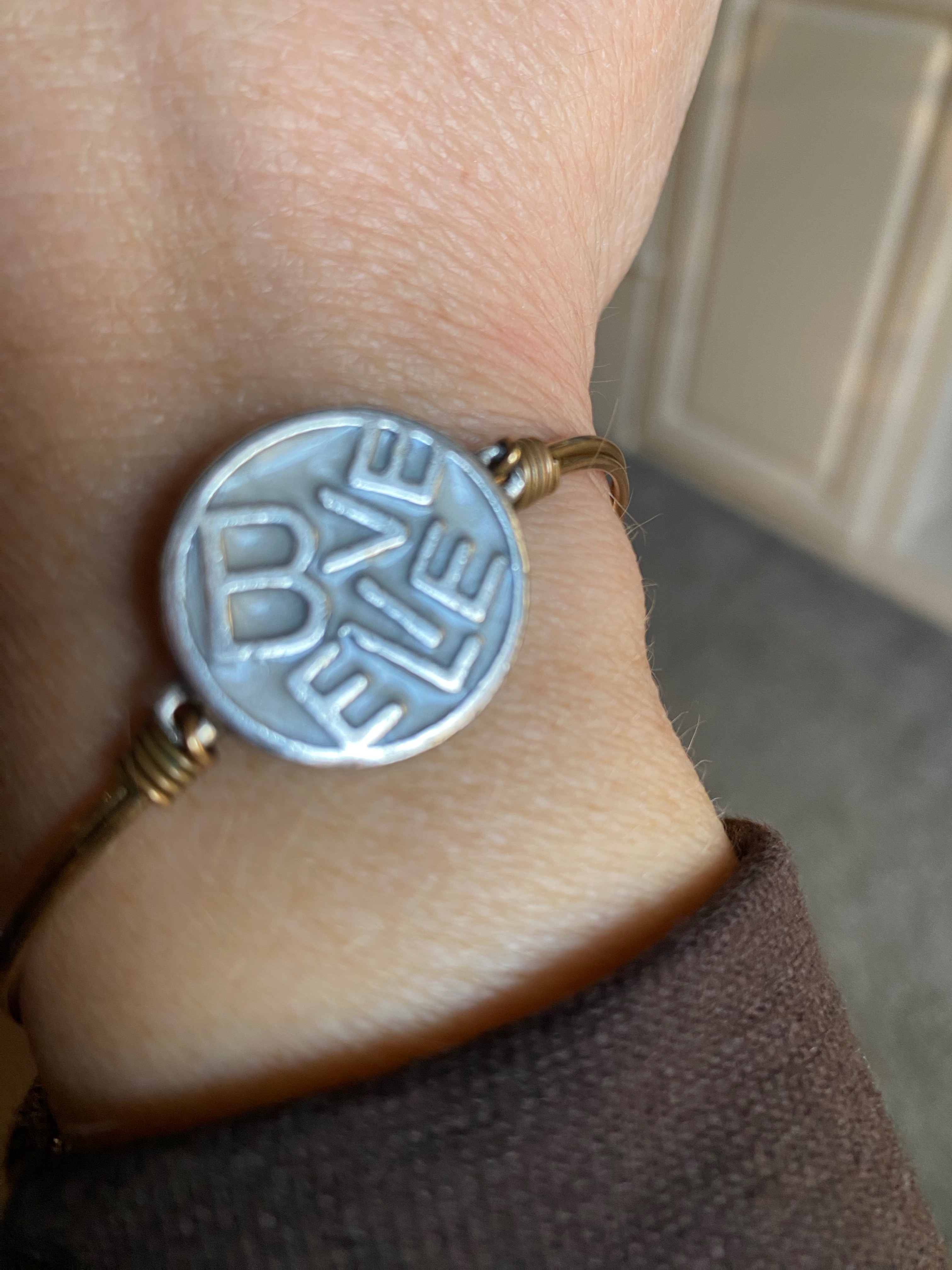
Last Sunday, the weather finally turned chilly in North Texas. I was so excited that sweater weather had arrived (at least for a few days), so I grabbed a pair of boots I hadn’t worn since winter. I gingerly reached into one of the boots because it seemed like something was inside it. I pulled out a bracelet that I hadn’t realized I was missing since I don’t wear as much jewelry in the summer. I was so excited to find the bracelet that had been hidden away. I immediately put the bracelet on and wore it to church. It is from the company Luca + Danni and has the word “Believe” stamped on it, but the word is jumbled, not linear as written words usually appear. 

I loved the bracelet the first time I saw it because my journey with belief has not taken a linear path. Our belief in God does not steadily increase in predetermined increments over the course of our lives. Instead, our experiences with faith tend to ebb and flow. Sometimes, we feel grounded in our faith, sure in our convictions, certain that we know what we believe. We feel our faith growing stronger and deeper. We feel authentically connected with God through prayer and service. 

At other times, though, we may feel completely lost. We may be confused about what we believe about specific matters of faith. We may feel that all our prayers fall flat and that we are disconnected from God. We may not know what we believe anymore. We may feel stuck in a desert place, tired and dried out. Life circumstances may become so trying that we wonder where God is. 

Faith does not lend itself to being wrapped up in a neat and tidy bow. Belief can be scattered and messy. We often feel ashamed to admit that fact, assuming everyone else feels confident in their beliefs. And some folks do act like they’ve never had an ounce of doubt. But we can take comfort in knowing most of us have felt our belief slipping at times or felt our faith is hidden so far below the surface, we may never find it again.

Our belief in God can always expand and strengthen. There is always room for growth.  Often, this happens by asking hard questions, exposing our misgivings, and stretching our understanding of God’s work in our lives and in the world. Engaging in those exercises will necessarily create some chaos in our beliefs. Perhaps a linear path in terms of what we believe wouldn’t work anyway because linear faith could be static and stale. 

We can rest assured that we can bring our muddled beliefs to God seeking guidance about how to put our beliefs back together. Having faith that whenever our beliefs become scrambled, God is willing and able to help us find it again and again as long as it takes. Even if it takes a lifetime. 

Let’s Go

Standard

During the opening act of a recent concert, I was sitting in the middle of a row trying to figure out the best route to the ladies’ room when I overheard the group of women next to me say they were going to the restroom. I told my husband Ben that I was going too because everyone in the aisle would move to let them out. I started to feel a little weird though following them so closely. So, when I ended up at the sinks beside the woman who had been sitting in the seat beside me, I felt the need to explain even though in retrospect I’m sure it was completely unnecessary. I said, “I think we’re sitting beside each other. I got up when you did so I could get out of the aisle more easily.” Thank goodness she was nice in response to my rambling. She said, “We should’ve grabbed you and said let’s go.” 

I was surprised and delighted by her response. I thought, that’s the attitude we all need, especially one woman to another. My respect for her statement only grew over the course of the concert – we didn’t say another word to each other – but the group we were there to see was The Chicks, who are very into women’s empowerment. What if we as women stopped comparing and competing and instead adopted the woman at the concert’s approach? A new version of the old mantra of military soldiers, “no man left behind.” 

If we said to one another, when you’re in a tough place, I’m going to come to you, grab you, and say let’s go. Not because we can fix each other’s problems but because we decide to be present in times of trouble. We promise that we won’t abandon our friends. We take care of and encourage them. We won’t let them isolate and hide in their misery. We insist on sharing their burdens. When a woman’s children are hurting, we rally to support her.

But we don’t limit our attention to those we know well, we also care about our community. When we see others suffering, we pour out our compassion. We stand with women who are disadvantaged or abused and don’t immediately blame them for the circumstances in which they find themselves. 

In the Biblical book of Ruth, this oft-quoted verse appears: “Where you go I will go, and where you stay I will stay. Your people will be my people and your God my God.” (Ruth 1:16).  Many times, this verse is used in support of spousal relationships, but these words are from Ruth to her mother-in-law Naomi after the deaths of their husbands when Naomi planned to return to her homeland. The story of Ruth and Naomi is about solidarity among women. Ruth stands by Naomi, and Naomi helps provide for Ruth. They are in it together. 

Sometimes it’s hard to reach out to others. We worry that we’re reading the situation wrong or that our help won’t be welcomed. Maybe we need to merely let others know that we are open and available to support and encourage them. But sometimes we need to follow the concert woman’s advice: grab someone and say let’s go … to coffee or for a walk or to get help. What would happen if women stood up for other women on a continual basis? I, for one, would love to watch that world unfold. 

Win or Lose

Standard

My ten-year-old son Alex decided to run for President of his elementary school’s student council. I was a little worried because Alex is tender-hearted, and I didn’t want him to feel sad if he lost. But he seemed determined, so we made posters, and he wrote a speech. His platform was all about kindness being the most important thing. We talked about how it didn’t matter if he won or lost, we were proud of his willingness to try. 

One day though, Alex came out of school crying. Someone had defaced one of the posters with his picture on it. Of course, I flew into mama bear mode and marched into the school office to deal with it. Thankfully, the administration and teachers were already on the case, and the principal talked to Alex about moving forward even if another person acted cruelly. We told him he hadn’t done anything to cause the situation and encouraged him to continue his presidential run. Fortunately, he received an apology from the student who’d made the bad choice. After all of that, we were especially proud when he persevered and gave his speech to the students in fourth and fifth grade. He had to wait another day to find out the results. We reminded him that he’d done the best he could and that his effort was the most important part of the process. He’d put himself out there and had done a great job. 

On the same day that Alex gave his speech, I was racking my brain for a writing idea. When writers can’t come up with ideas, we tend to descend into doom and gloom fairly quickly. I began to wonder if my blogging was a fruitless endeavor. Had I been wasting my time for the last three years? Was I wrong to think that God had called me to write in this manner? And that was when it occurred to me. I’d told Alex that effort was what mattered most, but I didn’t apply the same standard to myself.

As adults we don’t give ourselves credit for our dedication, commitment, discipline, or hard work unless we see positive results. If we aren’t successful by the world’s criteria, we consider ourselves failures. Recently, a couple of friends and I were talking about a viral video, and one friend mentioned that the last time she’d checked, a site must have 100,000 followers to monetize. If that’s the mark of success, I’m far from it. But if I celebrate my effort, then maybe I can at least pat myself on the back.

The day I started writing this piece, we still didn’t know if Alex had won the election. He came out of school and told us we would receive an email with the results later in the afternoon. But before and after school, we reminded him that we were proud of him, win or lose. And that was the truth. I was so impressed that he’d taken a chance and followed through on it. So, when Alex found out he’d won the election for Student Council President, we were delighted because he was so excited. But our pride had been present the whole time. Perhaps we can remember that the next time we feel like we’re not measuring up. We can choose to be proud of our efforts, win or lose. 

Asking for Help

Standard

A friend and I were texting about her role leading an elementary school PTA this year. She explained that it was like having a full-time job without the pay. Currently, she is working feverishly to make sure her school’s fundraiser launches successfully. I shuddered at the thought that she probably was asking people to do things constantly – sponsor the fundraiser, volunteer to help, ask for donations, etc. I realized that while I often encourage others to ask for help, in person and in my writing, I don’t do so well asking for help myself. Actually, I kind of hate it. 

I even hesitate if I offer to pay someone to help me. In fact, I was procrastinating when my friend and I had our conversation. I needed to return a call to get a quote for a particular service, and I needed to go to a vendor’s store to ask whether they could help me develop some merchandise for a group for which I was volunteering. But I kept putting it off. My husband Ben can attest to my reticence to make the phone call, whereas he will immediately call and ask for help if it’s on his list or on his mind. I make the list, which includes items that require asking for help, and then try hard to avoid them. Why am I so hesitant to ask for help? How can I tell people to seek help from others when I have such a hard time doing it myself? 

The more I thought about my reluctance to ask for help, I realized this pattern is emblematic of a deeper reality. I live with anxiety – thankfully it is not debilitating and is managed with therapy and medication. But that underlying sense of apprehension is always there at some level. I fear being rejected because that would feel like failure. Like most people, I don’t love being vulnerable, which is a requirement of asking for help. I don’t want to feel weak or like I am burdening others. I can talk to people all day long, but if the conversation requires that I request help, I balk. 

I’m taking a class that focuses on listening to others, but in the process, I’m learning to listen better to myself. Dissecting the reasons for our own behavior is hard but important work. I’d never connected my underlying anxiety to my inclination to put off asking for help. I just chalked it up as a character flaw. Because I now understand the connection between my anxiety and procrastination, I can give myself grace instead of beating myself up. I can show patience with myself as I work up the gumption to request assistance. I can remind myself that this is my normal “process,” and that I will eventually do what I need to do. That there is no shame in asking for help and that most of the time, people are happy to help. 

I know that going it alone is not always an option or the best course of action. While I may never be enthusiastic about asking people to help me, I can make my life easier if I remember anxiety is at the root of my reluctance. And I need to remember that when other people struggle with seeking help, they may be anxious or afraid too. We are all in this together – we all need help, and we can all be helpers. 

God Is Near?

Standard

One late afternoon a few weeks ago, my husband Ben and I walked out to the driveway as he prepared to take one of our boys to an activity. We were in the middle of our conversation when he exclaimed, “look at those clouds.” I turned around and was astounded by the big, fluffy white clouds hovering just above the rooftops of the houses around us. The sun highlighted their beauty. I felt as though they were close enough to touch. 

In that moment, I felt closer to God as well. Amazing how viewing the mountains or the ocean or a gorgeous sunrise can make us feel that God is near to us. Nature is not the only way we feel God’s presence obviously, but it is a common source of awe. The Psalmist was also inspired by God’s handiwork: “When I consider your heavens, the work of your fingers, the moon and the stars, which you have set in place, what is mankind that you are mindful of them, human beings that you care for them? Lord, our Lord, how majestic is your name in all the earth!” (Psalm 8:3-4 & 9). When we sense God is close, we may be filled with peace, wonder, and admiration. We may feel small in comparison to God’s magnificence, but still feel like an essential part of the larger universe.

At other times though, we may feel distant from God. We may feel isolated, weary, and abandoned. We wonder if God hears our prayers or cares about us. The Psalmist understood those emotions as well. Bluntly, he asked, “Why, Lord, do you stand far off? Why do you hide yourself in times of trouble?” (Psalm 10:1). Nature provides the imagery for these times too. We may feel we are wandering in the dry, unrelenting heat of the desert or lost in the tangled maze of the wilderness. The people of God experienced the confusion and despair of the arid desert when they escaped slavery in Egypt. (Exodus 16). And Jesus knew what it meant to feel separated from God when he spent a challenging time in the wilderness. (Luke 4). 

When we start to believe that God is absent, we must remember that almost everyone has experienced similar episodes. We are not alone in our feelings of frustration and anger. It’s okay to reach out to others and ask for their support and encouragement through the times when our souls feel empty. And we must remember that God is not gone even though it may feel that way. God will help us find our way back. When I couldn’t feel God’s presence, one of my favorite verses has helped me: “This is what the Lord says— ‘Forget the former things; do not dwell on the past. See, I am doing a new thing! Now it springs up; do you not perceive it? I am making a way in the wilderness and streams in the wasteland.’” (Isaiah 43:16, 18-19). 

We must hold on in times of desperation and believe that God will restore us. That God is still in relationship with us when we feel darkness only. God has provided us with his creation in nature, which includes both beautiful and harsh environments. When we feel we are trudging through the desert or the wilderness, let us know that God is working on new ways to reach us so we can once again feel the nearness of our God.  

Waking Up

Standard

Every weekday morning, Ben and I hit the snooze buttons on our respective phone alarms several times before we get up. We finally drag ourselves out of bed, but that’s where the similarities end. Within minutes of waking up, Ben is extremely chipper – singing and making jokes. I, on the other hand, drag for a while. I trudge to the kitchen to make the boys’ breakfasts and lunches. The kids, especially my ten-year-old son Alex, fall more into my camp. At times, Ben’s cheerfulness clashes with Alex’s unhappiness about getting up and going to school. `I’ve tried to explain to Ben that not all of us are like him. In fact, some of us don’t understand how he can be so happy that early in the morning. His response: “If you’re awake, you might as well be happy.” Much easier said than done.

I don’t think I’ll ever come close to the speed with which Ben goes from sleep to joviality. But I’ve learned to give myself some grace in the mornings because I’ve come to know who I am and what I can and cannot do in the early AM hours. I walk through the routine of preparing the kids for school, but I don’t make any real decisions until I’ve been awake for a while. I don’t immediately think about how many things I must do that day because I’ll feel overwhelmed. I watch the same morning show every day to learn the news and occupy my mind. I tell myself that it won’t be long until I feel more alive and then I can get on with my day. I used to become frustrated with myself in the mornings because I was groggy, allowed the world to crowd in too quickly, and let my anxiety run amuck. Now, I know that if I take my time to acclimate to the day, I’ll eventually be just fine.

I’m taking an online class in which we’re discussing effective listening from a Christian centered perspective. One of the main components to listening well to others is to know oneself. To be aware of the biases and world views we bring to the conversation that might get in the way of truly listening to another person’s experience. To know our weaknesses that might impede relationships but also to celebrate our positive traits that can enhance communication. When we know our anxieties and triggers, we can better listen to another’s problems without inserting ourselves into their narrative or making the conversation about ourselves when others are in need. When we believe in our strengths, we can feel confident in being with others as they struggle. In caring for ourselves, we can more effectively care for others. In knowing ourselves, we can know others more fully. 

Taking time and making space to understand and accept ourselves is important, essential even, to live authentically and be present with others in their struggles. Let us embrace the process of knowing ourselves so we can be awake in our lives and in the lives of others.

Grand Plans?

Standard

I’m a little obsessed with journals and notebooks. As a writer, I’m practically unable to pass up a journal that calls my name, especially those with an inspiring image or quote. Recently, when I was cleaning and organizing our room and office, I found an inordinate number of journals that I’d collected. I had to check them to see if I’d written anything in them because I often only write in part of a notebook. I picked up a spiral notebook with “Grand Plans” printed on the front. I assumed that I must’ve written in this one and wondered what I had to say about my grand plans at some previous point in time. I opened the cover and gasped because the pages were completely blank. Not one word. Didn’t I have grand plans? 

The fact that I lacked a grand plan in writing bothered me. But I couldn’t just fill in the empty pages immediately because I couldn’t identify my own grand plans. Nothing like writer’s block when you’re thinking about the future. My problem stemmed from my initial perception of the word “grand.” I automatically went to the idea of grand as something big, far reaching, exciting, earth shattering, monumental, and magnificent. Something that would change things and make a huge difference to many people. Something that would bring fame and success. What could I ever do that qualified as grand according to that view?

So, being the word nerd that I am, I followed the course I often take –  I looked up the word grand in desperate hope that another definition would suffice. And I found this alternate meaning of grand: “having more importance than othersForemost” (merriam-webster.com). I liked this different take on the concept. Instead of an elaborate, over-the-top scheme, maybe a grand plan can be relatively simple. When I thought of grand in this way, my perspective changed. I can easily think of plans that are more important to me than other plans. My grand plans revolve around my family – taking care of them, raising my kids to become competent adults, loving them boundlessly, and always having their backs. My grand plans include serving God by helping my church and community. As for my writing, I would love for my future to include wide readership and publication, but even if those dreams don’t come true, it is important that I write for myself and any others who might find encouragement from my work.  

My grand plans involve small, everyday actions that are consistent, routine, and reliable. Others may think these plans small and insignificant. But when I consider grand plans in terms of what is most important to me, it isn’t hard to figure out what is foremost in my life. Sometimes, we get stuck believing that our goals are not adequate or worthy if they aren’t large and impressive. We may not feel we are enough or don’t measure up to others because our plans are not considered fabulous by society. If we stay true to ourselves and those we love, our plans may be quiet and steadfast but grand, nonetheless. We shouldn’t feel daunted because our plans don’t qualify as grand by the world’s standards. We can be content that our plans involving our families and communities are special, important, and truly grand.  

Facing the Fear

Standard

I’ve always relished the beginning of the school year, even as an adult. I feel like it provides a new start similar to the New Year. This year, in particular, as my daughter went to college, I entered the school year with an even stronger feeling that a new chapter would emerge. I decided to lean into the idea that this year would bring fresh opportunities, especially with respect to my boys. It didn’t take long for two new proposals to crop up. One in the realm of church popped into my head during a meeting, and the other one came from school via a teacher’s request three weeks in. My first reaction to both was “that was fast.” And my second was “oh-no.”

Immediately, I felt resistance. I hadn’t expected either of the opportunities; both truly came out of the blue. And so, I wasn’t sure I wanted to accept the options. What would they entail? Would I be too busy if I took on the duties? I needed to pray about the prospects before I moved forward. As is my habit, I started writing in my prayer journal, which is a stream of consciousness exercise for me. I write what’s on my heart and mind without filtering so that I can truly express my feelings to God. This process also often reveals what I’m truly worried about. 

That is exactly what happened in this instance. I wrote about serving the church in a new capacity and said, “I worry that I won’t be good at it.” With respect to volunteering in a new role at school, I wrote “But I admit I am scared to do it. Can I do this right?” My concerns boiled down to fear. Fear that I wouldn’t measure up if I stepped outside of my comfort zone. That I would fall flat on my face. That I would embarrass my kids if I failed. That other people would complain about me behind my back. 

Once I identified fear as the root of my reluctance, I felt more at ease. I’m intimately familiar with fear and anxiety. I don’t like to fail, which makes me risk adverse. For those acquainted with the Enneagram personality types, I am a textbook Six who seeks safety and security and anticipates the worst possible outcomes. So, when I saw my concerns in black and white and realized my worries were based on fear, I thought, of course. And yet, even though I often default to fear, I needed to go through the process of prayer and analysis to understand why I felt hesitant. 

I’ve decided to pursue both new opportunities. I didn’t see them coming, but I’m grateful for them. While my fears will not disappear completely, I’ve learned that for me, fear can hold me back unnecessarily from exciting pursuits if I allow it. I recognize that being open to the possibilities without letting fear overwhelm me will be a lifelong struggle for me, but one well worth fighting.  

Staying Afloat

Standard

I returned home after dropping my daughter Riley off at college fully expecting grief to overwhelm me. I thought I would feel depressed and spend large amounts of time crying or in bed. Once I got home, though, a funny thing happened: I actually felt okay. Not that I didn’t miss her because I did. Driving away from her while we both cried was one of the hardest things I’ve ever done. But contrary to my expectations, I wasn’t devastated when I arrived home. I kept checking in with myself wondering why I felt alright and questioning whether I would falter at any moment. I expressed my bewilderment to my therapist who said she thought I’d made it through the hardest part. I honestly didn’t understand how or why I was making it without repeatedly falling apart.

During this entire time, before and after taking her to school, my friends kept checking in with me. They sent texts, left voice mails, commented on my Facebook posts. On Sunday at church, almost everyone asked how I was doing. A couple of my friend groups scheduled lunches to make sure I stayed busy. They even gave me gifts, sentimental reminders that they were here for me while Riley was away. 

Then, I got a text from a friend who said, “You’ve been in my thoughts and prayers friend!” And it dawned on me. All of the people who’d been thinking of me or praying for me were keeping me afloat. They were steering me toward a safe landing. They were God’s hands and feet when they reached out. They were God’s mouthpiece when they told me they would be there for me. They showed God’s love with their empathy and kindness. They followed God’s ways by surrounding me with light and friendship when I could’ve been overcome by darkness. 

I’ve heard people say they’ve “felt” other people’s prayers. I admit that I wasn’t entirely sure what people meant by that. Intellectually, I appreciated all of the prayers for me from others. But this time, in these circumstances, I actually felt buoyed by the compassion my friends demonstrated. I felt lighter and stronger and more capable of navigating these new waters.

I’m not saying I won’t encounter rough seas at any point of this journey, but I know now I can turn to any of those who offered help when I need them. They will row out to steady me and steer me away from the storms and the rocky shores. They’ll point me toward the beacon of God’s love just by being themselves. This is the gift of community.

I’m grateful for everyone who has taken a moment to think of me over the last few weeks. And I ask that they continue to send waves of positivity my way. I’ve learned how it feels to be held. I only hope that I can serve as a safe harbor in return someday. Thank you, Friends.

Bonded in the Nest

Standard

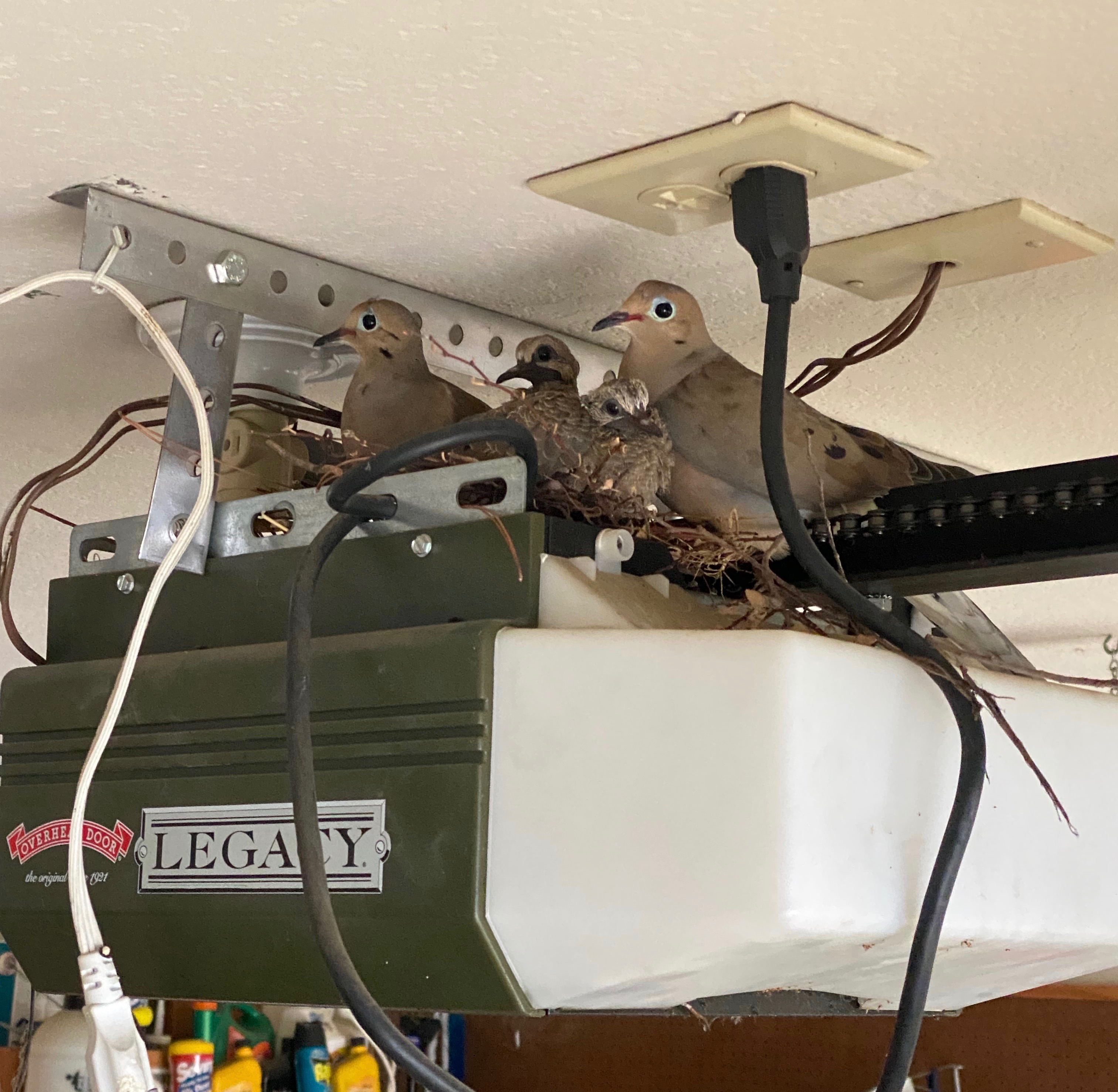
We’d packed up the van and were ready to leave for the airport to take Riley to college. Riley looked up at the bird nest in our garage and wondered when the pair of doves would have their baby. Just then she saw a pair of eyes peeking out from underneath the mother bird. Riley, Ben, Jed, and I hopped up on the edge of the van’s floorboard so we could see better. Mama bird didn’t like us being that close, so she flapped her wings and flew out of the garage. That was when we realized there were two baby birds. When I’d originally found the nest in the garage, there was only one egg. But now little sibling birds nestled side-by-side comfortable in the nest. Mama bird came back, and she and papa bird still take turns minding the nest. 

The discovery of two babies was made more special by the fact that we’d just witnessed Riley and her three brothers say goodbye to each other. Honestly, I think Ben and I expected the youngest Alex to be the most upset about her going away to school, so we were better prepared for his tears. We were caught off guard though by the strength of thirteen-year-old Clay’s emotions. His sobbing while he hugged Riley was absolutely gut wrenching. Thankfully, friends took Alex and Clay for fun and a sleepover, so they had distractions awaiting them. During this first part of the goodbye, Jed, our sixteen-year-old son, had remained stoic. I busied myself with some tedious activity in an effort to stop crying myself.  When I walked back into the family room, I saw Jed crying as he said his goodbye. That sent us all into a fresh round of tears. As hard as it was for Ben and I to leave Riley a few days later, watching our children bawl because they would miss one another may have been the most heart breaking part.

And yet, even while we were in the throes of those unbelievably difficult moments, I found myself thanking God for the gift of our family. Since having kids, I’ve always dreamed that they would be close. That someday we would be like those families in movies at the holidays when all of the children and their spouses and their kids gather together at their childhood home with mom and dad. When you watch the fighting and name calling and teasing that arises naturally between siblings living together every day, sometimes it’s hard to believe that the wish will come true. But on that day, in those tears, I became confident that their bond is solid and strong. I was full of gratitude for that scene that could’ve come from a movie.

The baby birds are getting bigger and now stretch their necks to watch us from their perch. It’s getting harder for mama and papa to sit on the nest with them inside. We’ve gotten attached to them and will miss them when they grow too big to stay. Just like we miss Riley. But I love that the baby birds have each other to share their early days. I hope and pray my children stick together through thick and thin well beyond their days in our cozy, crazy, beautiful nest.