Tag Archives: parenthood

Twenty Years a Parent

Standard

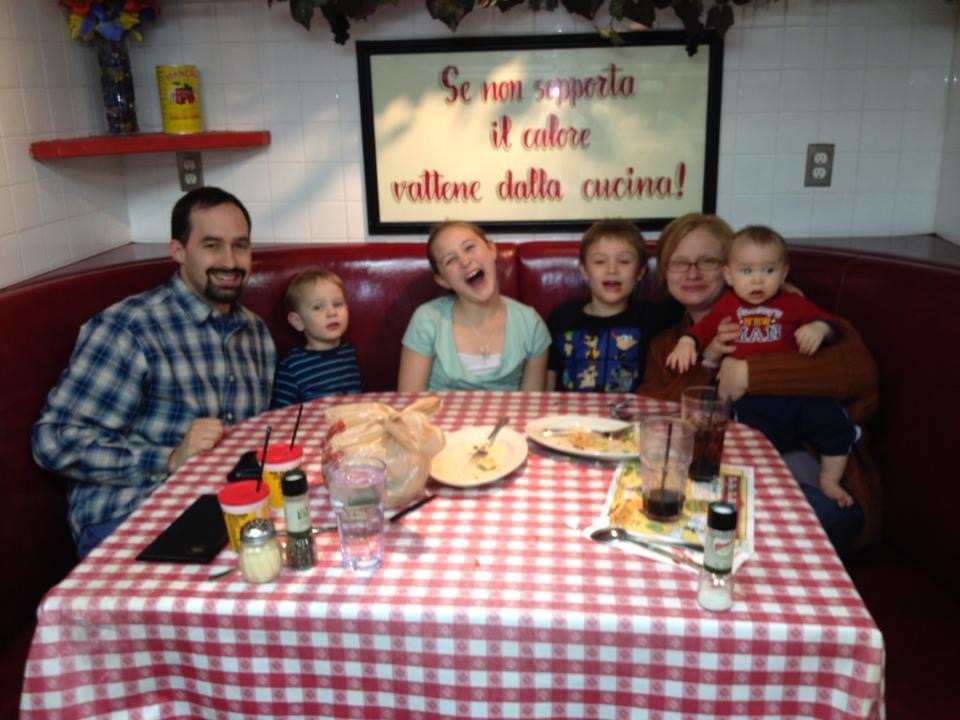
Several of our friends have recently welcomed babies into their lives. A couple of them are brand new grandparents. Others are younger couples experiencing parenthood for the first time. Add to that my daughter Riley turning twenty years old this month, and I’ve found myself reflecting on parenthood quite a bit. If I’d been employed at a business for twenty years, I would get a plaque or paperweight in recognition. But as a parent, success is harder to determine. 

Twenty years is a long time to do one job. As in any role, I’ve learned a lot. I’ve changed a lot. And the position was very different than what I expected. If on day one of parenthood, someone had shown me who I’d be as a twenty-year parent, I would’ve been surprised and disbelieving for many reasons. Honestly, way back at the start, I thought my children would be a lot like me as a child: fairly docile, shy, and compliant. Anyone who knows my family knows that is not a description of any of my children. Instead, they’re fun, loud, and irreverent. They’re super smart and opinionated. They’re very different from one another and yet share many of the same familial traits. They’re kind and care about others. They are real, authentic, and genuinely themselves. For a minute on this journey, I tried to blame my husband Ben for one of the children’s stubborn behaviors. I thought I was paying for something he’d done in his childhood. Then, one day during that child’s rant about the unfairness of his world, I realized I was looking in a mirror. He’d inherited his need to rail against injustices from me. Ultimately, I wish I’d been more like them when I was younger. But I hope that my evolution as a person has benefited them. Becoming more flexible and open has allowed me to parent them in ways I couldn’t have foreseen twenty years ago. 

Not that it’s been easy to relinquish my controlling nature at times. Riley and I spent her entire junior year of high school at odds over who should be in charge of her life. I thought if she would just do what I told her to do, how I told her to do it, she could proceed with less heartache, less pain, more happiness. Ben continually reminded me that Riley was not me. That Riley was raised in a different time and place and that her experiences were not mine. I knew that intellectually. And yet, it was so hard for me to accept. My desire to protect her and keep her safe overwhelmed me and proved difficult to moderate. Both Riley and I learned so much that year about one another and how to be in relationship with each other as she matured and asserted her independence. I learned that I still had a role to play in her emotional and social development, but the way I went about it was important. My expectations about that stage of parenthood were idealistic and ultimately unrealistic, but we survived and have a deeper and more fulfilling relationship now. Adapting may not be easy for me, but when it comes to my kids, I’m determined to eventually find my way. 

It’s strange to think that when the newborns we know reach the age of twenty, Riley will be forty! And if I’ve learned anything, it’s that time really does feel like it goes by in the blink of an eye. I’m looking forward to the next twenty plus years and the privilege of watching my kids grow into the adults they will become. And I know that I’ll continue to change as well. I can’t wait.   

Allowing Joy to Fill Us

Standard

One of my favorite animated movies is Disney Pixar’s “Inside Out.”  I’ve loved it since we saw it in theaters in 2015, and I’m pretty sure I’ve cried every time I’ve seen it.  I stood alone in line at Disney World to meet a couple of the characters, and even allowed my kids to join me in the photos when I got to the front.  The movie spoke to me, in part, because the main human character was named Riley, my daughter’s (and my maiden) name.  

The movie suggests that we all have characters in our brain that represent our dominant emotions: Joy, Sadness, Disgust, Fear, and Anger.  When Riley’s life turns upside down, the emotions battle for control.  Joy desperately tries to make things better and squeeze out the other emotions.  In the end though, the characters demonstrate that all of the emotions are necessary and important for a well-rounded life.   

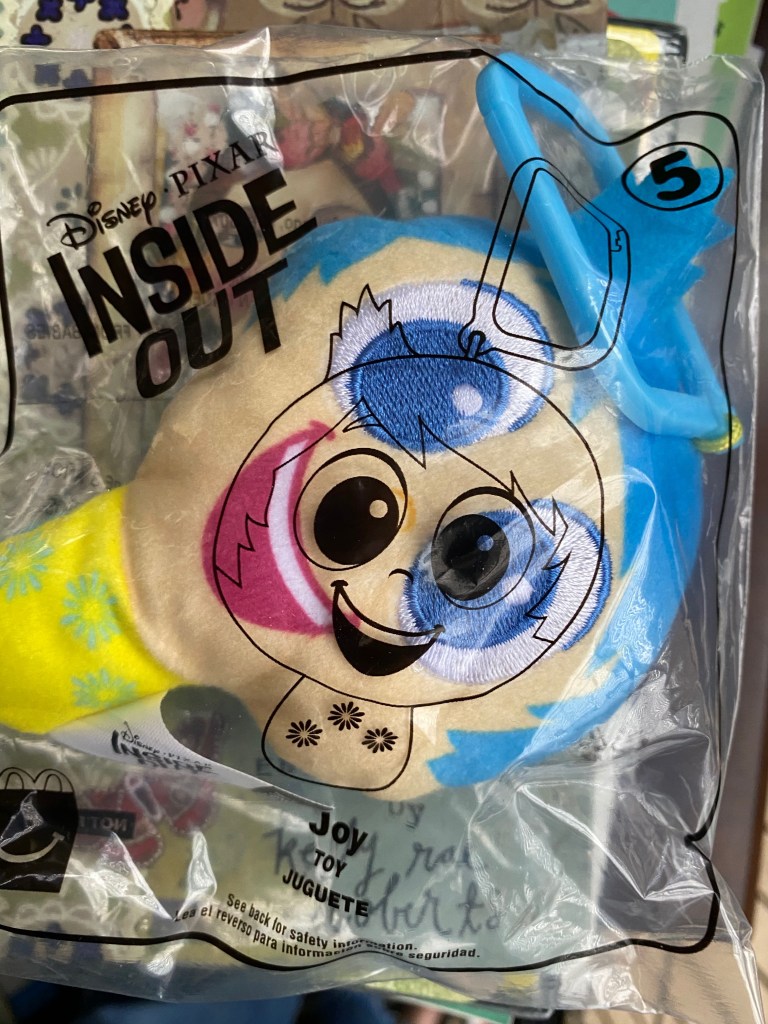
Recently, McDonald’s included Pixar characters in their Happy Meals, and when one of my boys got the Joy character, I grabbed it for my own. I placed the toy on my nightstand but didn’t open it.  Then, the other day, I realized that Joy was still inside the clear plastic bag.  Joy was trapped, so to speak.  

I admit that at times I’m more comfortable with the emotions of sadness, anger, or fear than with joy.  I’m an analytical person, so when I experience negative emotions, I pick them apart in my brain:  Why do I feel this way?  What’s wrong with me?  How can I fix the issues that are making me feel bad?  I often ruminate on the aspects of my problems for long lengths of time.  Analyze, overanalyze, and then do it again.  It makes me feel productive or working toward betterment.  And despite this false illusion, I can spin in the pain indefinitely.  The emotional lows can become a familiar and comfortable type of pain.             

Joy is different.  Experiencing joy can feel awkward because there’s nothing to overanalyze, no problems to isolate.  Joy requires us to live more in the moment, and I’m not always good at that.  Sociologist Brené Brown said, “Joy is the most vulnerable emotion we have.”  And so, I try to push it away.  

Yet, I don’t have a compelling reason to feel this way about joy.  I haven’t experienced a childhood trauma or overwhelming drama that would explain the aversion to joy that I sometimes feel.  But because I worry that it’s fleeting and undependable, I suffocate joy, just like it’s in a plastic bag.  And so, I’ve concluded that I need to work on embracing joy more often and with less trepidation.      

I started looking for references to joy in the Bible, of which there are many.  A passage in the Psalms stuck out to me: “When I said, ‘my foot is slipping,’ your unfailing love, Lord, supported me.  When anxiety was great within me, your consolation brought me joy.”  Psalm 94:18-19.  In order to fully appreciate the verse, I double checked the definition of consolation, which means, “the comfort received by a person after a loss or disappointment.” (Lexico.com)  When we feel anxious, especially after a loss or disappointment, God comforts us so that we can find joy again.  

God acknowledges that we will experience loss and disappointment.  But God doesn’t want us to stay stuck in our pain.  If we seek God’s love and comfort, then we can better accept the joy in life and in God.  Instead of resigning myself to the inability to settle into joy, I need to focus on the joy God wants for me and trust that he will be with me in both the pain and the joy.      

I removed Joy from the plastic bag as a symbolic gesture.  I want to loosen the white-knuckle grip that prevents me from appreciating joy and more fully release joy into my life.  God is a proponent of joy.  May we all follow God’s lead and embrace the joy God provides.