Category Archives: Spirituality Slice of Life

Connected

Standard

IMG_1596

When Ben and I are both at home, our cell phones connect so that if someone calls one of us, both phones ring.  I will glance at the phone but won’t answer if I think the caller is seeking Ben. This strategy works fine when the caller is a work colleague of Ben’s, but not as well when it’s someone we both know. At times, Ben has answered and been greeted by someone who is confused about why I didn’t pick up.  A couple of times Ben’s mom has asked, “why are you answering Tina’s phone?”  We both find it mildly annoying that the phones sync at home, but not enough to find out how to fix it.

Recently though, this cell phone connection reminded me of another connection. In the Bible, Jesus says, “For where two or three are gathered in my name, I am there among them.”  Matt 18:20.  This verse usually provides encouragement to me, but I’ve also found it somewhat confusing.  I believe that God is with each of us all of the time, individually, in our hearts, minds, and souls.  So, if God is with each of us, why did Jesus also note that he would be with a couple or group if they were gathered together in his name?

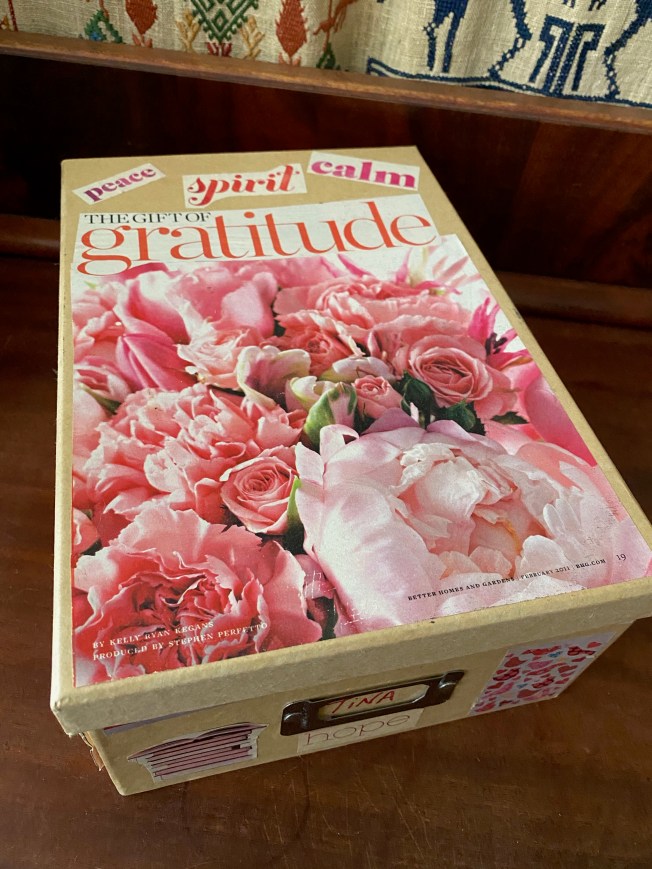
The other day, during this time of social distancing, I was feeling blue. While most days have been fine, I’ve found that some days leave me feeling down due to missing friends and activities.  In an effort to feel a little better, I decided to search for a box from one of our church’s annual women’s retreats.  We cancelled the one scheduled for this March because of Covid-19, so I thought that perhaps this old box would give me some comfort.  We’d created and decorated these particular boxes to hold lists or items for “In Case of Emergency” situations.  In the box, I’d made a list of things to do when I wasn’t feeling my best, which included writing, taking a walk, or getting rest.  I’d also made a list of people for whom I was grateful. I didn’t think it had been that long since we’d had this particular retreat, but much to my surprise it had been many years as evidenced by the fact that my seven-year old son Alex hadn’t even been born yet.

As I dug through the box, I found notes from women of the church who’d attended that retreat.  These notes were encouraging, sweet, and full of kindness.  They lifted my spirits all these years later.  A couple were written by friends who’ve since passed away.  I miss them and cherish these tangible reminders of our friendships.  Most of the women are still in my life and others have come along side us in the last few years.  We live in community with one another as part of the church. We teach Sunday School and Bible studies for the adults and the children; we worship and sing together; pray for one another; help each other during times of need; laugh and cry with each other; we invest in one another’s lives.  My life would be less rich without these women.  Thankfully, I also retain similar relationships with others whom I’ve met at churches or church related organizations in other places where I’ve lived in the past.

When Jesus talked about being present for people who gather in his name, I think he meant the types of relationships I have with my church friends. He is the overarching connection between us like the invisible force that synced Ben’s phone to mine.  He is the reason that most of those women and I know each other.  He is the tie that bound us together initially, and he helped us deepen those relationships over time.  There is something special that grows from God’s presence in these relationships.  And the wonderful truth is God can form those bonds for any of us, whether we are entering a church family for the first time in our lives or have been attending churches for years.

God is with us individually, yes, but he also forms the connection for his faithful community.  I miss my Church family during this time of isolation.  But because I know our connection was formed while we were gathered in God’s name, I know we remain connected during our physical absence from one another.  And we will rejoice when we can gather once again in Jesus’ name.


Easter – This Year

Standard

IMG_1489

Easter will not be the same this year.  At least not in terms of the modern American celebration of Easter.  Our church is pretty casual compared to many, but even we dress up a little fancier, sing a traditional hymn or two, and have an Easter egg hunt after worship.  But this year, in the midst of the Covid-19 mandated social distancing, we will not be together with the larger church family.  We will watch our worship service from home with our immediate family and miss being in close contact with our community.

This time in which we find ourselves is strange and disorienting. It is also scary and anxiety producing. Trying to protect ourselves and our families from an invisible germ that can sicken and even kill is a terrifying prospect.  As we should, we isolate, stay home, and try not to let the stress overtake us.

But we will not be the first group of people who were isolated and scared on Easter.
Our focus on Jesus’ resurrection is joyous, and we sing hallelujah in response.  But on that very first Easter, Jesus’ disciples had no certainty how the story was going to play out.  All they knew was that Jesus was dead, and they were now targets.

In John’s narrative, Jesus’ follower and friend Mary Magdalene visited the tomb early on Easter morning while it was still dark and found the tomb empty.  John 20. She hurried to Peter and John who also ran to the tomb.  Upon finding Jesus gone, Peter and John returned home.  Mary Magdalene stayed, distraught and weeping.  The women who followed Jesus were seemingly able to move more freely because they were probably not on the leaders’ list of Jesus’ compatriots who could cause trouble.  The men who closely followed Jesus gathered in a house with the doors locked because they feared that the leaders who killed Jesus would kill them too.

Later that morning, Mary Magdalene encountered angels and then Jesus himself.  She was the first to meet the risen savior.  She told the disciples all that she’d seen and that Jesus was alive.  But by the time Easter evening came, the men remained behind locked doors, huddled together, worried, upset, and scared.  When we talk about the disciples being afraid, we often view them with disdain: if they just had a little more faith, they’d have taken to the streets and freely exclaimed their friendship with Jesus.  Looking at their situation now, I feel more sympathy for the disciples.  They had every reason to be concerned for their safety. Actually, they were smart to stay under cover until they thought the threat was over.

At some point that night, Jesus suddenly appeared to the disciples in the midst of the locked room.  Jesus proclaimed, “Peace be with you.”  Depending on the gospel account, the disciples were terrified because they feared Jesus was a ghost and then overjoyed when he proved it was him (Luke 24:36) or simply overjoyed (John 20:19).  But either way, Jesus made his way into their place to lessen their fear. Jesus’ purpose was to make his presence known and to comfort them.

This year, we will miss out on the trappings of our normal Easter gatherings. Instead, we will be more like the original disciples isolated in their room.  And, we will continue to do the smart thing and stay in our homes until the threat is over.  But just as Jesus wanted the disciples to feel his presence in order to ease their fear and give them peace, he wants us to feel comfort and peace in our hearts, minds, and spirits.  Jesus was with his disciples on that first Easter, and he is with us today and always.

Constant Conversation

Standard

IMG_0626

Riley and I were on a girls’ trip, walking down a street in San Francisco, when she started to tell a story.  She was providing the context when she said, “Who was I talking to?  I can’t remember.”  She thought for a minute, mulling over the circumstances of the previous conversation. Then, she said, “Oh yeah, I was talking to myself.”  We both laughed pretty hard.  She proceeded to tell me about a discussion she’d had with herself about where she might live when she got older.

I, too, talk to myself – a lot.  Sometimes out loud, most of the time, inside my own head.  Constantly.  I narrate what’s happening.  I analyze. I debate.  I talk to myself about things I’ve done or said in the past and engage in imaginary conversations with others.  I dwell on the logistics of the day ahead and the length of my to-do lists. I figure out how to navigate future events, both those I excitedly anticipate and those I dread.

Honestly, I get tired of hearing my own internal voice.  Mostly because I’m not always nice to myself.  In fact, I can be downright mean.  I make a mistake, I call myself “stupid.”  I’m not getting much done, I’m “lazy.”  I may be a loser, failure, or bad mother, before noon on any given day.  I’ve read articles that ask if I would talk to a friend like I talk to myself.  Of course not!  I try not to be so nasty to anyone else.  Part of the problem is that I believe the things I tell myself and any failures provide evidence to confirm my diagnosis.  The other part is that I’m in the habit of berating myself.  The negative refrain has become automatic. Talking down to myself is a hard habit to break.

I frequently conduct internal conversations with God as well.  My stream of consciousness includes a lot of pleas: “help me,” “be with me,” and “give me strength.”  I pray about my anxieties and express my fears.  I don’t clasp my hands or fall to my knees, but this is my version of the Biblical suggestion that we “pray without ceasing.”  While I may not pray every moment of the day, my running discourse with God never truly reaches an end point.

I admit that I felt good about my non-stop prayer until I looked up exactly what the applicable verse said.  “Rejoice always, pray without ceasing, give thanks in all circumstances; for this is the will of God in Christ Jesus for you.”  Thess. 5:16-18 (NRSV).  My self-congratulatory attitude on the “without ceasing” part faded as I realized that most of my prayers involve requests and complaints, and some begging and whining. I may have the talking part down, but I’m not as good at rejoicing and thanking God.

And then I realized that talking to myself in such mean ways is the opposite of rejoicing and thanking God.  Instead of expressing gratitude for my abilities, talents, health, and blessings, I spend my time tearing myself down and complaining to God about my shortcomings and failures.

I don’t think God minds hearing my constant ramblings (at least I hope not), but I suspect he might prefer a little appreciation thrown into the mix.  And I believe it hurts his heart when we treat ourselves horribly.  Running ourselves down is not what God wants for any of us.  My internal dialogue with myself will never be perfect, but when I place it in the context of my greater, ongoing conversation with God, I want to try to be better.  Not only to myself, but even more importantly to God.


Clean Up

Standard

IMG_1454

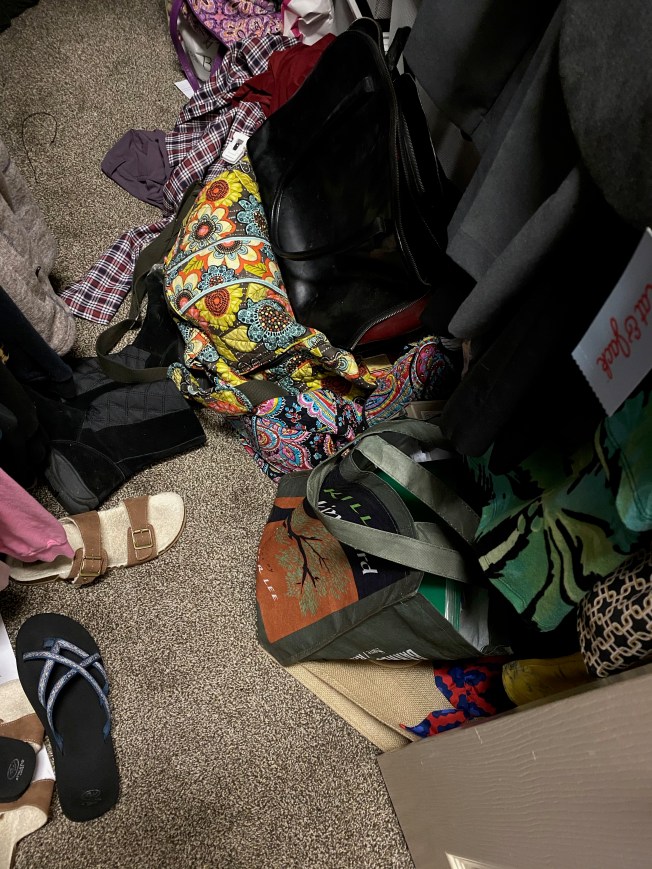
Every year when the weather people in the Dallas-Fort Worth area announce the first serious tornado watch of the season, I scurry to my walk -in closet because it is the innermost area in our home without windows.  I take my laptop with me, so I can watch the live weather updates.  And, then I start to clean my closet.  Every. Single. Year.

I pick the clothes up off the floor. I match my shoes and put them on a rack. Clothing tags, old receipts, and materials that have come in shipping boxes go in a trash bag.  I gather the remnants of wrapping paper, of both the Christmas and birthday variety. I replace the errant coat hangers on the rods.  I organize the various tote bags I’ve collected over the course of the last twelve months.

Once there was a tornado warning that went into effect right as the school day was ending.  I cleaned frantically even though I was home by myself.  The kids were at their various schools on lock down because they didn’t want parents of children on the roads.  Ben was driving home to beat the weather, but it was coming faster than expected.  He was virtually outrunning it as he traveled north.  On that day, I was anxious about the safety of my people, and the cleaning gave me an outlet for my nervous energy.

But most of the time, I have to clean so the family can manage to get in the closet with me.  The upside of having a large closet is that a lot of people can fit.  I’ve had our family of six plus the two large dogs crammed inside.  My parents had to go in there with us once.  The downside is that a lot of material stuff can fit in the closet as well – a lot of which ends up on the floor.  My organization-freak friends are hyperventilating as they read this confession.

I know that if I’d only taken a minute to put my things away each and every time, I could minimize the mess I always find myself in as bad weather approaches.  Instead of hurriedly throwing my shoes haphazardly in the closet or leaving the hangers in the floor when they fall, I could easily keep things neat and tidy and maintain order on a daily basis.  But I’ve never gotten in the habit of keeping my closet clean.

I wonder if sometimes we act the same way with God.  When we have a predicament in our lives, we tend to pray with increased fervor.  We plead for God’s help and rescue in dealing with serious troubles or facing difficult challenges.  And that is to be expected.  When things are not going right, we need to seek God’s help.  God wants us to come to him in crisis.

When we haven’t been in regular communication with God for a while prior to the anxiety producing difficulties though, most of us also experience a certain amount of guilt.  We feel sheepish in approaching God.  It’s as if he is a long distance relative instead of a well-known loved one.

Our relationship with God will grow and deepen when we spend time with God in prayer, study, service, and worship.  Investing time is necessary in order to have a healthy, intimate relationship with God.  Not so that he grants our wishes when we find ourselves in dire times, but so that we have a better understanding of his loving nature.  So that he is not a stranger when we call on him for comfort, calm, and peace.  By developing a pattern of interacting with God on a regular basis, we won’t hesitate to talk to him during the hard times.

If we make prayer a habit, then when a storm is looming, we won’t feel as though we must fix everything before we come to God.  God doesn’t need us to have neat and tidy lives before we talk to him. And if we talk to him consistently, we’ll have already revealed everything to him.

Approaching God can be easier in the hard times when we feel that God wants to take care of us, and we might even be able to encourage others to do the same.  To show them how God is a refuge when they need help.  When we maintain our relationship with God, we won’t unnecessarily scramble to clean up the messiness of our lives before we take shelter in his love.


Following

Standard

IMG_1392

We were on our spring break vacation and headed from one hotel to another for a meal via shuttle.  We walked through the hotel lobby, up an escalator, and then took an elevator.  As we moved through the parking garage, my seven-year old son Alex looked up at me and asked, “Who are we following?”  I pointed to the employee who knew the way from the hotel to the shuttle, but Alex’s question struck a chord with me.

As I write, the world is a crazy place with the Covid-19 virus forcing us to practice “social distancing,” a phrase most of us didn’t know a week ago. The kids are home and learning online instead of going to school.   Restaurants are closing their dining rooms along with the shuttering of movie theaters, hotels, and other businesses.  The unknowns make public and individual anxiety levels spike.  And the influx of information is rapid, overwhelming, and constantly changing. So, the question, “Who are we following?” is relevant today more than ever.  The question leads us to look at the underlying source of our information.  Is it reliable?  Is it from a trusted expert?  Or is it from a talking head who knows nothing about the truth but spouts misinformation anyway?

Since this crisis started, I’ve seen a lot of memes about how our ultimate trust should be in God.  And for me that is true, but even then the question remains who do we follow?  Where do we get our ideas about who God is and what he desires for the world?  I’ve heard descriptions of Jesus that don’t sound anything like the Jesus I know.  I think even Jesus would say, “Are they talking about me?”  I contend that everyone, and I mean everyone, interprets the Bible.  Where do they get their interpretations?  Are they to be trusted?  Simply saying, “we should read the Bible for ourselves,” isn’t enough by itself either.  There are contexts – historical, cultural, religious – that weigh on the narrative that we might not know on our own.  It’s complicated and challenging.  Sometimes, we might want to throw our hands up in frustration.

One of the greatest gifts my parents gave me was permission to ask questions.  We would gather around the dinner table and talk about politics, the latest news, the world in general, and they allowed me to question anything and everything.  And that freedom to ask questions extended to what we’d heard or learned at church.  We sat at the table during Sunday lunch and dissected the sermon or the Sunday school lesson. Not in an effort to be blasphemous, but to decide if we agreed or not.  I could say, “that doesn’t sound right to me,” and then my parents, brother, and I would discuss the subject.

Nothing was off limits.  I learned that not only was it okay to question, but it was expected and encouraged. I was never told I had to believe something just because a certain person or party or group said it was true, not even if that person was one of my parents.  I was taught to search for the source of the material and then make a well-informed decision.  I became more comfortable with uncertainty and with “I don’t know” as the answer to a question.  This willingness to dig deep and question things has served me well, at school, at work, and in deciding what I believe.

We need to be comfortable asking ourselves, who are we following?  And, why are we following them?  God doesn’t mind the questions.  In fact, I think he welcomes them.  God wants us to know who he truly is.  The first step – the willingness to ask questions – may be one of the most important things we can do for our beliefs and our faith.


Treading

Standard

IMG_7133I’m not a strong swimmer.  When I was young, we didn’t spend much time around water, so I was thirteen years old when I took swim lessons.  I was fine the first week of lessons.  Of course, we also spent the first week in the shallow end.  During the second week, we moved to the deep end of the pool and my panic set in.  I especially hated treading water.  I flailed around day after day unable to coordinate my movements.  I couldn’t maintain my balance and keep my head above water while treading.  My fear prevented me from hearing the instructor’s directions.  I couldn’t focus on learning the movements.  I was too scared.

Fast forward to today, my kids swim like fish in the pool and in the lake at camp.  The water is a source of joy and fun for them.  They’ve taken swim lessons from the time they were toddlers.  While we’ve taught them a healthy respect for the water, they are not frightened of it, like I admittedly still am at times.

A while back, I felt like I was attempting to tread water in life, and not doing it well just like when I was a kid.  In every situation, I assessed and analyzed and second-guessed myself.  Anxiety played through my mind and body as I anticipated potential scenarios.  Panic set in quickly and didn’t dissipate easily.  I was flailing again.

Then, one day, this thought came to me: “stop struggling.”  I felt a sense of calm come over me.  To me, stop struggling didn’t mean give up and allow the water to overcome me.  Instead, I realized that by constantly living in flight or fight mode, I couldn’t relax enough to tread properly.  I couldn’t focus on figuring out how to fix problems that had resolutions because I was always in conflict, even when a lot of it was self-imposed.  I couldn’t set aside issues that didn’t need instant attention because my thoughts were too erratic.

But if I stopped struggling, my mind would still.  My movements would become smoother and less chaotic.  I would accept or ask for help without resentment or guilt rather than dealing with everything on my own.  The fear and panic would subside for a while, and I would regain my balance.  Then, I would coordinate my mind and choices better so that I would regain my equilibrium.

I may not be able to tread well in the water, but now at least, the lesson is not lost on me.  When I am unable to hold my head above the waves of this journey of life due to my fear and anxiety, I remind myself to stop struggling and take a deep breath because only then can I start treading.

Nosy

Standard

IMG_1199

I have a heightened sense of smell.  I turn up my nose at only a whiff of a strong scent, good or bad.  Every time I became pregnant, my sense of smell became more acute. While pregnant with Jed, I visited the zoo with Riley, and after walking by the penguin house, I literally ran to the bathroom because of the smell-induced morning sickness.  I’m convinced my sense of smell never returned to normal levels after each baby was born.  And, I guess that’s good because no one told me that as a mom I’d need a nose that could detect anything out of the ordinary at the slightest hint.

Who knew I’d willingly lift a baby’s bottom to my nose to determine if the diaper was dirty?  I can’t count the times I’ve walked around the kitchen sniffing in an effort to find an offending odor.  There may be food in the sink that hasn’t made its way completely through the garbage disposal, a forgotten dish rag may have become wet and gross, the garbage may need to be taken out, or a left over in the refrigerator may have turned on us. But believe me, I will track down the source and eliminate it.  I’ve had to figure out exactly who needs the first shower after the kids come home from practices.  And, much to my dismay, I’ve picked up a pair of underwear near a basket of clean laundry and taken a sniff to determine if it was clean or not.  It was not.  I’ve even crawled around on the floor with my nose an inch from the carpet to locate the precise whereabouts of the dog’s or cat’s accident.

Let’s just say, I’ve stuck my nose in plenty of places it did not belong in the name of motherhood.  But the common factor in all of the experiences when I’ve smelled things I’d rather not, is an undercurrent of affection for the people I hold most dear.  It’s my job to take care of them.

When it comes to those outside of our immediate circles though, we’re often told that we shouldn’t stick our noses in other people’s business.  But I’ve started wondering if we use that advice as an excuse to avoid being involved in the lives of others.  “I don’t want to bug him,” I’ve told myself.  “I don’t want to upset her,” I’ve said.  So, I haven’t asked about the person’s health, family situation, or prolonged absence from church.  Worse yet, I might not talk to them at all because to speak without acknowledging the issues would be even more awkward.

But our reluctance to talk to others about their problems may lead to more suffering.  If no one checks in on them, they may become isolated and lonely or feel worthless because no one seems to care.  Instead of protecting them from discussing their problems, we protect ourselves from unease but end up acting selfishly.

When I was younger, my mother used to call me “Nosy Rosy” because I wanted to know everything about everything. She said I would be in another room and yell, “what?” if there was a bit of conversation I didn’t hear accurately while eavesdropping. Maybe the adage about sticking to our own business is partly because, at times, people have less than noble motivations. If our curiosity flows from a desire to spread the juicy information to others, then we should keep to ourselves.

But if we truly care about people, we must take a chance and enter into the difficult conversations.  Perhaps we preface the conversation by telling them if they don’t want to talk, that’s okay.  We need to let them know that our inquiry stems from our concern for their wellbeing. They can refuse to engage in conversation, but at least they will remember and appreciate that we asked in the first place.

The next time we say we don’t want to stick our noses into someone else’s business, let’s think about why.  If the answer is to avoid our own discomfort, then we should rethink our response.  Expressing our love and concern to other people is valuable to them and to us.  Let’s take a deep cleansing breath and get a little bit nosy.


Use Your Strength

Standard

IMG_1105

My son Alex’s second grade class recently had a civics lesson, in which the class elected a Teacher of the Day.  On Monday, the class voted and winnowed the field down to two candidates. Alex was one of the last two standing, and he was so excited.  The next day, the class divided into groups to help craft campaigns for the candidates. One of their tasks was creating a campaign poster that featured a drawing of him.  He said he knew one child was good at drawing faces, so he asked her to draw the head.  Alex asked one child to draw the body, another the hands, while still another created the background, and he drew the shoes. He said, “I tried to use everyone’s strengths,” when making the assignments.  I told him that was a very good idea and figured he must have learned that from his amazing teacher Mrs. Davis.

On Wednesday, his excitement turned to tears because he was concerned that he was going to lose the race and because he was frustrated.  A couple of his friends had gotten into an argument while they were finishing the poster.  One of them was mad that another had more artistic responsibilities.  He was getting a crash course in how hard it is to manage a team sometimes.  We talked through the situation and tried to focus on how nice it was to be nominated. Alex won the election after he made a little speech on Thursday.  I was glad he won, mostly because I didn’t want him to get upset at school if he’d lost.

Alex’s determination to draw on his friends’ strengths reminded me that God has blessed each of us with our own strengths.  The fact that Alex and his friends were drawing the body, and that the same analogy is used in the Bible was not lost on me.  The Bible says that each of us has a gift that can be used in the service of God, and that together we make up the body of Christ.  1 Cor. 12.  Just as the human body is made up of many varied parts with specialized functions, so is the body of Christ.  Finding our specific gifts and then using them to further God’s work is vital to a well-functioning church family or community.  Initially, we may not see exactly how our gifts fit in with the larger whole, but when we willingly offer our skills and talents, God will find a way to put them to good use.

Knowing our own strengths is as important as helping others express their strengths. When his friends started squabbling over their assignments, Alex got a dose of the competition and jealousy that sometimes emerges when we feel our particular talents or gifts are not being properly appreciated.  The Bible talks about that too, “And if the ear would say, ‘Because I am not an eye, I do not belong to the body,’ that would not make it any less a part of the body.  If the whole body were an eye, where would the hearing be? If the whole body were hearing, where would the sense of smell be?”  In other words, to make the body work to its fullest potential, we have to use our gifts and let others use theirs.  We need to show appreciation for all the talents people bring, not just the most obvious or lauded ones.  While one person may be front and center at church every week, another may pray for others in the quiet of their room every night.  Both are essential.  Everyone is necessary and important to God’s body.

Several years ago, I was serving on my Church’s board and was trying to get other people to serve as a greeter on Sunday mornings.  To me, this was an easy ask.   All you had to do was smile, say hello, and hand out programs.  Why wouldn’t people agree to help?  After expressing my frustrations, I got my answer.  While I was comfortable welcoming people, not everyone was.  Some folks got nervous or weren’t good with names or just didn’t like doing it.  Now, I understand the value in people doing what they love and what they do well in furthering God’s work here on earth. I’ll be the greeter all day any day, but don’t ask me to make a home cooked meal for the family with the new baby. I’ll buy a meal and take it to them but cooking from scratch makes my anxiety go through the roof.  My gifts are different than your gifts, and that’s how we’re able to get things done.

After the week-long campaign, Alex brought his poster home, and I could see that he and his friends had made the perfect illustration of how the body works best when we work together.  Just like the body of Christ works better when we recognize our own strengths and those of others, and then we get to work individually and as one.


Ashes

Standard

IMG_8376

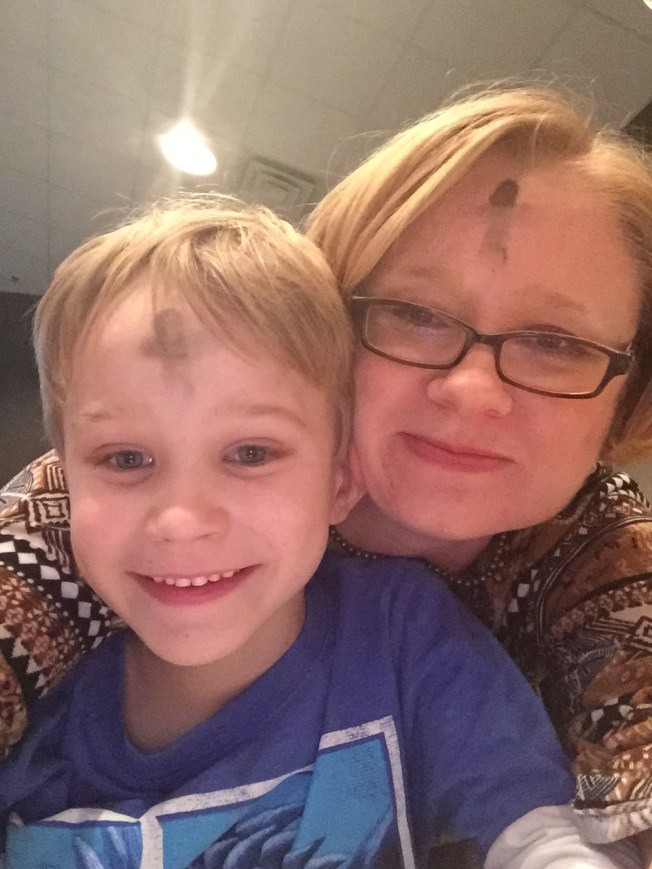
When I pick my sons Clay and Alex up from elementary school, I often give them a rundown of the afternoon ahead.  I tell them whether they have karate or soccer practice or if their older brother has a basketball game.  This day happened to be Ash Wednesday, the start of the Lenten season in preparation for Easter.  I explained that we’d go to Church for a small service, and then Pastor Chris would put ashes on our heads in the shape of a cross.  They’d participated in Ash Wednesday services before, but I wasn’t sure they remembered.

That’s when nine-year-old Clay asked a question that made me hit the brakes. “Who are we putting on us?” he said. “What?” I said, whipping my head around to stare at him.  His concern startled me.  “No, no, we aren’t putting anyone’s ashes on our foreheads!” I exclaimed.  I told him that the ashes were from the palms we’d used last year during Palm Sunday when we waved them in Church to simulate the welcome Jesus received on his way into Jerusalem before Holy Week.  The Church had burned the palms last year and kept the ashes.

I racked my brain about why he would think we were going to use someone’s ashes.  Our nineteen-year-old cat had died recently, and we’d talked about how we would get his ashes from the vet.  I figured that was why he was nervous that we would end up with a being’s ashes on our heads. Honestly, there are a lot of things about Ash Wednesday, Lent, Palm Sunday, Holy Week, and Easter that can be mystifying, even for adults.

I grew up in Church, but ours did not commemorate Ash Wednesday or Lent. So, when I was in law school, I was unfamiliar with the practice.  Every year, for three years, when my friend Charissa would come to school with ashes on her forehead under her bangs, I would point and say, “You have some dirt on your forehead.”  Not to be rude, in fact, I thought I was being helpful.  But I had forgotten that it was Ash Wednesday because it was not a part of my practice.

I know there are probably deep theological meanings behind Ash Wednesday that I still do not comprehend even though I’ve experienced it for almost twenty years now.  But what I like is the symbolism of God’s claim upon on our lives and our dedication to God in return.  The cross made of ashes rubs off quickly and easily, but perhaps one of our goals for Lent should be to more fully inhabit what the dust on our foreheads demonstrates. What if we try to make our lives a visible reflection of God’s love?  Instead of seeing a cross on our foreheads, people can look at the way we live and see God’s light and love.  Not an easy commitment by any means, but one to consider.  Not in an effort to be perfect, but to show others that God loves imperfect people anyway.

God loves us and wants to remind us of his love over and over and wants us to share that love in turn.  May we make every attempt to fulfill this hope: that others can point to us and identify us as representatives of God’s love, even without the ashes on our heads.


Table for Three

Standard

IMG_0667

The first stop on our girls’ weekend, which happened to be around Valentine’s Day, was breakfast at a place we’d heard was delicious.  Based on the crowd that morning, others had heard the same.  Before we ordered at the counter, we walked through the restaurant to find a place to sit.  The only table available was long and fit for a big group.  We sat at the end assuming another small group could take the other end of the table.  I told my friends to go order while I saved our seats.

A gentleman walked in and he and his teenage son sat at the other end of the table.  After a moment, he approached a server, and I overheard him say that he had a party of eleven on the way.  They were going to need the whole table, where I sat, or to push other tables together.  They both glanced my way, but didn’t say anything to me.

My initial thoughts were not overly generous.  Nope, not happening.  We were here first.  They can’t have the entire table.  They are just going to have to wait until we are finished eating.  I’m not moving.  I could feel my body tense as I became defensive and possessive.

But then, in a moment of clarity, I looked around the room, just to see if there were any vacancies.  Another father and his son dressed in his boy scout uniform (yes, really, a boy scout) had recently exited the restaurant leaving a table with two seats.  On further inspection, I saw an extra chair sitting alone against another wall.  A family had abandoned the chair in favor of a highchair for their baby.  All I had to do was grab the chair and sit down at the other table to make it a table for three.

I got up and told the man needing the large table that he could have the entire table.  We would move to the smaller one.  He protested at first.  He said it wasn’t necessary.  His group wouldn’t arrive for a few more minutes, he said.  No, I insisted.  We could move to the smaller table.  It wasn’t a hardship.  He thanked me profusely.

I waved at my friends to tell them I’d moved when they returned from the counter.  I explained what had transpired, including my thought process that focused entirely on the scarcity of seats and my need to hold on to what was ours.  I was embarrassed that I’d been ready to dig in my heels to keep our seats when all I had to do was open my eyes to see the space that was appearing all around us.

We ate.  The man’s large group arrived.  During our meal, the man approached our table, said thank you again, and handed me a frosted sugar cookie in the shape of a heart.  I was surprised and delighted.

When I became entrenched in getting my own way, I couldn’t see the other options in front of me.  When I got out of my own way and saw the possibilities though, my heart and the love in the room grew beyond my expectations.

A heart cookie was a delicious end to a meal, a great start to the weekend, and a beautiful symbol of a lesson learned.