Category Archives: Spirituality Slice of Life

Unplugged

Standard

IMG_3562

We had a slight flood the other night.  I almost stepped in a puddle in front of the kitchen sink, but when I looked under the sink, there was nothing leaking.  That was when I noticed the river running from the laundry room through the kitchen.  After I screamed in alarm, I yelled for the two older kids to help me because Ben wasn’t home.  I stopped the washing machine from filling with water.  We sopped up the water with more towels than I care to count.  It was quite the production as we cleaned up the laundry room and set up fans in the kitchen to dry the floor that we’d just had refinished earlier in the year.  Minor crisis, yes, but overall calamity averted.

The whole situation made me think of a similar incident with my Mom’s washing machine when I was a kid (at least as accurately as I can recall).  We’d been at an evening Vacation Bible School session at our church.  When we arrived back home, the carpet in the hallway in front of our laundry closet was soaking wet. The washing machine had leaked while we were gone.  My Dad had been working long hours at the time.  Instead of trying to fix it like he normally would have, he asked Mom to buy a new washer and have it delivered.  When Dad began to install the new washing machine, he pulled the old one out and discovered that the machine was partially unplugged.  Somehow, the plug had wiggled out from the socket.  The machine wasn’t broken after all.

We all feel broken sometimes – isolated, unworthy, and lonely.  We may even feel broken beyond repair.  I wonder though, if at times, we feel the sense of brokenness because we are unplugged from the power source.  In other words, we are disconnected from God.  We may think that no one else has experienced emotional distance from God, but in actuality, most of us have felt a lack of God’s presence at one time or another.  God is still there, but we struggle to feel him.

Many people in the Bible lamented the times they were lost in the wilderness or the desert (both literally and figuratively).  When I’m feeling separate from God, I try to get back to basics by praying and reading the Bible so I can reconnect to the energy source.  One of the verses that has always made me feel better says, “Do not remember the former things, or consider the things of old. I am about to do a new thing; now it springs forth, do you not perceive it?  I will make a way in the wilderness and rivers in the desert.”  Isaiah 43:18-19.  God offers hope, even when things seem bleak.  He is present even when I’m wandering far from him.

My obstinance is often the root of the problem.  It’s as if I’ve inserted a plastic baby-proofing outlet cover into the plug. God is willing to provide comfort and peace, but I am too caught up in being upset or angry.  I won’t let God help me.  I won’t invite him into my life or the situation.  I stand in my own way, sabotaging my path to become closer to God.  When I find myself in those times of resistance, I pray that God will open my heart to his assistance.

Sometimes the journey back to feeling God’s presence is long and tiring. And, we may feel like we are barely hanging on to our faith.  But God is waiting and wants to reconnect.  Returning to our power source may be difficult, but it is essential to our wellbeing.  God can help us unblock the way.  Perhaps we are not as broken as we presume, but are unplugged from God, the giver of grace, love, comfort, and hope.


Margins

Standard

IMG_3471

When I was a little girl, we always went to my grandmother’s house for Thanksgiving and Christmas.  She would cook a feast, and I only have happy memories surrounding those meals and holidays. I didn’t realize at the time that my grandmother didn’t have a lot of money.  I didn’t give it a second thought because we always had plenty to eat.  Her house was modest and not fancy, but it was what I’d always known.  It was just grandma’s house.  I don’t know much about the generations that came before my grandmother.  I haven’t searched the genealogy websites for records detailing when my family came to America.  But, I have a feeling they came as poor immigrants.

Jesus’ family was clear about their ancestry.  In the book of Matthew, the first chapter is dedicated to tracing Jesus’ lineage to show that he was a descendant of great Jewish people, including King David.  One of the women mentioned in the story is Ruth, Jesus’ great grandmother who lived many generations before his birth.  Ruth, who is one of only two women with individual books in the Bible.  We often talk about her story because of her dedication to her mother-in-law Naomi.  When Naomi’s husband and adult sons died, leaving both she and her daughter-in-law Ruth widows, Ruth decides to leave her homeland of Moab to follow Naomi to Bethlehem in Judah.

In doing so, Ruth becomes not only a widow who is childless, but an immigrant in a strange land.  She is a foreigner who is poor and takes on the responsibility of feeding herself and her mother-in-law.  But with jobs unavailable, the only way to find food is to go behind the workers harvesting the fields and glean what they left or the crops at the edges as dictated by Jewish law.  In the Old Testament, farmers are directed to leave a margin all around their fields to feed the poor and are counseled against harvesting twice.  Lev. 19:9-10.  They are told not to gather every little kernel, so the poor can come behind later and avoid starvation.

When Ruth meets Boaz, the owner of the field, he tells her to only glean in his fields.  She asks, “Why have I found favor in your sight, that you should take notice of me, when I am a foreigner?”  Boaz says he’s heard about all she’s done for her mother-in-law, how she left her native land.  He then says, “may you have a full reward from the Lord, the God of Israel, under whose wings you have come for refuge!”  Ruth 2:10-13.  Eventually, Ruth and Boaz marry and have a son who becomes the grandfather of King David. Matt. 1.

Generations later, Jesus is born into Joseph’s family making him a descendant of Ruth and King David.  Jesus, himself, along with Mary and Joseph would become refugees in Egypt when Jesus was a young child.  In theory, at least, Joseph could work to provide for them, and they had treasure from the wise men.  Matt. 2:14-16, 19.  But without Ruth’s determination to survive, none of the rest happens in the same way. She is essential to Jesus’ story.

In the youth Sunday School class that Ben and I teach, we’ve been studying the book, “And Social Justice for All,” by Lisa Van Engen this semester. We’ve discussed poverty, hunger, racism, immigration, disparities in education, lack of access to health care, poor drinking water, and the climate crisis.  Many of the problems have common threads that are generational and systemic in nature.  One of the goals of the book is to show young people that the problems in the world and in our country are closer to home than we might think.  Your classmate may be hungry and that’s why he can’t focus. The girl who is super smart may not be able to go college because her family can’t afford it.  The person working at the gas station may have fled a war-torn country and can no longer work as a doctor now that he lives here. The mom working three jobs feels she is failing because she doesn’t have much time to spend with her kids.  We’ve talked about how we must open our eyes and our hearts to the plights of others.  By serving others, we serve God.

I am not advocating for a particular set of policies to address the problems we face.  They are complex and serious.  But I feel we are called to learn about the issues in the world and address them with kindness and empathy.  In this season of Thanksgiving and Christmas, we can view the many chances to help charities as “causes,” or we can think about the actual people who are in need. The faces, names, and lives of those who are desperate every day of the year, not just at the holidays.  If it is hard for us to imagine the lives of those who suffer from any of these societal problems, maybe we can think of our grandmothers and remember that at one point, in generations past, it is altogether possible that one of our ancestors was a foreigner in a strange land seeking refuge.  And if that’s not enough, think of the immigrant, widowed, poverty-stricken Ruth, Jesus’ ancestor, and thank God that he provided people to help her. May we help those living in the margins today.


If the Shoe Fits . . .

Standard

img_3412.jpeg

I love clothing and jewelry with words or quotes on them.  I don’t mean the ones with logos or vacation destinations on them, although I own plenty of those as well.  I’m talking about the ones that remind me to “be brave” or “be the change you wish to see in the world” or “just breathe.”

So, of course, I was drawn to a pair of Alegria brand shoes with all sorts of positive affirmations written on them: “universal love,” “peace and love,” “visualize peace.”  One day, I looked down at these shoes, and read one of the slogans, “we’re number one.” Immediately, the chant of this phrase ran through my head in the same way we yell it at sporting events with our pointer fingers outstretched, “we’re number one, we’re number one!”  A minute later, I realized that “we’re number one” didn’t really match with the other mantras on the shoes.  I looked back down and reread the motto.  It didn’t say “we’re number one” after all.  In actuality, it said, “we are one.”

I’d misread the shoe – big time.  “We are one,” was much more in keeping with the mood of the shoe.  Bragging about being the best contradicted the theme and the drawings of flowers, peace symbols, and hearts that adorned them.  Why was my default assumption about being better than others as opposed to being in harmony with others?

I’ll admit that I’m competitive by nature.  I like to win, especially with respect to sports and grades when I was younger and in school.  But I try to be kind and reach out to others.  I want to include people, don’t I?  Or, do I let competition separate me from other people?

Sometimes, I compare myself to others.  Okay, more than sometimes.  Comparison is more of an automatic reaction. I don’t consciously decide to compare myself to other people but do it, nonetheless.  Comparison, for me, is just another form of competition.  Often, my insecurities show up in the competitions in which I choose to participate.  When I feel that I don’t measure up, I tend to focus on that quality in others.  I want to be the best, but I don’t necessarily win the comparison competition.  A lot of times, I look at others and laser in on how they are thinner, seem to have it all together, have a better personality, or are more well-liked (does high school ever end?).  As usual, I compare my interior, emotional life to others’ external life as displayed in person or on social media.

But God doesn’t compare us.  I have a hard time believing that God loves me, not in comparison to anyone else, but for who I am.  For who he made me to be.  He doesn’t need to compare.  He knows us – what we think, how we feel, what makes us happy, angry or sad, what we dream, and who we are in the quiet moments when we are alone and the most honest with ourselves.  God knows, but he still doesn’t compare us to each other.

God’s love is not a competition we need to try and win.  We can’t make God love us more by convincing him we are “better” than others.  He loves us individually and unconditionally.  He gives his grace and mercy freely.  Instead of comparing and competing, God would much rather we work together to do his work on Earth: spread peace, help those in desperate need, try to get along.  Pretty much the opposite of competition.

There’s no need to routinely compare or compete with anyone else.  I confess that this may be difficult for me personally. But I’m going to make an effort to be more mindful when I find myself falling into the competition trap.  I may even put my shoes on to remind myself that we don’t have to be number one all of the time because, in fact, “we are one.”


Blank Spaces

Standard

IMG_3319

We have a room in our home that is small and warm. It smells good and hums with energy.  Most of the family wanders through at some point during the day or comes looking for me assuming that’s where I’ll be.  “I’m in here,” I say, and they track me down to the space just off the kitchen.  The whole family benefits from the goings on there. A lot of items come into the room, I mean a lot, but they may take a while to leave.  This makes the space kind of cluttered, but I go there often anyway.  Sometimes we become frustrated because we can’t find something we need, but we usually get past our hang ups once we locate the lost item.  We turn the lights off only at bedtime.  But I don’t read or write or even watch tv in the area because there is no seating.  It’s not a sweet little nook.  It’s the laundry room.

Until recently, I really didn’t enjoy my time in the laundry room.  I went through the motions of washing and drying clothes. The clutter comes from my distaste for folding clothes until the baskets are literally spilling over.  The searching usually involves someone’s need for socks.  I even expanded the laundry room into the side garage in order to have enough space to hang up some of the clothes for the six of us.  Obviously, laundry is an unending chore. So, while my time in the laundry room may occur in small increments, it adds up over the years. And occasionally I felt the time was wasted, even though it was necessary time spent.

A few months ago, I looked around at the blank, cream colored walls in the laundry room and suddenly realized it didn’t have to be this way.  I could decorate the laundry room, and I could decorate it any way I wanted.  I’d collected prints and quotes over the years but hadn’t known where to display them.  The pictures that I’d gathered appealed to me but were not suitable for decorating the general areas of the house.  So, the prints accumulated, unused, hidden away in a stack in our office.  Now, I knew exactly what to do with them.  I bought a box of tacks and arranged the sayings and drawings on my laundry room walls.  I didn’t measure the walls or try to center things exactly.  I put them up in a way that pleased me, and it didn’t matter what anyone else thought.  The walls now speak to me every time I go into the laundry room.  The words inspire me.  The artwork soothes me.

I’ve reclaimed the space, and in so doing, began to wonder what time and space I’ve failed to fully utilize in other areas of my life. I think we’ve all experienced situations when we’ve hidden away our talents, stayed silent, or played small.  And by talents, I don’t mean artistic ventures only.  I mean the ability to bake a pie, make others feel welcome, tend a garden, teach a child, paint a room, create a spreadsheet, balance a budget.  We are not authentic when we deny our talents.  Either we don’t see the opportunities, or we don’t seize them when they present themselves.  Maybe we are scared of being vulnerable or hurt.  If we take a risk and try to use our abilities, we may fail and that’s a miserable feeling.  The fear of failure can be paralyzing.  We keep the walls of our lives blank and our talents hidden away.

And what does God want for us?  He wants us to be true to ourselves and embrace the gifts he has given us.  He longs for us to splash our talents all over the canvas without overcalculating or waiting too long.  To understand that even the mundane tasks in life might be better if we look at them through the unique prism he’s granted to each of us.  He knows how scared we are of failure (especially me), but hopes we still try even without guarantees of success.  Perhaps in the effort, we find out something more about ourselves and our skills and trust our God a little bit more even if we feel like a flop at the time.

We can look for ways to reclaim our days in small ways.  By pulling out those hidden talents, we create beauty, light our imaginations, and inspire others.  We become more authentically ourselves and more faithful to God at the same time.  Let’s look for the blank spaces that are waiting for our individual contributions and infuse them with our creativity, our ingenuity, and God’s love.


Debris Down Under

Standard

IMG_3208

I was searching for one of my kids’ electronic devices as per usual. We returned to the place he’d been sitting that morning to see if it fell on the ground or if he’d simply overlooked it in his angst filled search.  When our superficial review of the sofa did not produce results, I yanked the couch cushions off.  I gasped. And not because I’d suddenly found the iPad.

It was disgusting.  Let’s just say it’d been a while since I’d cleaned under the cushions. Popsicle wrappers, Legos, coins, popcorn, dirt, socks, three remote controls, and dog hair were scattered over the surface and wedged in the crevices.  I sighed and started scooping up the trash while picking out the small toys and money.  When I stood up, I noticed that the iPad had fallen onto the window ledge behind the couch. At least the mystery of the missing device was solved. I retrieved the vacuum in order to finish cleaning up the mess.

I shouldn’t have been shocked about the dirty state of the couch.  This is not one of those sitting areas reserved for company in a front parlor of days gone by.  My boys eat, sit, play, and sleep there all the time, and the dogs do as well.  My daughter prefers the floor, so she can’t be blamed for this mess at least, but the rest of us are guilty.  We literally live our days on this sofa.

Every time I pull the cushions back, the gunk awaits just below the surface.  We don’t intend to collect the debris under the cushions, it just happens.  When we don’t tend to it often, it gets worse and worse, which is like life, of course.  On the surface, everything seems fine.  We go through our daily routines, post our best moments on social media, and hope our lives appear neat and tidy from the outside.

But often, just below our carefully constructed veneers, our inner lives are in shambles.  We are barely hanging on, dealing with a litany of problems, both our own and those of the people we love.  We beat ourselves up, believe we are worthless, and hang on to the remnants of shame.  The pressure underneath builds as we avoid dealing with the crumbs of broken dreams and the leftovers from damaged relationships.  We do not dare peer underneath because as long as we cover up, we can pretend the hard stuff doesn’t exist.  That is, if we even realize the turmoil is growing.  Some of us have become so good at ignoring our emotional health, we are in danger of being suddenly overcome by the rubbish.

Even worse, we think we’re the only ones to struggle to handle the issues threatening us.  We feel out of the loop while everyone else appears to know how to easily manage their lives.  Unfortunately, the effort to stay above the fray only reinforces the distance between us. We fear that if we are real about what’s going on inside, we won’t be met with understanding and compassion, but rather ridicule and criticism.  So, we keep quiet and further isolated.

God knows though.  He is not surprised by the emotional clutter in our lives or the dirt we try to hide.  In fact, he wants to help us deal with the undercurrent tugging at us.  One of the ways in which he offers that help is through community.  Instead of withdrawing due to the fear of being found out, God wants us to find a group of like-minded believers with whom we can share our lives.  Trying to find our tribes may sound daunting and time consuming or even impossible, but it is well worth the challenge when we finally find communities that are welcoming and warm.  I’m not discounting that this may be difficult, but I think we can all find our people eventually if we keep up the effort.

What may begin as superficial acquaintances has the potential to grow and deepen.  Mutually supportive relationships can be born out of these communities.  The more we invest in others, the better equipped we are to reveal our own foibles to them and depend on them when we need help.

I was a part of a small group at my church for eight years.  During that time, members came and went, and spanned the generations from about 35 years old to over 70.  We read a variety of spiritual books and shared prayer requests, and in so doing, we learned a lot about one another.  Over time, we earned one another’s trust and became comfortable discussing the challenging aspects of our lives that we usually hide.  We dove deep into our issues and those of our families, including illnesses, deaths, divorces, pregnancies, miscarriages, addictions, and the hard parts of caring for elderly parents and young children. Eventually, our group dissolved as folks’ time commitments changed and they could no longer attend.

But when one woman from our group died after a short bout with cancer, we gathered at the funeral and cried and laughed as the pastor shared stories about her in his eulogy.  Despite our collective grief, I felt blessed that we had genuinely known her and had been known by her based on the relationships we formed in that group.

God intends for us to live in community. When we find our people, no matter how long the search may take, we can choose to be vulnerable and seek their help to deal with the dirt that may lie below the surface of our lives.  God wants us to move away from hiding our emotional debris and move toward the people he brings into our lives.  It’s okay to pull the cushions off the couch and ask for help in cleaning up the mess.


Guess What?

Standard

IMG_1833

“Guess what?”  That’s how my seven-year-old son Alex starts almost every conversation. Either that or he says, “Do you want to hear something?”  He enthusiastically asks those questions over and over during the course of a day. They’ve become his verbal ticks in a way.  I’m not sure he could introduce a new topic without asking them first.

“Guess what?” he asks. “What?” I respond.  “Do you want to hear something?” he says.  “Sure,” I say.  In most cases, the conversation revolves around video games or superheroes. If I’m being completely honest, I’m not always that interested in his chosen topic.  And sometimes, I don’t listen fully to his long and winding tales.  I “uh-huh” and “really” a lot, both when I’m completely engaged and when I’m not.

Lately, as a joke, my husband, his father, Ben will answer for me upon hearing Alex’s requests for attention.  “No, she doesn’t want to hear it,” he will laughingly say.  Alex ignores Ben and proceeds with whatever he was going to tell me anyway.  He knows Ben is kidding, so he doesn’t take him seriously.  Alex does not shut down his conversation based on our reactions. He’s too young to think that we wouldn’t want to listen, and he trusts us as his parents.

As we grow up, though, our experiences with other people may lead us to feel that others do not want to hear our stories or do not truly listen to us when we talk.  If we feel unheard about the small matters, then we will be hesitant to share the important things.  We may begin to keep our thoughts and words to ourselves if we don’t believe that anyone cares. We start to feel unimportant and unworthy.

Sometimes, I think the hesitancy born out of our relationships with others carries over into our relationship with God.  It makes sense that we would see things this way.  We are reluctant to pray to God because we worry that God will not want to hear about our issues in the first place or that he won’t truly listen to us when we talk to him.  If I can’t listen fully to my son, whom I adore, when he explains all the details about gathering coins on a video game, why do I think God wants to listen to my complaints about work or family or myself for the umpteenth time?  How can God wade through my ramblings and figure out the essence of my worries?  I have this image of God saying, “Can we get to the point, Tina?”

Deep down, we also doubt we are worthy of God’s attention.  We believe that God has more important things to worry about than our problems.  We reason that God could not care about minor difficulties when others are sick or dying. One of my dearest friends, who had cancer for ten years before she died, would worry that she was bothering God because there were people starving in developing nations.  We compare our issues with other people’s problems and rank them according to their perceived severity.

In so doing, we limit God.  We assign our human faults to him.  He always listens with rapt attention when we talk to him. This is difficult to grasp. We don’t even deal with constant eye contact well during a personal conversation.  We probably couldn’t handle it if another human being gave us the undivided devotion and focused dedication that God does every single time we speak to him.  He wants a relationship with us, which is based, in part, on open and honest communication.  He does not ignore us or berate us or get tired of us.

And he does not compare us.  He does not deem one person worthy of healing and another not or one worthy of success and another not.  I just don’t believe it works that way because that would be against God’s nature. He loves all of his beloved children, and we are all his children.  He comforts the poor and sick.  He hopes that those of us in better conditions (financially, health-wise, with more stability) will help those in need as a response to the love God gives us.  Sharing that love with others will hopefully help them further their relationships with God. Maybe if we listen to those who need help, we can restore their views of the way in which God listens to all of us when pray.

I think we should be more like Alex in approaching God.  He assumes that he is worthy, that what he has to say is important, and nothing stops him from expressing his views.  God believes the same about us and wants to listen.  So, the next time each of us prays, maybe start with “Hey God, guess what?”


Jesus the Superhero

Standard

IMG_3046

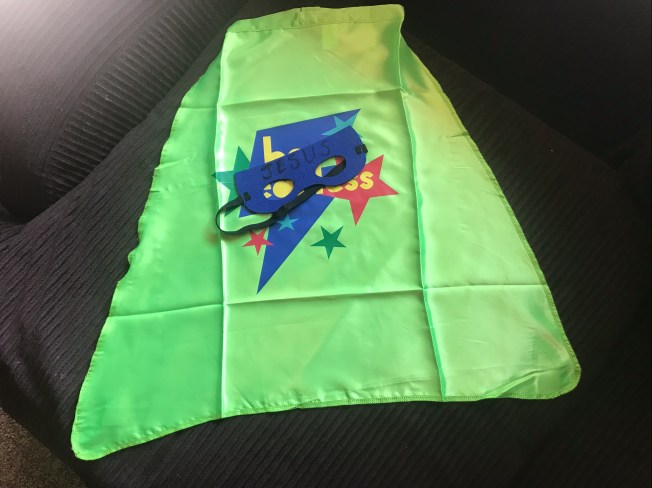
There are downsides and upsides to belonging to a small church.  Because there is not a person paid to organize the children’s education program, sometimes things fall through the cracks, usually due to some miscommunication.  For example, when the person who faithfully volunteers to lead Sunday morning children’s worship is out of town, and no one else plans a lesson even though she thought someone had agreed to do so.  The upside is that in a small church, most people notice what is going on and will step in to help when they see a hole that needs to be filled.

And so it was this past July, when I realized that the kids lined up in the hallway headed to children’s worship lacked an adult ready to lead them.  I scrambled to come up with a story to teach them. Suddenly, the idea of “Christmas in July” popped into my head.  I’d seen plenty of commercials for Christmas in July sales and the Hallmark Channel was playing movies with snow and holiday decor.  The kids confessed that they were not familiar with the phenomenon, so I tried to educate them on the concept that some of us like Christmas so much that we like to think about it in the middle of the year as well as in winter. So, we read the nativity story, and began our discussion.

That was when things went off the rails a bit.  The youngest child was soon to be in kindergarten (and new to the class), whereas, the oldest ones were getting ready for fifth grade (again, small church, so all the elementary aged kids hang together).  Somehow, and I can’t exactly recall how, we ended up talking about superheroes.  We went around the circle and each person named who his or her favorite superhero was. Then, God bless him, one of our fifth graders provided the connection I needed to tie it back to Jesus.  “Jesus was like a superhero,” he said.  “Yes!” I declared.  “Jesus was like a superhero in the way he treated people and how he always wanted to help people.”

And then came my mistake: “It’s not like Jesus could shoot fire out of his fingers.  He was a hero in a different way.”  But our kindergartner had only heard part of what I’d said.  With wide eyes, he exclaimed, “Jesus could shoot fire out of his fingers?” with a tone of awe and reverence.  “No, no, that’s not what I said.  Jesus COULD NOT shoot fire out of his fingers.”  I tried to back track as quickly as I could and explain that was not what I meant, but I feared I was not getting through to the little boy.  He was already off in the land of imagination with fire streaming from Jesus’ hands to stop the bad guys.  The older kids, including two of my sons, enjoyed a good laugh at my expense.

After it was over, I found my young friend’s dad to let him know what had happened and why his son might now believe that Jesus had superpowers akin to those we see in the movies.  Thankfully, the dad smiled and laughed.  However, I felt like I’d failed big time.  I had images of the child growing up to share a horror story of how some idiot volunteer teacher lied to him at five years old when she said Jesus had superpowers. He would relay what a disappointment it was to find out it was not true as he grew older.

But the whole episode made me wonder if in our heart of hearts, we wish that Jesus really were a superhero getting rid of the villains in our lives. Or a magician?  Or Santa Claus?  Or a genie in a bottle granting all of our wishes?  We want God to be what we want him to be and do what we want him to do.  And if life does not work out the way we expect, we are disappointed.

We tend to look at the miracles in the Bible that Jesus performed and question why he does not intercede in our lives the way he did when he was physically present in this world.  It’s true that Jesus healed some (but probably not all of the) people who came to him and changed the weather a few times to demonstrate his divinity to the questioning crowds. But he also spent most of his time telling stories trying to teach people about who he was and how to love.  And he enjoyed socializing over a meal.  Were those sermons and conversations and dinner debates as important as the “big” miracles?

Do we think that God is no longer in the business of engaging in our lives because we don’t see the type of miracles that are portrayed in the Bible? What kind of miracle would Jesus have to perform to get our attention in our modern, technologically, medically advanced world anyway?  Fire shooting from his fingers?

Maybe, instead, we should look for evidence of Jesus in the quieter moments of connection with others.  We could attempt to channel God in the ways we choose to help others.  Building strong, healthy relationships is one of the most significant ways we can experience God’s love.  Taking the time to discuss issues and dive deep into one another’s lives is the day to day vision for life that Jesus may want for us.

God may be showing up daily in the little, consistent miracles.  Let us look for the love of Jesus in the everyday moments. Instead of being disappointed in the absence of superhero miracles, we might be pleasantly surprised in the ways we actually see his presence in all of our lives.


The Year of “Why Don’t We”?

Standard

IMG_1268.jpg

IMG_2418.jpeg

I’ve read Shonda Rimes’ book, “The Year of Yes,” and Sherri Salata’s book, “The Beautiful No.” But starting last fall, my teenage daughter Riley and I engaged in the year of “Why Don’t We”?

It all started at the Jingle Ball.  That might conjure images of Cinderella: women in long, flowing gowns, men debonair in tuxedos, eating fancy hors d’oeuvres, and dancing in complicated patterns to classical music all in a magical holiday setting.  But alas, this Jingle Ball was a rock concert.

I agreed to take Riley, who was almost fifteen at the time, and her friend to the concert. Jingle Ball is an annual holiday tour in which a variety of artists, many of which are up and coming, sing short sets of their music.  It’s a great way for newer acts to get in front of audiences and gain attention. And let me say, this plan worked perfectly when it came to Riley.  But I’ll get to that in a second.  Our seats were toward the top of the arena.  We could see the stage just fine, but we were nowhere near the stage. After the first singer finished, an usher walked up the steep stairs, asking for groups of three.  Riley raised her hand and began waving to get the usher’s attention because we fit the three-person party requirement.  The woman handed us three tickets, and we scrambled out of our seats and down several escalators to reach the new seats in the lower bowl of the venue close to the edge of the stage.

“This never happens, girls,” I told them.  I felt obligated to temper their expectations that this kind of thing would ever occur at future concerts.  After we arrived in our new seats, a group that none of us knew took the stage: a boy band called “Why Don’t We.”  I don’t remember a lot about their performance that night.  I didn’t know any of their songs.  In fact, I’d never heard of them before.  I was still marveling at our good luck in getting the better seats.  I remember looking at the screen to see a close up of one of the band members, and agreeing with the girls that he was extremely cute, but otherwise it was kind of a blur.

Riley was an instant fan, however.  By the next day, she was begging me to buy tickets for the Why Don’t We show in Dallas, close to our town, in March of the next year.  “We just saw them last night,” I said.  “But tickets are selling out now,” she lamented.  And when I looked online, she was right.  Apparently, everyone who’d seen them the night before was as enthralled as Riley.  So, I bought tickets for Riley and two of her friends.

That is when my Why Don’t We (“WDW”) education began.  Riley played their music every morning and afternoon on the way to and from school.  She talked about “the boys” and their personalities. When I gifted her their book (almost as a joke), she was thrilled.  Thankfully, I liked their music, so it wasn’t bad when their lyrics became ingrained in my brain.  I knew all of the boys’ names, Jonah, Daniel, Corbyn, Zach and Jack, by the time the March concert rolled around, but I still couldn’t tell some of them apart by sight, which is now embarrassing to admit.   I loved how happy the concert made Riley and her friends.

Honestly, I enjoyed the show too.  Riley had hit on some of my favorite things:  I’ve always liked live music, and the boy band phenomenon brought back a lot of memories of my dedication to New Kids on the Block when I was a teenager. She seized on that connection and started showing YouTube videos of the boys in interviews to me.  Now, I knew each one by sight and personality.  I thought it was cool that each of them sang lead in every song because that was not typical of the boy bands I grew up with. All the while, we laughed and sang and talked about the funny things these guys did.  Then, I started listening to their music when Riley was not in the car!

We found out WDW had added a show in Memphis, Tennessee, at Elvis Presley’s Graceland in June when we were already going to be visiting my parents in Arkansas.  This almost felt like fate.  Elvis was my mom’s teen idol, and she had imparted her love of Elvis to me. To the point that I’d worked at Graceland as a tour guide the summer between college and law school.  On the day of the show, Riley and I spent a day touring Graceland with my running commentary about Elvis, his life, and the mansion itself.  Riley’s meet and greet with the band was quick, but she was elated to hug them and take a photo with them, especially when Jonah kissed her on the cheek without her even asking.  We were fairly close to the stage at the concert, so that we could see their faces clearly without depending on the video screens.  We had so much fun, screaming, singing along, jumping up and down. At the Dallas show, I’d been pretty staid, but I was so involved in the experience by this point that I let loose and just lived in the moment.  It was a magical day from start to finish.

Riley left for three weeks at summer camp and then another three weeks at a dance intensive in Orlando, Florida.  Of course, I missed her while she was gone for those six weeks.  But even while she was out of town, we kept in touch about WDW. We each stayed up late in our different time zones one night in July to listen to the boys’ latest song release. In 2019, they released one new song per month, and the fans’ anticipation grew as each month drew near an end.  Looking at the tour schedule, we were concerned that they would not be back from overseas in time to join the Jingle Ball tour again.  Therefore, we didn’t know when we would get to another concert, especially one in our hometown.  So, upon Riley’s return, we decided to squeeze in one more summer road trip for a WDW show in Tulsa, Oklahoma, in spite of the protests of all the boys in our family (dad and three brothers), who said, “Again?!?”  Our answer was yes.  Once again, we had a great time on our road trip and at the concert.

I figured that was it. We were all done with WDW concerts, at least until we heard whether the group would be at Jingle Ball.  Or so I thought.  When Riley asked if she could enter a twitter contest to get VIP tickets to the boys’ performance on the Today show on Labor Day, I offhandedly said, “sure.”  “Why not?” I thought.  I was certain there was no way she would win.  I assumed there would be a lot of entries, and even if she did tweet about the band’s latest song a bunch, it would come down to a random draw with others who tweeted.  What I didn’t anticipate was Riley’s dedication to tweeting.  Because that girl went all in, tweeting at any and every opportunity.  I was still more worried that I would have to console her disappointment in losing after all of her effort than I was about her succeeding.  On the Thursday night before Labor Day, after 9:00 at night, she looked up from her phone with tears streaming down her face.  “I won,” she whispered.  I cannot include the expletives I said along with, “you’re kidding me?”

We scrambled to discuss this with my husband/her father Ben.  I’d allowed her to enter, she’d won a once-in-a-lifetime kind of contest. She and I would go, on the condition that Riley pay for her airline ticket in order to defray some of the unexpected costs of the trip.  She gladly agreed.  So, we flew to New York City (non-direct) after church that Sunday.  And on Labor Day, we walked to the Today show at 4:30 in the morning.  Thankfully, Riley’s name was on the VIP list.  I’d feared that we would show up and something would’ve fallen through or been too good to be true.

At about 6:30, we filed into the area set up for the concert, but even as we watched the boys do sound check, I could tell Riley was unhappy.  We were not as close as we wanted to be, and the barricades kept us from getting closer.  As the morning wore on, and the 8:30 show time approached, I watched as Riley decided to take action.  She had figured out that people with lower level passes were in the area closer to the stage, and she was not taking no for an answer.  She gathered a small group of about ten people who had similar passes as ours, and began talking to one adult after another (approximately four men, in fact) until she got to someone who could change the situation.  Finally, the man in charge had a police officer open the barricade for the ten of us to go toward the area in front.  We stopped at the walk-out portion of the stage where we’d seen the guys rehearse one of their songs.  I was amazed at Riley’s persistence and gumption.  You could see the sheer determination on her face, and I was immensely proud. This moment was worth it all for me.  She faced an adverse situation and wouldn’t let anyone tell her no.

When the concert began, we were able to thoroughly enjoy every moment.  We appeared on national television, saying we were from “Frisco, Texas!”  Jonah and Corbyn both reached out and touched Riley’s hand.  After it was over, we happily walked the streets of New York and went to the top of Rockefeller Center in the rain.  We flew home that night, exhausted, but feeling the trip was a smashing success.

“Why don’t we?”  We asked the question over and over.  Why don’t we go to shows in Dallas, Graceland, Tulsa, and New York?  Why don’t we act spontaneously?  Why don’t we connect over the love of music and the ties that bind generations of boy band fans?  Why don’t we use almost any excuse to take mother-daughter trips, make memories of a lifetime, and deepen our love for one another?  This band Why Don’t We makes this mama’s heart happy because they gave Riley and I a reason to ask ourselves, “Why don’t we?”  And, hopefully, in the future, we will continue to ask the same question in myriad situations because we know that the resulting experiences might just be amazing.

 

An Imperfect Legacy

Standard

“Clay is my favorite,” my then 5-year old Alex pronounced one day in the van after school.  He was not talking about art supplies, however.  Clay is his 8-year old brother.

In response, my first-born child, daughter Riley said, “Alex, that is not nice.”

“Yeah, Alex,” Jed, my oldest son chimed in.

To make her point that this kind of favoritism was hurtful, Riley said, “Well, Jed is my favorite then.”

“Riley’s my favorite,” Jed said.

Alex held firm.  “Clay is still my favorite.”

Throughout this conversation, Clay had been sitting silent by himself in the back row of the van.  “Who’s your favorite, Clay?” one of the older two asked.

“I’m not saying,” Clay said.  Smart, I thought.  He’s going to avoid the whole issue.  But he waited a beat, then revealed his real answer with deadpan seriousness, “I hate you all.”

Clay can bring the funny.  On that day, with that statement, he broke the tension as we all laughed, long and hard.

But the whole conversation stayed with me, and not just because of the comedic gold.  One of my greatest desires as a mother is for my kids to grow up and like each other.  To stay close to home, in the “home is where the heart is” sense.  No matter where they roam, near or far, I want them to miss each other, long to see one another, and show up for each other when it counts.

I’ve always loved those movies in which large families gather for Thanksgiving or Christmas or a family reunion.  Hilarity ensues, with dashes of turmoil and discord, but in the end, they all come together and announce how much they love each other and will stay together as a family no matter what.  I know it doesn’t always work that way, though.  Siblings can be very different people with little in common.  Think about all the genetic material, which goes back for generations, coming together in myriad and infinite ways in each child.  They didn’t choose to be in the same family.  If given a blank slate, they might not associate with one another at all.

As children, or even as adults, choices are made and slights are divvied out, intentionally or unintentionally.  A comment from your brother or sister can stay with you for a lifetime.  My brother and I are friends, but when I try on a pair of jeans for the first time and view my backside, I always think about the time he called me “long butt.”  Of course, I was not without sin.  My kids love to hear the story of me dragging said brother across the floor when he was little and leaving a huge carpet burn on his back that got me in big time trouble.

My kids can fight with the best of them.  A lightsaber battle can turn ugly in a second.  The car can become a war zone on a road trip.  But emotionally, things can be much worse.  If Riley and Jed are really mad at each other, she will inevitably bring up that trip to Disney World when Jed was younger and had several raging fits when he didn’t get his way.  She ignores the times when she used to scream and cry when we tried to get her to go to bed.  Then there is the insult that can really cut deep: one of the older kids calls a younger sibling a “baby.”  Make it “cry baby” and all hell breaks loose.

They keep mental count of how many basketball tournaments, soccer games, and dance recitals each of the other siblings has attended.  They keep detailed score, inaccurately, yes, but it’s a real competition to them.

I learned early on in my parenting career that my job is more of a manager.  The illusion of actual control dies a startling and sudden death when your beautiful toddler daughter, who does not like to wear dresses, lays flat out on the floor in a tantrum when you try to put a dress on her for photos.  She only ceased to cry when we put on an Elmo T-shirt, which she proudly wore in the picture that graced our holiday card.  By the way, she is a ballerina now and wears tights and beautiful costumes all of the time.  Go figure.

I know that once they are adults and no longer subject to punishment, or “consequences” as we call it these days, I will have absolutely no control over whether they come home at all to see their father and I or to see each other.  I won’t be able to make them do anything.  So, here I am putting my wish into the universe, praying that they will be close friends one day, or at least have the grace to tolerate each other.  Or maybe, they will read this when I’m old and say, “oh yeah, Mom wanted us to at least speak occasionally.”

My hope is that the heart we are building in this home, and the memories that come from it, will tie them together somehow.  I don’t even care if they reminisce about the times when Mom was a raging banshee about – whatever – fill in the blank.  Or how they learned to cuss because I drove them everywhere for years.  I hope they laugh about how silly we were, how cluttered the house was because everyone treasured their books, and Legos, and paper, so many pieces of paper.  But mostly, remember that their Dad and I love them beyond measure.  That they will always have our parental hearts in common.  And I hope that my heart, the one they heard for nine months in utero and laid against as they nursed, will continue to beat in their minds and souls and remind them that they are my legacy.  Hopefully, that legacy will be one of love, imperfect, but unconditional.  One that might bring them a little bit closer to home and each other every time they remember.

Published in Bella Grace, Issue 18, Winter 2019


No Room?

Standard

Mary “brought forth her firstborn son, and wrapped him in swaddling clothes, and laid him in a manger; because there was no room for them in the inn.” Luke 2:7 (KJV). These are the words and images ingrained into my head as far back as I can remember. Mary and Joseph wandering from place to place, but because everyone else was in town too, all the rooms were full. Jesus was born in poverty, amongst the animals, as a demonstration of how humble, how human, how much like us he was.

But recently I read this version: she “laid him in a manger, because there was no place for them in the inn.” Luke 2:7 (NRSV). It struck me that not having a place to stay might not just be an example of Jesus’ humility, and honestly, poor planning on the part of his parents, but perhaps a bit of foreshadowing.

When we say there was no room at the inn, it sounds like bad luck. If there’d only been a bit more space, they would have gladly let Mary and Joseph stay. When we say there is no place for them, it sounds more like rejection. Even if the innkeepers had some space, they weren’t going to let Mary and Joseph inside, especially if they’d had any inkling of their story, her being pregnant before they wed and all.

Maybe it was a lack of accommodation, but maybe there was more to the story. Jesus would be rejected all of his life by everyone from the people in power to those from his hometown. Almost every time we see Jesus eating, preaching, or simply being kind to others, he is with the outcasts, the ones who had no place in society. He told stories about servants, shepherds, and farmers, and praised good Samaritans and widows who gave all they had.

Everyone had a place at Jesus’ table, which was, in fact, metaphoric given he did not actually have a table and was dependent on others for welcome and sustenance. And so, we need to ask ourselves some questions. Is the table at school merely full without extra chairs or are some students not allowed to sit there? Do we extend welcome or subtly let others know they don’t have a place in our communities, be they small or large? Do we try to understand that some people have felt like outcasts their entire lives even if we’ve never felt that level of rejection?

There is a difference between no room right now and no place at all, ever. Jesus understood the people on the outside. He cared about every person he met, and he made sure each one felt his love. My prayer is that we be ever more mindful of those who feel left out, walked on, and cast aside, and that we seek ways in which to include them. Jesus showed us that love is expansive, not a limited commodity to hoard. May we follow in his outcast footsteps.